More than five decades after astronauts last walked on the Moon, sealed lunar rocks from the Apollo 17 mission are finally giving up new secrets. And the findings are not what scientists expected.
Researchers led by Brown University have discovered unusual sulfur signatures in pristine moon rocks, challenging long-held assumptions about how the moon formed and evolved.
This isn’t just a niche scientific update. It could reshape how we understand the Moon’s deep interior and even its origin story.
What did scientists actually find in the moon rocks?
The key discovery lies in sulfur isotopes, tiny variations of the same element that act like chemical fingerprints.
The unexpected result
- Lunar rocks showed unusual depletion in sulfur-33 (³³S)
- These values are very different from anything found on Earth
- The signal was detected in volcanic material from deep within the Moon
This matters because scientists expected the Moon and Earth to share similar chemical traits.
Why did that assumption exist?
For decades, researchers believed:
- The Moon formed largely from Earth’s material
- Both bodies should have similar isotope signatures
That expectation holds for oxygen. But sulfur just broke the pattern.
Why are isotope ” fingerprints ” so important
Isotopes help scientists trace the origin and history of planetary material.
Think of them as cosmic barcodes:
- Matching patterns = shared origin
- Different patterns = different history or processes
In this case, sulfur is telling a different story than oxygen.
That suggests something more complex happened during the Moon’s formation or early evolution.
Why were these Moon rocks sealed for so long?
Not all Apollo samples were studied immediately. Some were deliberately preserved.
The idea behind the delay
NASA stored certain samples under controlled conditions:
- Sealed in helium to prevent contamination
- Left untouched for future generations
- Reserved for when better technology became available
That strategy paid off.
Enter modern science
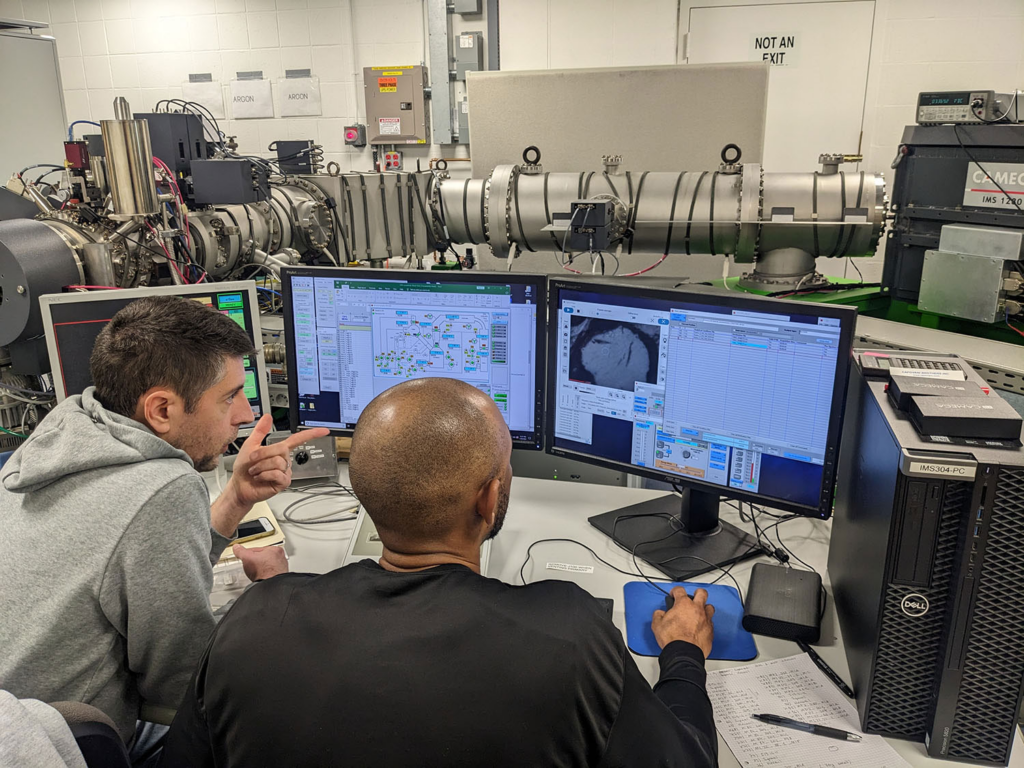
The samples were opened under NASA’s ANGSA (Apollo Next Generation Sample Analysis) program, allowing researchers to use tools that didn’t exist in the 1970s.
One key technique:
- Secondary ion mass spectrometry
- Enables ultra-precise measurement of isotope ratios
Without this technology, the discovery might have remained hidden.
Where did these rocks come from?
The samples were collected from the Taurus-Littrow Valley, a geologically rich region explored during Apollo 17.
They were extracted using a core tube:
- About 60 cm (24 inches) deep
- Preserved layers of lunar history
- Included material from ancient volcanic activity
This means the sulfur signal likely comes from the Moon’s interior, not just surface contamination.
What could explain the strange sulfur signature?
Scientists are considering two main theories.
1. Ancient lunar atmosphere and surface chemistry
One possibility is that the Moon once had a thin atmosphere.
In that environment:
- Ultraviolet sunlight could alter sulfur chemistry
- This process can reduce sulfur-33 levels
- Surface material may have later mixed into the interior
The catch?
The Moon doesn’t have plate tectonics like Earth. So scientists must explain how surface material traveled downward.
That mystery opens new questions about early lunar processes.
2. A different origin story involving Theia
The second explanation goes deeper into cosmic history.
According to the leading theory:
- A Mars-sized body called Theia collided with Earth
- Debris from the impact formed the Moon
If Theia had a different sulfur composition:
- That signature could still exist in the Moon’s mantle
- The new findings may be a leftover “fingerprint” from that collision
This would mean the Moon is less Earth-like than previously believed, at least chemically.
Why this discovery matters
This isn’t just about sulfur. It’s about rewriting parts of lunar science.
Key implications
- The Moon’s interior may be more chemically complex
- Earth-Moon similarities may not apply to all elements
- Early lunar history could involve unknown processes
It also strengthens the case for studying untouched samples with modern tools.
A broader scientific impact
Understanding the Moon helps scientists:
- Reconstruct the early solar system
- Compare planetary formation processes
- Interpret data from Mars and other bodies
In short, the Moon is a time capsule, and we’ve just opened a new compartment.
What comes next?
The findings raise questions that require more data.
Future research directions
- Compare sulfur isotopes with samples from Mars
- Analyze additional Apollo samples
- Study lunar meteorites for similar patterns
Scientists hope these comparisons will reveal whether the anomaly is local or global.
TL;DR
- Scientists opened sealed Apollo 17 Moon samples after 50 years
- They found unusual sulfur isotope signatures not seen on Earth
- This challenges assumptions about the Moon’s composition
- Possible explanations include ancient lunar chemistry or a different origin via Theia
- The discovery could reshape our understanding of how the Moon formed