
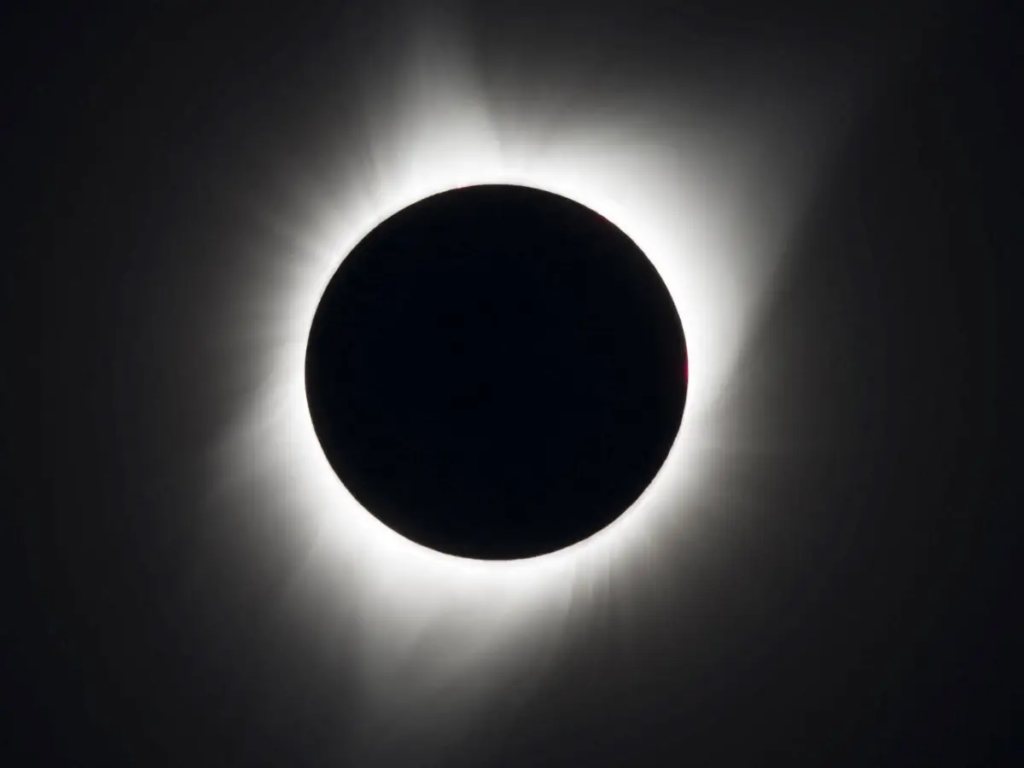
The Total Solar Eclipse 2026 is taking place on August 12, bringing a major celestial event into focus for skywatchers and astrology followers alike. While the eclipse will not be visible from India, some practitioners of Vedic astrology believe the period can be used for reflection, restraint, and stepping away from unnecessary conflict.
The eclipse will cross parts of Europe, Greenland, Iceland and the Arctic. India will not experience the eclipse as a visible astronomical event. Traditional Hindu calendar practices also distinguish between an eclipse that can be physically observed in a particular region and one that cannot.
That distinction is important because beliefs about an eclipse’s spiritual or astrological effects are separate from the scientific explanation of what happens in the sky.
When is the total solar eclipse in 2026?
The total solar eclipse is occurring on August 12, 2026. According to the timings provided in the source material, the eclipse begins at 9:04 p.m. IST, with totality beginning at 10:28 p.m.
The maximum phase is expected at 11:16 p.m., followed by the end of totality at 12:04 a.m. The eclipse will completely end at approximately 1:28 a.m. IST.
However, these timings do not mean the eclipse will be visible from India. The path of totality passes through regions including Greenland, Iceland and parts of Spain and Portugal.
For Indian readers, the event is therefore primarily a celestial and cultural point of interest rather than a directly observable total eclipse.
What does Vedic astrology say about the 2026 total solar eclipse?
In Vedic astrology, an eclipse, or grahan, is traditionally interpreted through the relationship between the Sun, Moon, Rahu and Ketu.
The Sun is commonly associated in astrological traditions with identity, confidence, vitality and personal direction. An eclipse is therefore viewed symbolically as a period when these themes can feel temporarily unsettled.
Acharya Poonam Dutta of Annant Drishti described the period as one in which some people may feel “a little off centre.” Her comments represent an astrological interpretation rather than a scientifically established effect of an eclipse on human behavior.
That distinction matters. There is no scientific evidence that a total solar eclipse causes changes in personality, decision-making or emotional states through gravitational or celestial forces. Astrology offers a belief-based framework for interpreting the event.
Why does astrology advise stepping away from noise?
According to Poonam, the traditional advice to slow down during a grahan is less about fear and more about creating space for reflection.
She says people may experience overthinking, tiredness or a desire to withdraw from noise during such periods. From an astrological perspective, that can make the eclipse a useful time to pause rather than force decisions.
The advice can be summarized simply:
- Avoid unnecessary arguments.
- Give yourself time before making major decisions.
- Postpone difficult conversations if they can reasonably wait.
- Spend some quiet time away from phones and social media.
- Use prayer, reading or other calming activities if they are meaningful to you.
- Avoid treating every passing thought or emotion as something that requires immediate action.
The emphasis is therefore on restraint rather than dramatic ritual.
Should you avoid starting something new during an eclipse?
Traditional Hindu practices vary, but some families and practitioners consider an eclipse an unsuitable time for beginning auspicious activities.
Poonam’s interpretation takes a more reflective approach. She suggests that the traditional instruction to wait is connected to the idea that important decisions should be made when the mind feels clear.
That does not mean an eclipse makes a new project, marriage, investment or conversation inherently dangerous. Rather, within this belief system, waiting can be viewed as a way to avoid acting impulsively.
For people who follow these traditions, the day can become an opportunity to pause and reconsider plans before acting.
What is Sutak Kaal and does it apply in India?
Sutak Kaal is a traditional period associated with eclipses in Hindu religious practice. However, practices surrounding Sutak can differ according to regional traditions, calendars and individual beliefs.
The supplied source notes that traditional Panchang rules generally apply eclipse-related observances to places where the eclipse is physically visible.
Since the August 12, 2026, total solar eclipse is not visible from India, readers should not assume that every traditional eclipse restriction automatically applies.
Anyone following a particular religious or regional Panchang should consult the calendar or tradition they normally follow rather than relying on generalized social media claims.
What should you do during the eclipse according to astrology?
The advice offered by Poonam is notably low-key.
Rather than recommending elaborate rituals, she suggests using the period to reduce external distractions and allow thoughts to settle.
Take a break from constant stimulation
Stepping away from social media, endless notifications and heated conversations can create some breathing room, regardless of whether someone accepts the astrological explanation.
A short period without the phone can also make it easier to distinguish between an immediate emotional reaction and something that genuinely requires attention.
Avoid forcing difficult conversations
If an argument or emotionally charged discussion can wait, astrology practitioners may recommend postponing it.
Poonam’s advice is essentially to avoid trying to resolve every problem immediately. A pause can provide perspective before a conversation becomes unnecessarily heated.
Choose a calming activity
Prayer, taking a bath, reading or simply sitting quietly are among the activities she recommends.
These should be understood as personal or spiritual practices, not medically proven methods for managing the effects of an eclipse.
Let thoughts settle
Another part of the astrological interpretation concerns delayed clarity.
Poonam suggests that an idea that feels confusing during the eclipse period may look different several days later. An old ambition may return in a new form, or a previously avoided thought may become harder to ignore.
That interpretation turns the eclipse into a symbolic checkpoint rather than a prediction of specific events.
Do solar eclipses actually affect how people feel?
From a scientific standpoint, a solar eclipse is the result of the Moon passing between Earth and the Sun and temporarily blocking some or all of the Sun’s light from reaching parts of Earth.
There is no established scientific evidence that a solar eclipse causes people to become more emotional, confused or impulsive because of the eclipse itself.
Some people may nevertheless experience changes in mood or attention around unusual celestial events. Anticipation, cultural beliefs, disrupted routines and the excitement surrounding a rare event can influence how people experience the day.
That is different from saying the eclipse itself has been demonstrated to alter human psychology.
Why the 2026 eclipse is culturally interesting
The August 12 eclipse sits at an interesting intersection of science, religion, astrology and popular culture.
Astronomers can calculate the eclipse precisely and predict its path years in advance. Astrologers interpret the same event through traditional symbolic systems. Religious communities may follow their own rules concerning prayer, fasting or auspicious activities.
These approaches answer different questions.
Science explains what causes the eclipse and where it can be seen. Astrology and religious traditions provide cultural or spiritual interpretations for people who follow them.
Keeping those categories separate allows readers to explore the traditions without confusing belief with established scientific evidence.
What is the best way to approach the eclipse?
For people who follow Vedic astrology, the central message from Poonam is not to panic or treat the eclipse as a day of impending trouble.
It is to slow down.
That means there is no need to turn every thought into a prediction or every uncomfortable feeling into a cosmic warning. The suggested approach is much quieter: step away from unnecessary noise, avoid impulsive reactions and give yourself time to think.
For readers who do not follow astrology, the same period can simply be treated as an opportunity to observe a rare astronomical event and learn more about eclipses.
Either way, August 12 is a useful reminder that not every moment needs an immediate response.
A note on the claims
Astrological interpretations in this article are attributed to Acharya Poonam Dutta and should be presented as beliefs or traditional interpretations, not scientific conclusions but pseudo scientific claims.
The eclipse timing, visibility and path should be independently verified against authoritative astronomical sources before publication. The article should also avoid suggesting that the eclipse can directly cause changes in health, emotions or behavior unless supported by credible scientific evidence.