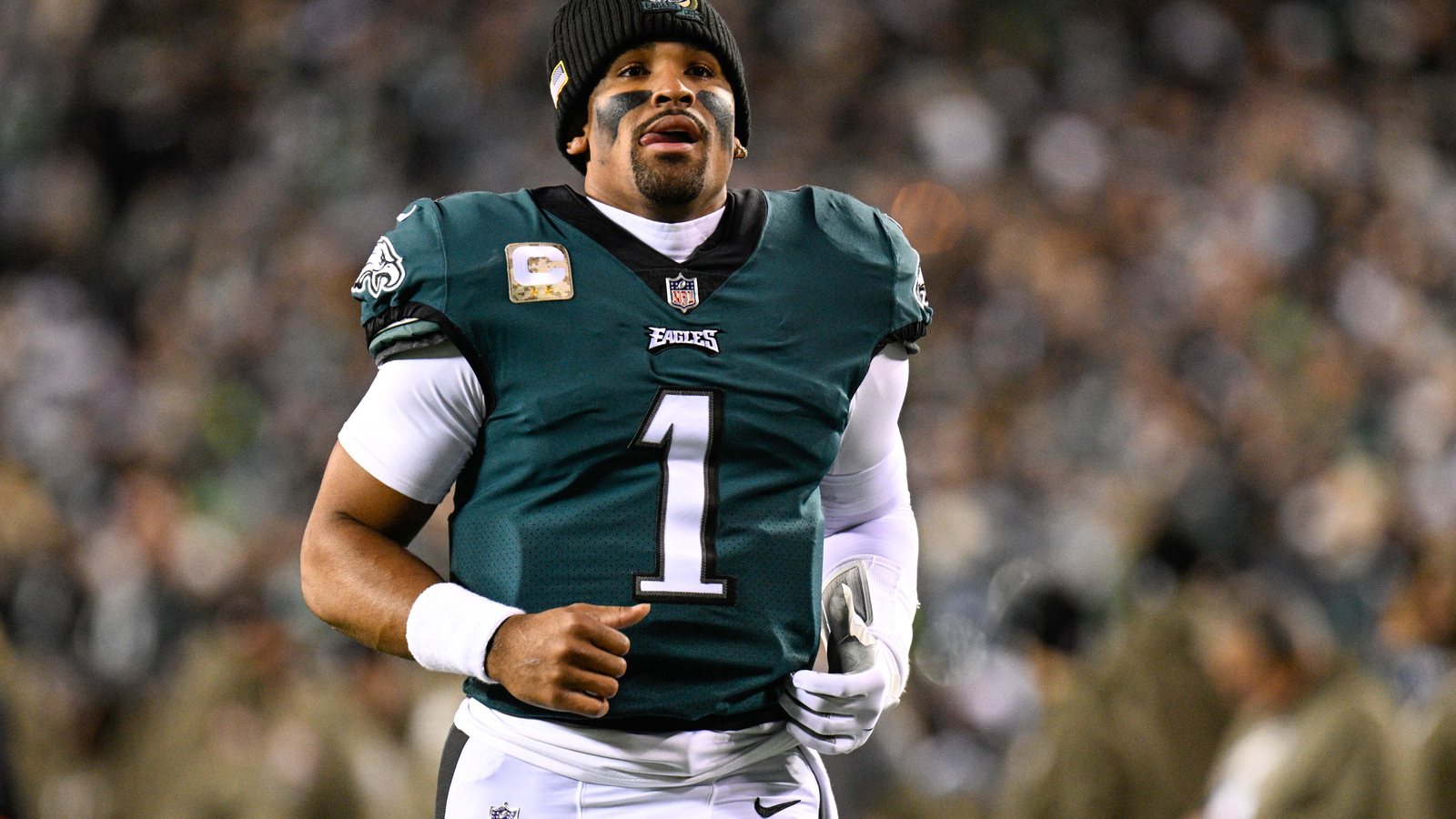
Jalen Hurts will miss the rest of the 2026 NFL season. On October 19, the Eagles and his agent, Nicole Lynn, issued a joint statement on his condition. It said the quarterback has a deep vein thrombosis and “bilateral pulmonary emboli,” meaning blood clots in both lungs. His treatment with blood thinners bars him from any contact activity.
That leaves Philadelphia, now 2-4 after four straight losses, without its franchise quarterback for months. The front office must also explain why Hurts played in London a day after doctors found a clot in his calf.
Doctors found a clot in London the day before kickoff
The Eagles’ own October 15 statement lays out most of the sequence. It shows how little time passed between his first treatment and kickoff.
Oct. 4: Hurts takes a cleat to the calf during a 24-20 loss to the Los Angeles Rams.
Oct. 7–8: He practices in full Wednesday and Thursday. After Thursday’s practice he visits the training room asking for treatment, the team said. It was his first treatment for the calf.
Oct. 10: After the flight to London, “out of an abundance of caution,” an ultrasound finds a superficial blood clot. Team staff and London doctors conclude “that activity and mobility were important and that Jalen could safely play.” They recommend a follow-up scan within 72 hours of the game and the flight home.
Oct. 11: Hurts plays the full game in a 19-17 loss to Jacksonville at Tottenham Hotspur Stadium. He completes 21 of 40 passes for 220 yards and a touchdown, per the AP.
Oct. 14: A follow-up ultrasound shows “movement in the small blood clot.”
Oct. 15: The Eagles rule him out against Carolina.
Oct. 16: He goes on injured reserve.
Oct. 18: Tanner McKee starts in a 25-14 home loss to the Panthers. He goes 26 of 45 for 215 yards and a touchdown.
Oct. 19: The joint statement upgrades the diagnosis to DVT plus clots in both lungs. NFL Network’s Ian Rapoport and ESPN’s Adam Schefter reported he is expected to miss the rest of the season.
How a superficial clot became a season-ending diagnosis
According to the joint statement, London specialists found a “left calf superficial vein thrombosis.” That is a clot in a vein near the skin, and on its own it would not necessarily have kept Hurts off the field. Dr. William Gray is chief of cardiovascular services at Main Line Health. He told 6abc that “ninety percent of people who have superficial venous thrombosis respond to conservative measures.”
Hurts now has a different and more serious condition. The National Heart, Lung, and Blood Institute defines a deep vein thrombosis as a clot in a deep vein. It usually forms in the lower leg, thigh or pelvis. A pulmonary embolism happens when a clot breaks loose and travels through the bloodstream to the lungs. With a large clot or many clots, the NHLBI warns, a pulmonary embolism can be fatal.
ESPN reported that doctors consider Hurts’ clot “provoked” because it followed a known injury. That label carries a more favorable outlook with treatment. Vascular surgeon Dr. Syed Zaidi told The Sporting News that trauma is a recognized trigger.
Blood thinners, not the clot, end his season
Anticoagulants “keep blood clots from getting larger and stop new clots from forming,” the NHLBI says. Their main side effect is bleeding. Depending on the cause, treatment can last “several months or for a lifetime.”
The NIH’s MedlinePlus guidance covers patients on the blood thinner warfarin. It tells them to avoid activities that could cause injury, “such as contact sports.” It also tells them to call a doctor after hitting their head, something no quarterback can promise.
Dr. Parth Rali, a Temple Health specialist commenting from outside the team, told CBS Philadelphia: “Ideally, minimum blood thinners has to be for three months.” He added, “You cannot have any contact sports because on blood thinners.”
Three months from mid-October runs to roughly mid-January, after the regular season ends. That is why the season is over even if his recovery goes to plan.
The Eagles have not fully explained the London decision
The open question is why doctors cleared a player with a known clot to play, then let him fly home. Long flights are a known risk factor for DVT, Dr. Rali told CNN. The team’s account shows the doctors in London built that flight into their plan. They recommended a scan within 72 hours of both the game and the trip home. That scan found the clot had moved.
There is also a dispute over rest. Tom Pelissero reported for The Ringer that Hurts had been awake about 36 hours before kickoff, as summarized by OutKick. Lynn gave The Ringer a different account, according to CBS Sports. She said he was at a hospital into early Sunday morning but got some sleep in a stadium room.
Nick Sirianni was the only senior Eagles figure to take questions Monday. “I’m not a medical expert,” he said, per CBS Sports. He added that the same staff “helped 21 of our 22 starters be available in the Super Bowl,” per 6abc.
General manager Howie Roseman and owner Jeffrey Lurie had not spoken publicly as of Tuesday. Until one of them does, the London questions will keep landing on a head coach who says he is not a medical expert.
Dr. Gray offered the staff a defense. He told 6abc: “The best thing that happened was that the team taking care of him followed up.”
An NFL Network analyst apologized to Hurts
Some of the early criticism targeted Hurts himself. On NFL GameDay Kickoff on Oct. 15, NFL Network analyst Michael Robinson suggested Hurts was protecting himself. He told viewers to “Google ‘superficial blood clot’ as opposed to a real blood clot,” Awful Announcing reported. After the lung diagnosis he apologized, calling his comments “unfounded.” Fox News’ OutKick also covered the reversal.
Taylor Moton’s return is the closest guide for Hurts
Athletes have come back from lung clots, though the cases differ in ways that matter. Doctors found multiple clots in the right lung of Taylor Moton, the Panthers’ right tackle, in late June. While on blood thinners, he could not take contact because of the risk of a brain bleed. He returned to padded practice on Oct. 13 after missing roughly the first two months of the season, ESPN reported.
That is close to the course Rali described. Moton was back in pads after coming off the medication, nearly four months after doctors found his clots. Saints receiver Chris Olave’s lung clot cost him only the final game of the 2025 season, ESPN reported. He was due back for the offseason program. Neither case suggests the diagnosis itself has to end a career.
The cautionary case is Chris Bosh, whose problem was recurrence. He had a clot in his lungs in February 2015 and another episode in February 2016. In June 2017, a doctor for the NBA and players’ union ruled his condition career-ending, Fox News reported. He never played again, and the Heat retired his No. 1 in March 2019.
The Eagles expect a full recovery
The Eagles’ on-record outlook puts Hurts on Moton’s track rather than Bosh’s. “Jalen’s prognosis is very good, and we expect a full recovery,” the joint statement says. It adds that he should be able to “resume contact football activities when off the blood thinners.” It also says “we anticipate that he will have no long-term effects.” He will stay around the team and keep conditioning.
Hurts’ five-year, $255 million extension runs through 2028 and includes $179.3 million guaranteed, per the AP. Neither the team nor his camp has said anything suggesting a change to that deal.
His absence removes the man who runs the tush-push sneak the NFL tightened its officiating rules on last year. For now the offense belongs to McKee, a 2023 sixth-round pick, with newly signed Joe Milton behind him. His next chance to stop the skid comes Oct. 26, when the Eagles host the Dallas Cowboys on Monday Night Football.