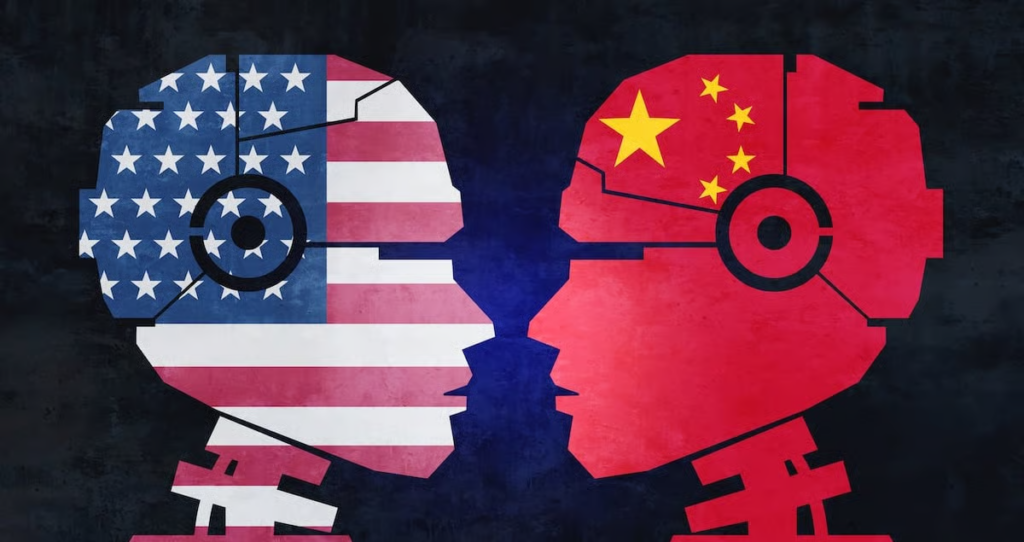
The latest clash between the United States and China is centered on a fast-moving and highly consequential frontier: artificial intelligence. Washington has accused Beijing of orchestrating large-scale efforts to replicate advanced American AI systems, while China has dismissed the claims as unfounded and politically motivated.
At the center of the dispute is a technical practice few outside the AI industry had heard of until recently—“adversarial distillation.” Now, it’s becoming a flashpoint in global tech competition.
What Is Adversarial Distillation in AI?
Adversarial distillation is a method used to recreate the behavior of a sophisticated AI model—often without access to its internal architecture or training data.
How it works
In simple terms, the process involves:
- Feeding inputs into a powerful proprietary AI model
- Collecting its outputs (responses, predictions, or generated content)
- Using those outputs to train a separate, typically smaller model
Over time, the secondary model begins to mimic the capabilities of the original.
Why it raise red flags
This approach is controversial because
- It may bypass intellectual property protections
- It allows competitors to replicate costly R&D without equivalent investment
- It can spread powerful AI capabilities without oversight
Leading firms like OpenAI and Anthropic have warned that such practices could undermine both innovation and safety.
What Did the White House Actually Say?
The accusation stems from a memo issued by White House Office of Science and Technology Policy Director Michael Kratsios.
According to the memo:
Foreign entities, primarily based in China, are conducting “deliberate, industrial-scale campaigns” to extract capabilities from US frontier AI systems.
The claim suggests not isolated incidents but a coordinated effort at scale—something that could have serious implications for national security and economic competitiveness.
However, the US has not publicly released detailed evidence or announced specific countermeasures.
How Did China Respond?
Beijing moved quickly to reject the allegations.
A spokesperson from China’s foreign ministry described the report as:
- “Groundless”
- A “slander” against China’s technological achievements
Chinese officials emphasized that:
- Their AI advancements are the result of domestic innovation and international collaboration
- The country respects intellectual property rights
- The US should “abandon biases” and encourage cooperation instead of confrontation
This response reflects a broader pattern: China often frames such accusations as attempts to contain its technological rise.
Why This Matters: The Bigger AI Power Struggle
This isn’t just about one technique or one accusation. It’s part of a larger contest over who controls the future of AI.
1. Economic stakes
AI is expected to contribute trillions to the global economy over the next decade. Control over advanced models means:
- Competitive advantage for companies
- Strategic leverage for governments
2. National security concerns
Advanced AI systems can be used in:
- Cybersecurity and cyber warfare
- Intelligence gathering
- Military applications
Unauthorized replication raises fears about misuse or loss of control.
3. Innovation vs. access
There’s a growing tension between the following:
- Protecting proprietary technology
- Ensuring global access to AI tools
Adversarial distillation sits right at this intersection.
How Are US Companies Responding?
American AI firms are increasingly coordinating their defenses.
Emerging strategies include:
- Model watermarking: Embedding hidden signals to identify copied outputs
- API restrictions: Limiting how users interact with AI systems
- Monitoring usage patterns: Detecting suspicious high-volume queries
- Legal action: Strengthening terms of service and pursuing violations
Some companies are also collaborating informally to share threat intelligence.
The Apple Factor: Competing in China’s AI Ecosystem
While not directly tied to the accusation, companies like Apple face a parallel challenge: operating in China’s tightly controlled and rapidly evolving AI market.
Key hurdles include:
- Regulatory requirements around data storage and AI outputs
- Competition from domestic AI giants
- Pressure to localise technology
For Apple and others, the question is how to balance compliance with protecting proprietary innovation.
What Happens Next?
At this stage, the situation remains more rhetorical than actionable.
Possible next steps:
- US policy action: Export controls or sanctions targeting AI-related technologies
- Increased scrutiny: More oversight of cross-border AI collaboration
- Industry-led defenses: Stronger technical safeguards by AI companies
- Diplomatic escalation: Further strain in US–China relations
If evidence emerges to support the claims, pressure for concrete action will intensify.
TL;DR
- The US has accused China of large-scale AI intellectual property theft using “adversarial distillation.”
- China denies the claims, calling them baseless and politically driven
- The issue highlights deeper tensions over AI dominance, security, and innovation
- Tech companies are already taking steps to protect their models
- The dispute could shape global AI policy and competition in the years ahead