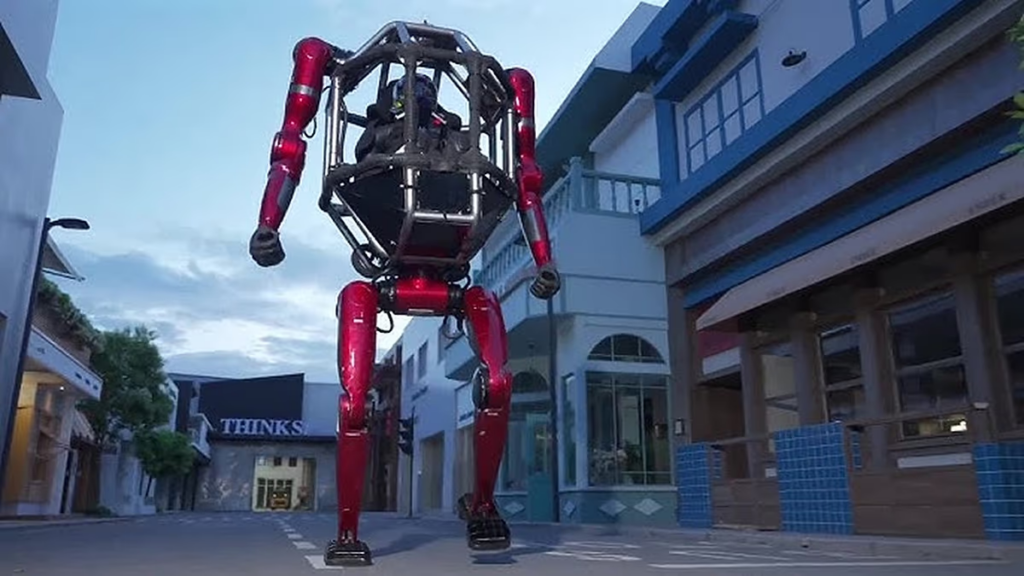
A scene that looks ripped straight out of anime and science fiction has officially rolled onto the real-world robotics stage. Unitree Robotics has unveiled the GD01, a towering pilotable robot the company describes as the world’s first “production-ready” transformable mecha. The machine can walk on two legs, shift into a four-legged mode for rough terrain, and even smash through walls in dramatic demonstration footage that quickly exploded across social media.
At nearly 2.8 meters tall, the GD01 feels less like a conventional robot and more like a prototype escaped from a futuristic battlefield simulator. The difference is that this one is apparently available for purchase, assuming you have roughly €500,000 sitting around and a garage large enough to store a mechanical rhinoceros.
What is China’s new GD01 Mecha Robot?
The GD01 is a manned robotic vehicle designed to be operated directly by a human pilot seated inside an open cockpit embedded in the robot’s torso.
What the robot can do
According to Unitree Robotics, the machine can:
- Walk upright on two legs
- Transform into a four-legged configuration
- Traverse uneven terrain
- Carry a human operator
- Smash through obstacles and walls
The transformation capability is what separates it from most humanoid robots currently in development.
Instead of behaving like a strictly human-shaped machine, the GD01 shifts posture depending on terrain and movement needs, almost like a robotic centaur deciding whether today calls for sprinting or stomping.
How big is the GD01?
The machine is enormous by consumer robotics standards.
Size and weight
Unitree says the robot:
- Stands roughly 2.8 meters tall
- Weighs around 500 kilograms with a pilot inside
- Includes an open cockpit for human operation
That makes it substantially larger than most commercially available humanoid robots currently showcased by companies like Tesla or Boston Dynamics.
And unlike those systems, this one is designed for someone to literally climb into it.
How much does the robot cost?
The GD01 starts at:
- 3.9 million yuan
- Roughly €500,000
- About $650,000
That places it firmly in the category of:
- Experimental robotics
- Luxury industrial technology
- High-end research hardware
In other words, not exactly your next weekend impulse purchase.
What technical details are still unknown?
Despite the dramatic launch, Unitree has not yet revealed several major specifications.
Missing details include:
- Battery life
- Maximum speed
- Operating range
- Payload capacity
- Runtime duration
- Safety systems
Those unanswered questions matter because giant bipedal robots face major engineering challenges involving:
- Power consumption
- Stability
- Heat management
- Terrain adaptation
- Mechanical wear
Walking on two legs already requires enormous computational balancing. Doing it while carrying a human inside a 500-kilogram machine raises the complexity level considerably.
Why the robot is drawing so much attention
The GD01 arrives at a moment when China is rapidly accelerating its robotics ambitions.
China’s robotics race is intensifying
Over the past several years, Chinese companies have aggressively expanded into:
- Humanoid robotics
- Industrial automation
- AI-driven machines
- Consumer robotics
Unitree has emerged as one of the most visible players in that push.
From robot dogs to giant mechas
Founded in 2016 by engineer Wang Xingxing in Hangzhou, Unitree initially became known for quadruped “robot dogs.”
The company’s machines are often compared to Spot, but Unitree gained attention by producing lower-cost alternatives at scale.
According to the company:
- It now controls roughly 70% of the global quadruped robot market
- Delivered more than 5,500 humanoid robots in 2025
- Surpassed competitors in humanoid robot shipments
Its machines have even appeared during China’s hugely popular Spring Festival Gala broadcasts, giving robotics an unusually mainstream public presence.
That comparison would help readers understand how radically different the GD01’s design philosophy is.
Is this a real product or just a publicity stunt?
That is the question hanging over much of the internet reaction.
Why skepticism exists
Historically, giant humanoid robots have struggled with:
- Limited battery endurance
- High operating costs
- Poor practical usefulness
- Difficult mobility
Many “mecha” concepts end up functioning more like engineering showcases than practical vehicles.
But Unitree has a track record
Unlike some flashy robotics startups, Unitree already mass-produces working robots and has proven it can commercialize advanced systems.
That gives the GD01 more credibility than many futuristic prototypes that never progress beyond promotional videos.
What could robots like this actually be used for?
Right now, the applications appear limited, but possibilities include:
- Industrial inspection
- Hazardous environment operations
- Entertainment and tourism
- Robotics research
- Disaster response testing
- Military experimentation
The wall-smashing demonstrations naturally invite comparisons to military systems, though Unitree currently describes the robot as a civilian platform.
Still, whenever a 500-kilogram transforming machine starts punching concrete, people tend to imagine more than warehouse logistics.
Why the “mecha” era suddenly feels closer
For decades, giant pilotable robots existed mostly inside:
- Anime
- Video games
- Science fiction films
Now, multiple trends are converging:
- Better AI systems
- Stronger electric motors
- Faster processors
- Improved robotics balance algorithms
- Falling manufacturing costs
The result is that machines once considered purely fictional are beginning to appear in prototype form.
We are still far from everyday mech suits stomping through city streets. But the distance between fiction and engineering is undeniably shrinking.
And somewhere, every kid who grew up watching giant robot battles just looked at this video and whispered: “Finally.”
TL;DR
- China’s Unitree Robotics unveiled the GD01, a giant pilotable transformable robot
- The robot stands nearly 2.8 meters tall and can switch between two-legged and four-legged movement
- It reportedly costs around €500,000
- The machine can carry a human pilot and smash through obstacles
- Several key specs, including battery life and top speed, remain unknown
- The launch highlights China’s growing dominance in the robotics industry