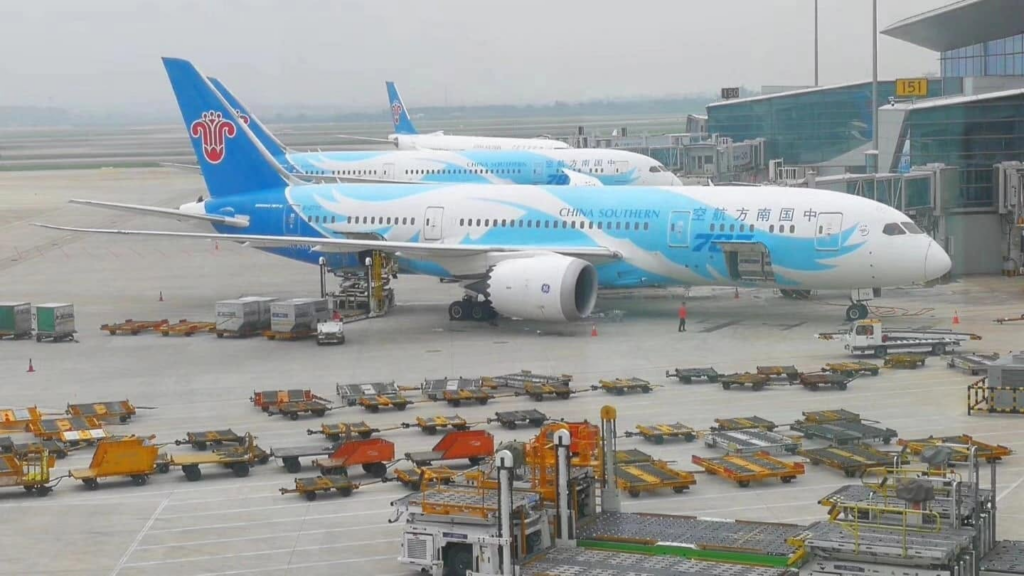
A China Southern Airlines Airbus A321 was struck by lightning while taxiing at Shenzhen Bao’an International Airport during a powerful thunderstorm, startling passengers and delaying the flight by several hours.
The aircraft was preparing to fly to Wuxi in China’s Jiangsu province on Saturday afternoon when heavy rain, strong winds and lightning moved across the airport. One passenger later described feeling a powerful electrical strike hit close to the aircraft as the plane waited for takeoff clearance.
An inspection found nearly 20 lightning strike marks on the aircraft, including on its underside and tail control surfaces. Despite the dramatic appearance of the damage, airline staff said the aircraft’s electrical systems and structure remained safe, and the plane was returned to service after maintenance.
What happened to the China Southern Airlines plane?
Flight CZ3209 was scheduled to depart Shenzhen for Wuxi at around 4:40 p.m. on Saturday.
The Airbus A321 was taxiing and waiting for clearance when a thunderstorm intensified around Shenzhen Bao’an International Airport.
A passenger recalled that the aircraft began shaking as strong winds and heavy rain swept through the area. He then heard a powerful thunderclap and felt what seemed like lightning strikes hitting the aircraft.
The passenger later described the sensation as feeling as though the plane itself had been struck.
Flight-tracking data cited by The First Scene showed that the original departure was delayed by about four hours. China Southern ultimately replaced the aircraft, and the replacement flight departed at approximately 8:40 p.m., arriving in Wuxi at 10:49 p.m.
How much damage did the lightning cause?
The aircraft was inspected by ground maintenance personnel after the incident.
According to China Southern Airlines staff, technicians discovered nearly 20 strike marks on the plane.
The marks were reportedly concentrated in two areas:
- The underside of the aircraft
- The elevators, which are movable control surfaces on the horizontal tail
The discovery may sound alarming, but visible lightning marks do not necessarily mean an aircraft has suffered serious structural damage.
Commercial aircraft are designed with lightning protection systems because encounters with lightning are a known hazard in aviation.
Why can lightning strike a plane without bringing it down?
A lightning strike on an aircraft can be spectacular, but the electricity generally travels along the aircraft’s exterior rather than passing through the passenger cabin.
The A321 has a largely conductive aluminium-alloy structure. When lightning hits the aircraft, the electrical current can spread across the outer skin before exiting elsewhere.
This principle is known as the Faraday cage effect.
The aircraft’s exterior essentially provides a conductive path around the cabin, helping keep the electrical discharge away from passengers and sensitive equipment inside.
That does not mean lightning strikes are completely irrelevant to aircraft safety. A strike can leave entry and exit marks, damage antennas or sensors, affect electrical systems, and require inspection before the aircraft returns to service.
That is why airlines do not simply assume an aircraft is fine after a lightning encounter.
What happens when lightning strikes an aeroplane?
A typical lightning strike can enter the aircraft at one point and exit at another.
The current follows the aircraft’s conductive exterior, while specialized systems are designed to protect critical components from electrical surges.
After a suspected strike, maintenance crews can inspect areas where the current entered and exited and check systems that could have been affected.
In this case, technicians examined the China Southern aircraft and inspected its electrical circuits. The visible strike marks were subsequently repaired.
The aircraft was then returned to service by Sunday.
Why did the airline replace the aircraft?
China Southern Airlines said it switched aircraft with passenger safety and the overall passenger experience in mind.
That decision also meant that the affected A321 could undergo a more detailed inspection and maintenance without keeping passengers onboard while checks were completed.
The replacement aircraft eventually departed several hours after the original scheduled departure.
This is an important distinction: the aircraft being replaced does not necessarily mean it was considered unsafe to fly. Airlines frequently take aircraft out of service temporarily after lightning strikes so maintenance teams can conduct the required inspections.
Can passengers feel a lightning strike on an aeroplane?
Passengers can certainly hear and feel the effects of a lightning strike or the surrounding storm.
A strike may produce a sudden flash, loud bang or vibration. Strong winds and turbulence associated with the same thunderstorm can also make the experience more dramatic.
In the Shenzhen incident, the passenger specifically described strong winds, heavy rain and the aircraft shaking before the loud electrical discharge.
That means the sensation experienced inside the cabin was not necessarily caused entirely by the lightning itself. The surrounding thunderstorm conditions were also affecting the aircraft.
Are airplanes frequently struck by lightning?
Yes. Lightning strikes are a known part of commercial aviation.
Aircraft routinely operate through an atmosphere where thunderstorms and electrical activity can occur. Modern airliners are therefore engineered and certified with lightning protection in mind.
A lightning strike can look dramatic from the ground or inside a cabin, but it does not automatically constitute an emergency.
The key issue is whether the strike caused damage that could compromise the aircraft or its systems. That is determined through inspection and maintenance, not simply by the presence of a visible strike mark.
Why are lightning strikes more concerning during takeoff?
The timing of the Shenzhen incident is notable because the aircraft was on the ground and preparing for departure.
Airlines generally try to avoid operating near severe thunderstorms because storms can produce lightning alongside heavy rain, strong winds, turbulence, hail, and other hazards.
For an aircraft that is already airborne, pilots can often coordinate with air traffic control to avoid the strongest parts of a storm.
An aircraft waiting on the ground has different considerations. Airport operations can be affected by lightning, high winds and reduced visibility, while crews may have to wait for conditions to improve before departure.
What happened to the passengers?
Passengers on the original flight experienced a significant delay after the aircraft was taken for inspection.
The airline arranged for another aircraft to operate the service. According to flight-tracking information cited by the report, the replacement flight eventually departed at around 8:40 p.m. and arrived in Wuxi at 10:49 p.m.
There were no reports in the information provided of passengers being injured by the lightning strike.
The incident therefore ended as a frightening aviation episode rather than a catastrophic accident.
What the incident tells us about aircraft safety
The Shenzhen lightning strike illustrates an important feature of modern commercial aviation: aircraft are built with hazards such as lightning in mind.
A plane being struck by lightning can leave very visible evidence, including burn marks or small damaged areas where the electrical current entered and exited.
But the presence of those marks alone does not tell us how severe the event was.
What matters is what happens during the subsequent inspection.
In this case, maintenance crews inspected the aircraft, checked its electrical circuits, repaired the strike-related marks, and returned the aircraft to service.
The passenger’s description of feeling a “huge bolt” therefore captures how frightening the event felt inside the cabin, but it should not be interpreted as evidence that passengers were exposed directly to the electrical current.
The bigger picture
Lightning remains one of the more dramatic natural phenomena that commercial aircraft can encounter, but it is also a hazard that aviation engineers have spent decades designing around.
The Shenzhen incident demonstrates why airlines treat suspected lightning strikes seriously even when everyone onboard remains safe.
The aircraft must be inspected, its systems checked, and any damage repaired before it can resume normal operations.
For the passengers aboard China Southern Airlines Flight CZ3209, the result was a frightening few moments followed by a long delay. For the aircraft, it was a reminder of the electrical power contained within the thunderstorms that commercial aviation routinely has to navigate.