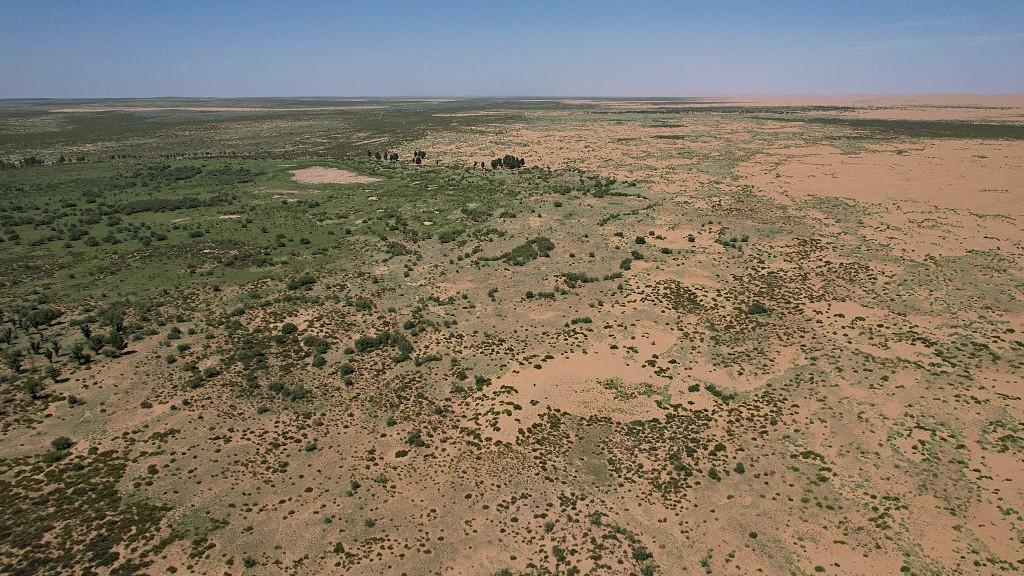
For decades, the Taklamakan Desert symbolized geological stubbornness. A basin ringed by mountains, starved of moisture, and famous for sandstorms that could swallow roads overnight. Now scientists say its outer rim has begun behaving differently. Instead of only emitting carbon, parts of the region are absorbing it.
The shift comes after nearly half a century of ecological engineering under China’s massive afforestation campaign. Often called the “Great Green Wall,” the effort has planted roughly 66 billion trees across northern China, including the edges of the Taklamakan. New research suggests the area now functions as a carbon sink in certain zones, a rare outcome in extreme arid landscapes.
This is not a story about turning dunes into rainforests. It is about altering the physics of land-atmosphere interaction.
What is happening in the Taklamakan Desert greening project?
The Taklamakan covers about 337,000 square kilometers, making it one of the largest shifting sand deserts on Earth. More than 95 percent of its surface is mobile dunes, and the surrounding mountains block moist air from entering.
China began intervention in 1978 under the Three-North Shelterbelt Program. The goal was not aesthetic greening. It was defensive land engineering.
Primary objectives:
- Stop desert expansion into farmland and cities
- Reduce sandstorms
- Stabilize dunes near infrastructure
- Improve regional climate conditions
After decades of planting and maintenance, vegetation belts now ring portions of the desert’s margins.
How did scientists determine that it became a carbon sink?
Researchers analyzed 25 years of ground observations, satellite monitoring, and atmospheric carbon modeling using NOAA’s CarbonTracker system. Their findings were published in the journal PNAS.
What changed in the carbon cycle
Vegetation affects more than just shade and soil.
When plants establish roots in loose sand:
- Soil retains moisture longer
- Microbial life increases
- Organic matter accumulates
- Carbon stays locked in the ground
The study’s co-author, Caltech planetary scientist Yuk Yung, described it as evidence that human intervention can enhance carbon sequestration even in extreme deserts.
The desert interior remains largely barren. The carbon sink effect occurs primarily along vegetated edges, not across the full dune sea.
Why planting trees changes desert physics
Wind loses its weapon
Sandstorms require loose particles and uninterrupted airflow. Vegetation breaks both.
Tree belts act like aerodynamic speed bumps:
- Reduce surface wind speed
- Trap moving sand
- Form stable soil crusts
Soil begins behaving like soil again
Bare sand cannot hold nutrients. Root systems change that.
Over time:
- Microbes colonize root zones
- Organic matter accumulates
- Water infiltration increases
The land transitions from a moving surface to a semi-stable ecosystem.
Carbon storage emerges as a side effect
The original program targeted erosion control, not climate mitigation. Carbon capture appeared later as measurable vegetation mass accumulated.
What is the “Great Green Wall,” and how big is it?
The Three-North Shelterbelt Program spans northeastern, northern, and northwestern China and aims for completion around 2050.
Key numbers:
- Started: 1978
- Trees planted: over 66 billion
- Forest cover in China: ~10% (1949) → over 25% today
- Coverage: multiple deserts, including Taklamakan and Gobi
Does this mean deserts can all be greened?
Not automatically. The Taklamakan project succeeded due to precise placement, species selection, and irrigation engineering.
Why it succeeded
- Planting along margins rather than interior dunes
- Using drought-resistant shrubs and trees
- Combining barriers with water management
- Maintaining plantations for decades
Limitations
- High maintenance cost
- Water usage concerns
- Ecological trade-offs in some regions
- Not suitable for every desert climate
Large-scale afforestation in arid zones can fail if planted species outconsume groundwater. The success depends on balance, not just tree numbers.
Could India’s Thar Desert become a carbon sink?
The Thar Desert is smaller, at about 264,000 square kilometers but climatologically different. It receives seasonal monsoon rainfall, unlike the hyper-arid Taklamakan.
That actually complicates direct comparison.
Why replication is uncertain
- Different rainfall patterns
- Distinct soil composition
- Existing human settlements
- Grazing pressure
However, shelterbelt forestry around villages and highways could still reduce dust storms and store carbon locally.
Instead of copying China’s model exactly, countries would likely adapt the principles:
- Strategic planting corridors
- Native drought-tolerant species
- Soil stabilization before dense planting
Why this matters globally
The biggest implication is not that deserts can become forests. It is possible that land management can shift the regional carbon balance without waiting for rainfall changes.
Practical impacts
- Protects infrastructure and agriculture
- Reduces air pollution from dust
- Moderates local climate extremes
- Adds measurable carbon storage
In climate policy terms, this sits between mitigation and adaptation. It does both.
TL;DR
- China planted about 66 billion trees around the northern deserts since 1978
- The Taklamakan’s edges now absorb more carbon than they release
- The change comes from dune stabilization and soil formation
- It does not turn the entire desert green
- The approach may guide other dry regions, but requires local adaptation