
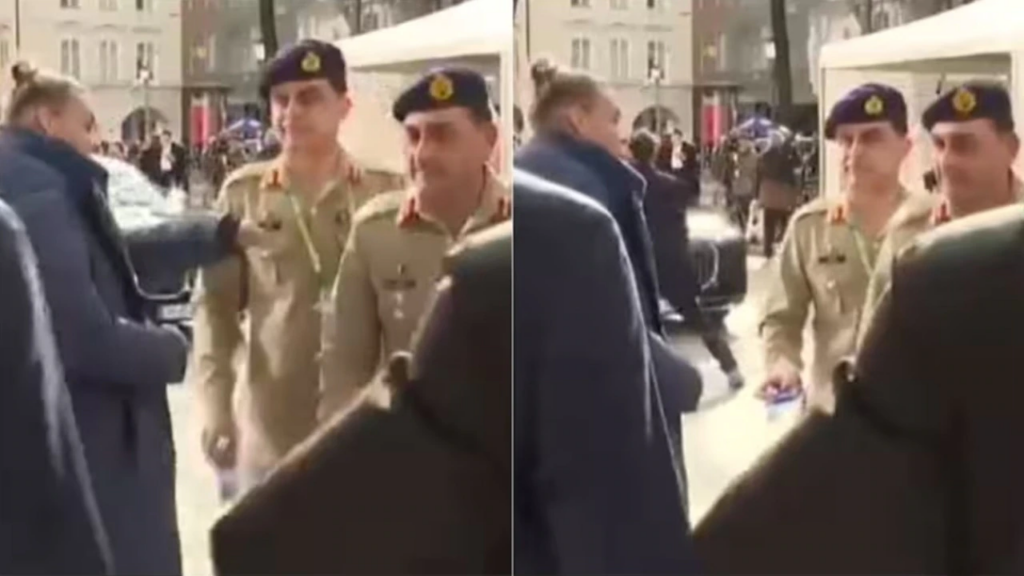
A short video from the entrance hall of the Munich Security Conference triggered an outsized geopolitical debate.
In the clip, security staff stop Asim Munir, Pakistan’s field marshal, and request identification before letting him enter the venue in Munich, Germany.
Within hours, social media split into camps. Some called it a diplomatic slight. Others said it was exactly how high-security summits are supposed to work.
The incident itself lasted seconds. The argument around it will last much longer.
What actually happened in the video?
The footage shows Asim Munir approaching the conference entrance alongside aides. Security personnel briefly stop him and request credentials. He presents them and proceeds inside without confrontation.
No official complaint has been filed. No host government statement suggests wrongdoing.
That simplicity is precisely why the debate grew. People projected meaning onto a moment that may have had none.
Why are attendees checked regardless of rank
Major security summits operate under strict accreditation rules:
- All participants must wear badges
- Recognition alone is insufficient
- Guards cannot rely on facial familiarity
- Even heads of state are screened in advance
- Last-minute arrivals often trigger manual verification
In other words, security systems are designed to distrust memory and trust documentation.
Is this unusual for global leaders?
Not really.
At large international forums, security staff are typically contractors or multinational teams. They cannot realistically memorize hundreds of military chiefs, ministers, intelligence heads, and diplomats.
The Munich conference alone hosts hundreds of delegates across dozens of countries. Recognition is statistically improbable.
Historical context
High-ranking figures frequently undergo visible checks at summits, but cameras rarely catch them. Viral attention transforms routine procedure into perceived symbolism.
Security doctrine prioritizes neutrality. A guard who recognizes some leaders but not others introduces bias risk, which security planners try to eliminate.
Why the internet treated it as a snub
Online reactions focused less on protocol and more on perception.
Three psychological factors drove the reaction:
- Rank expectation
A field marshal is assumed to be instantly recognizable. - National pride narratives
Viewers interpret the treatment of leaders as the treatment of countries. - Camera framing
A short clip removes surrounding context like queue procedures or prior checks.
In digital culture, optics outrun procedure.
Political reactions and protest statements
Beyond social media commentary, criticism came from the Jeay Sindh Muttahida Mahaz, which objected to Munir’s presence at the conference.
The group accused Pakistan’s military establishment of political influence and human rights abuses. Their statement referenced historic controversies, including events linked to the formation of Bangladesh and internal political tensions.
They also cited cases involving former leaders such as Benazir Bhutto, Zulfikar Ali Bhutto, Imran Khan, and Liaquat Ali Khan.
Pakistan’s government and military have historically denied allegations of systemic wrongdoing.
These claims reflect political positions and require sourcing from official statements and independent human rights reporting before publication.
Why security optics matter in diplomacy
Diplomacy operates partly on choreography. Entrance moments are symbolic theaters of power.
A handshake’s length can matter.
A seating arrangement can matter.
Even a security pause can matter.
But symbolism depends on intent.
The difference between procedure and signal
| Scenario | Meaning |
|---|---|
| Random credential check | Routine |
| Selective targeting | Diplomatic signal |
| Denied access | Political action |
In this case, access was granted immediately after verification. That strongly supports the “routine protocol” interpretation.
The role of viral media in shaping geopolitical narratives
Modern diplomacy now includes a third participant: the algorithm.
Short clips flatten complexity. Security procedure becomes international commentary. The speed of reaction often exceeds verification.
Why these moments trend globally
- recognizable uniform or rank
- international venue
- national pride
- absence of context
A ten-second clip becomes a global referendum on prestige.
What the Munich Security Conference represents
The annual gathering is not just another diplomatic meeting. It is one of the world’s premier defense dialogue platforms, attended by military chiefs, intelligence heads, and policymakers.
Because of that, its security posture is closer to a classified facility than a public conference. Entry control is therefore strict by design, not by attitude.
So was it embarrassment or routine?
Based on available evidence:
- No denial of entry occurred
- No official protest was filed
- Uniform credential checks are standard
- Event security protocols support verification
That points toward a routine procedure rather than a diplomatic insult.
However, public interpretation often follows emotion rather than protocol manuals. For supporters and critics alike, the clip became a proxy argument about authority, visibility, and geopolitical standing.
The broader lesson
Diplomacy used to happen in closed rooms. Now it happens in the entrance corridors, captured on smartphones.
Security systems aim for impersonality. Politics interprets everything personally.
The moment likely meant little to the guards who performed their job. It meant a great deal to viewers deciding what it symbolized.
In international relations, perception travels faster than fact and sometimes farther than truth.