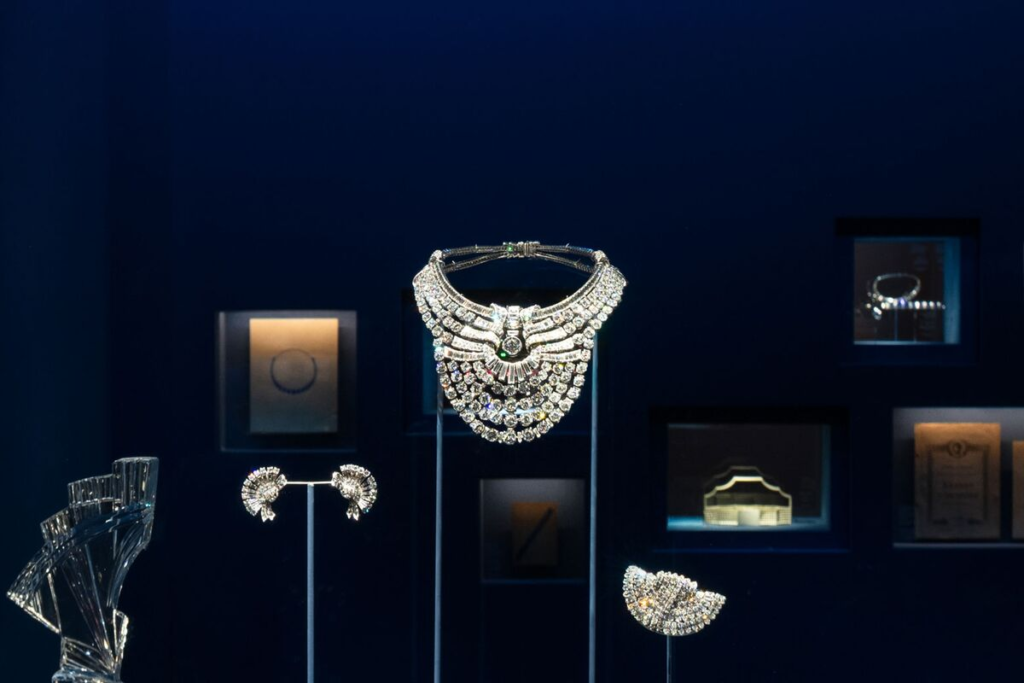
Two men walked into a Vienna museum as ordinary visitors, paid for admission and then smashed a glass display case with a hammer before escaping with a historic 200-carat diamond necklace once worn by Egypt’s Queen Nazli.
The brazen theft took place during public hours at the Museum of Applied Arts (MAK) in Austria on Thursday, August 27. The stolen Van Cleef & Arpels necklace contains 673 precious stones and was created for the former Egyptian royal family. Austrian police are now searching for the two suspects, who did not wear masks and were captured by surveillance cameras.
The necklace was part of an exhibition dedicated to Van Cleef & Arpels that featured hundreds of pieces. The exhibition has since been closed following the theft.
The robbery is the latest in a series of increasingly audacious museum thefts across Europe, raising fresh questions about security at institutions displaying high-value jewelry and cultural treasures.
How did the Vienna museum heist happen?
The suspects did not need to break into the museum after dark or disguise themselves as staff.
Instead, they bought tickets and entered the MAK during normal opening hours, according to Austrian police.
Once inside, the men went to the Van Cleef & Arpels exhibition and targeted the necklace. Police said one of them smashed the glass display case with a hammer before the pair fled with the jewelry.
The suspects were not wearing masks, meaning surveillance cameras captured their faces. Police have released images as part of the investigation.
A police spokeswoman told German news agency dpa that one of the men was believed to be carrying a real firearm. Visitors and security personnel were reportedly present when the case was broken.
No injuries were reported.
The suspects then escaped on foot in an unknown direction.
What necklace was stolen from the Austrian museum?
The stolen piece is a platinum and diamond necklace containing 673 precious stones weighing more than 200 carats in total.
It was created by French luxury jewelry house Van Cleef & Arpels for Egypt’s former royal family and has a particularly notable royal history.
Queen Nazli of Egypt wore the necklace in 1939 for the wedding of her daughter, Princess Fawzia, to Mohammad Reza Pahlavi, then the crown prince of Iran and later the country’s shah.
Van Cleef & Arpels describes the creation as a “triumph of white jewelry,” reflecting its platinum setting and extensive use of diamonds.
The necklace is not simply valuable because of the stones themselves. Its connection to two former royal families gives it an additional historical and provenance value that would make it difficult to replace.
How much was the stolen necklace worth?
Reports have described the necklace as worth several million dollars.
A more concrete reference comes from its 2015 Sotheby’s auction, when the piece was estimated at between $3.6 million and $4.6 million and ultimately sold for about $4.3 million.
Its current market value may not be identical to that earlier auction price.
That distinction matters because the value of historic jewelry can depend on provenance, rarity, condition, market demand and the circumstances of a sale. The 200-carat weight alone does not determine what such a unique historical object is worth.
Why was Queen Nazli’s necklace on display in Vienna?
The necklace was being shown as part of an exhibition devoted to Van Cleef & Arpels at the MAK.
The exhibition, titled “Prime Pieces: Van Cleef & Arpels High Jewellery x Masterpieces from the MAK Collection,” brought together major pieces from the French jewelry house alongside works from the museum’s collection. It had been scheduled to continue through September 27.
The theft has now disrupted the exhibition.
The MAK confirmed the robbery but has declined to provide extensive details while the investigation continues. The museum’s broader collection remains open to visitors, with the affected exhibition excluded.
Who are the suspects?
Police are looking for two men.
Authorities said both entered the museum without masks and were clearly visible on surveillance footage.
The suspects have been described in reports as slim men around 175 centimeters tall, with dark hair and beards. They were reportedly dressed in black clothing and dark sneakers.
Their decision not to conceal their faces is one of the most striking aspects of the robbery.
However, investigators have not publicly established why they chose that approach or whether they expected the theft to be completed quickly enough to avoid identification.
Police are investigating whether the theft was carried out for a wider criminal organization or whether the suspects acted independently.
Until authorities identify and question them, any claims about who commissioned the theft remain speculation.
Why would thieves steal a famous necklace that is difficult to sell?
Historic jewelry creates a peculiar problem for criminals: the object can be extremely valuable but also extremely recognizable.
A famous necklace with a documented royal history cannot simply be taken to a reputable auction house and sold without attracting attention.
That makes the stolen necklace’s future uncertain.
Criminals may attempt to dismantle valuable jewelry and sell its individual components, although doing so would destroy much of the object’s historical and artistic value. Europol has warned that organized criminals are increasingly targeting gold and precious stones because valuable materials can potentially be separated from the original objects.
The stolen necklace’s distinctive provenance could therefore become both its greatest value and its greatest obstacle to legitimate resale.
Why is Europe seeing so many museum heists?
The Vienna robbery comes amid a striking run of high-profile museum thefts across Europe.
The most dramatic recent example was the Louvre robbery in Paris in October 2025. Thieves entered the museum in broad daylight and escaped in less than eight minutes with jewelry valued at around $102 million. Several suspects have since been arrested and charged, although most of the stolen jewelry has not been recovered.
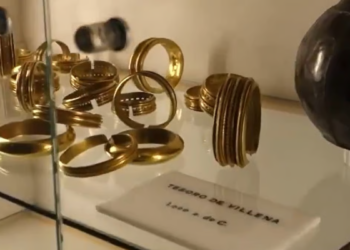
Then, just one day before the Vienna theft, thieves targeted the Treasure of Villena in Spain.
The Spanish robbery was dramatically different in its target but similarly fast.
What happened in the Spanish museum robbery?
Thieves raided the Villena Museum in Alicante province early Thursday and stole most of the Treasure of Villena, a collection of Bronze Age artifacts dating to roughly 1,000 BC.
The museum’s alarm sounded at around 5:20 a.m., and authorities said the thieves had left by approximately 5:24 a.m.
The collection includes dozens of gold bracelets, bowls, vessels and other objects, along with pieces made from silver, iron and amber.
The gold alone has been valued at around €1.7 million, or roughly $2 million, although the archaeological and historical value of the collection is far greater.
Authorities are investigating whether an earlier alarm at a nearby sports center was deliberately triggered as a possible diversion.
Is this becoming a new pattern for European museums?
The recent robberies suggest that criminals are increasingly willing to target museums with fast, forceful operations.
Traditional museum thefts often involved planning, covert entry and attempts to avoid detection.
Recent cases have demonstrated a different approach: get inside, break the display, grab the most portable valuables and leave before police can respond.
Europol has warned that museum theft tactics are evolving, with brute force increasingly replacing the discreet methods historically associated with art theft. The agency has also highlighted the attraction of gold and precious stones because they can potentially be melted down or separated from their original forms.
That creates a difficult security challenge for museums.
A museum can build sophisticated alarms, cameras and display cases, but an institution open to the public must still allow visitors to enter and move around the galleries.
What happens to the stolen necklace now?
The immediate priority for Austrian authorities is locating the suspects and recovering the necklace.
Because the piece is internationally recognizable and has a documented history, investigators can potentially alert auction houses, dealers, collectors and law-enforcement agencies across borders.
The necklace’s distinctive design and provenance also make it difficult to disguise completely.
For now, however, its whereabouts remain unknown.
The MAK has closed the affected exhibition while authorities investigate, and police are appealing for information about the two men captured on surveillance footage.
Why this theft is different from an ordinary jewelry robbery
The Vienna heist stands out because the stolen object is more than an expensive necklace.
It connects the history of Egypt’s former monarchy, Iran’s former imperial family and one of the world’s best-known luxury jewelry houses.
Queen Nazli’s 1939 appearance wearing the necklace gives the piece a documented place in 20th-century royal history. Its subsequent appearance on the international art market further established its provenance.
That combination makes the loss particularly significant for both the museum world and the market for historic jewelry.
The thieves may have walked out with a necklace worth millions of dollars, but they also took an object whose identity is difficult to erase.
The bottom line
Two men paid to enter Vienna’s Museum of Applied Arts before smashing a display case and stealing a 200-carat platinum and diamond necklace during public hours.
The Van Cleef & Arpels piece contains 673 precious stones and was created for Egypt’s former royal family. Queen Nazli wore it in 1939 at the wedding of her daughter, Princess Fawzia, to Mohammad Reza Pahlavi, the future shah of Iran. The necklace sold for approximately $4.3 million at Sotheby’s in 2015.
Police say the suspects were unmasked and were caught on surveillance cameras. One was reportedly carrying a firearm.
The theft is now part of a worrying sequence of museum robberies across Europe, including the recent four-minute raid on Spain’s Treasure of Villena and last year’s spectacular Louvre jewelry theft.
For European museums, the challenge is increasingly clear: protecting priceless objects is no longer just about keeping sophisticated burglars outside. It is about stopping determined criminals who are willing to walk through the front door.