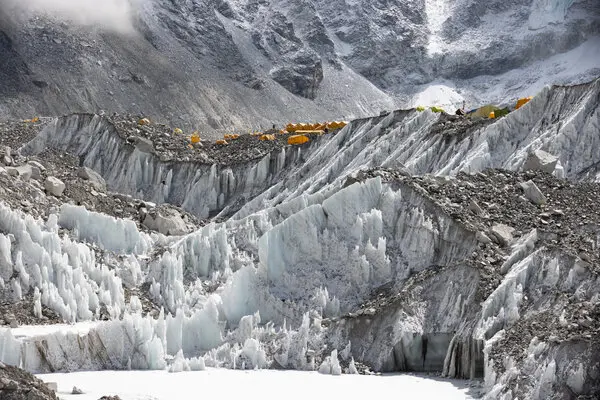
Mount Everest’s Khumbu Glacier is facing an unusual source of human-caused warming: the heat carried by urine from thousands of climbers and support workers who gather at base camp each spring.
A new study published in the journal Regional Environmental Change estimates that heat from urine discharged directly onto the glacier could melt about 154 tons of ice during a single climbing season.
That sounds startling, but the science tells a more important story. Urine is responsible for only a small share of the human-generated heat at Everest Base Camp. Fuel burned for cooking, heating, and electricity is by far the larger contributor.
The researchers say the findings highlight a broader problem: a temporary settlement of thousands of people is operating directly on a glacier that is already being reshaped by climate change.
Why is human urine melting the Khumbu Glacier?
The explanation is surprisingly simple: temperature.
People at high altitude need to drink large amounts of water to reduce the risk of dehydration. Thousands of climbers, guides, cooks, and other workers therefore produce large quantities of urine during the spring climbing season.
In 2023, researchers estimated that people at Everest Base Camp generated about 6,766 liters of urine each day. Because urine leaves the human body at roughly body temperature, some of its heat can be transferred to the surrounding snow and ice when it is discharged directly onto the glacier.
The researchers calculated that this heat could account for about 154 tons of ice melt over the season. The figure represents heat-transfer calculations, not the claim that urine is physically melting an enormous percentage of the glacier by itself.
How big is Everest Base Camp during climbing season?
Everest Base Camp is not a tiny collection of tents.
During the spring climbing season, it becomes a temporary high-altitude settlement. In 2023, the researchers estimated that around 1,600 tents occupied roughly 26 hectares of the glacier.
The camp contains kitchens, power generators, communications equipment, and other facilities that allow thousands of people to live and work there for weeks.
That concentration of human activity creates a localized source of heat on an already vulnerable glacier.
Is urine actually the biggest cause of the melting?
No. This is the crucial part of the study.
The largest human source of heat at the camp is fuel consumption. During the 2023 season, the camp used 824 cylinders of liquefied petroleum gas, about 18,935 liters of kerosene, and roughly 5,130 liters of gasoline for cooking, heating, and electricity.
The researchers estimated that fuel-related heat accounted for about 94% of the human-caused ice and snow melt they calculated.
Urine accounted for the remaining 6%.
So while the urine finding makes for an unusual headline, the more consequential message is about the energy-intensive infrastructure required to maintain a large settlement on a glacier.
How much ice can all that human activity melt?
The researchers estimated that heat generated by camp activities was enough to melt about 2,492 tons of snow and ice during the 2023 climbing season.
That puts the urine contribution into perspective. The roughly 154 tons attributed to urine are significant as a localized effect, but they represent only a fraction of the total human-generated heat.
The study also cautions that its estimate is not a complete accounting of every heat source at the camp.
The researchers did not include some potential contributors, such as heat associated with helicopter operations, climbers’ bodies and yaks used to transport supplies.
Is climate change still the main problem?
Yes.
The study does not argue that climbers’ urine is driving the overall retreat of the Khumbu Glacier.
Instead, the researchers place the camp’s local impact inside a much larger climate picture. Rising global temperatures are the dominant force affecting glaciers throughout the Himalayas.
Satellite observations analyzed in the study show that the area around Everest Base Camp has been warming rapidly. Landsat data from 1991 through 2023 indicated that surface temperatures at the base camp increased by an average of about 0.28 degrees Celsius per year, roughly twice the rate recorded across the surrounding Khumbu Glacier.
That difference suggests the increasingly built-up camp is developing a localized warming effect on top of the region’s broader climate-driven warming.
Why is the Khumbu Glacier important?
The Khumbu Glacier is more than an impressive landscape feature. It is part of the high-altitude environment that makes the Everest climbing route possible.
The glacier is also a component of the Himalayan cryosphere, a network of snow and ice that stores freshwater and influences downstream ecosystems and communities.
As glaciers lose mass, they can contribute to changes in river flows and increase risks associated with unstable glacial lakes.
That is why even a seemingly small local source of additional warming matters when it is concentrated on a glacier that is already under pressure.
Could the base camp itself become unsustainable?
That is one of the study’s biggest concerns.
The researchers examined possible locations for moving Everest Base Camp away from the most vulnerable section of the glacier. They identified two potential areas southwest of the existing site.
But moving the camp is not an easy fix.
A new location would have to support thousands of people, equipment, food, waste management systems and climbing operations in one of the most difficult environments on Earth. Relocating the settlement could also transfer environmental pressure to another fragile area.
The researchers therefore call for a combination of measures rather than relying exclusively on relocation.
Could solar power help protect the glacier?
The study points toward reducing the amount of fossil fuel burned at base camp.
Solar power could replace some of the fuel currently used for electricity and heating, cutting the amount of additional heat and emissions generated at the site.
Better waste and sanitation systems could also reduce direct discharge onto the glacier. Collecting urine instead of allowing it to reach the ice would remove one localized pathway by which body heat is transferred to the glacier.
These measures would not stop climate change, but they could reduce the camp’s contribution to an already stressed environment.
Why does the study matter beyond Mount Everest?
Everest has become an unusually clear example of a broader problem facing high-altitude tourism.
As infrastructure grows in extreme environments, human beings can create localized environmental effects that would have been almost unimaginable when those places were visited only by small groups.
The lesson from the Khumbu Glacier is therefore not really about urine. It is about scale.
A few climbers have one environmental footprint. A temporary city of thousands has another.
At Everest Base Camp, that footprint now includes fuel combustion, waste, transport, buildings and thousands of people living directly on a glacier.
Can human activity be reduced without closing Everest Base Camp?
That is likely to be the practical challenge.
Everest climbing supports a substantial local economy and provides employment for guides, porters, cooks, transport workers and other communities connected to mountaineering tourism.
The answer is therefore unlikely to be as simple as removing the camp altogether.
Instead, researchers are pointing toward lower-impact infrastructure, cleaner energy, improved sanitation and potentially moving parts of the settlement onto more stable ground.
The goal would be to reduce the local environmental burden while allowing climbing activity to continue.
What the urine finding really tells us
The remarkable part of the study is not that urine has suddenly become the main force melting Everest.
It has not.
The 154-ton estimate represents about 6% of the human-related melt calculated for the 2023 climbing season. Fossil-fuel use produced the overwhelming majority of that estimated human contribution, while climate change remains the much larger driver of glacier loss overall.
But the urine finding is still useful because it exposes how many small heat sources accumulate when thousands of people live for weeks on a frozen landscape.
Everest’s glacier is not being threatened by one strange culprit. It is being subjected to a growing collection of human pressures while the climate around it warms.
And that is precisely why the researchers say the long-term sustainability of the world’s highest mountain’s base camp needs a rethink.