
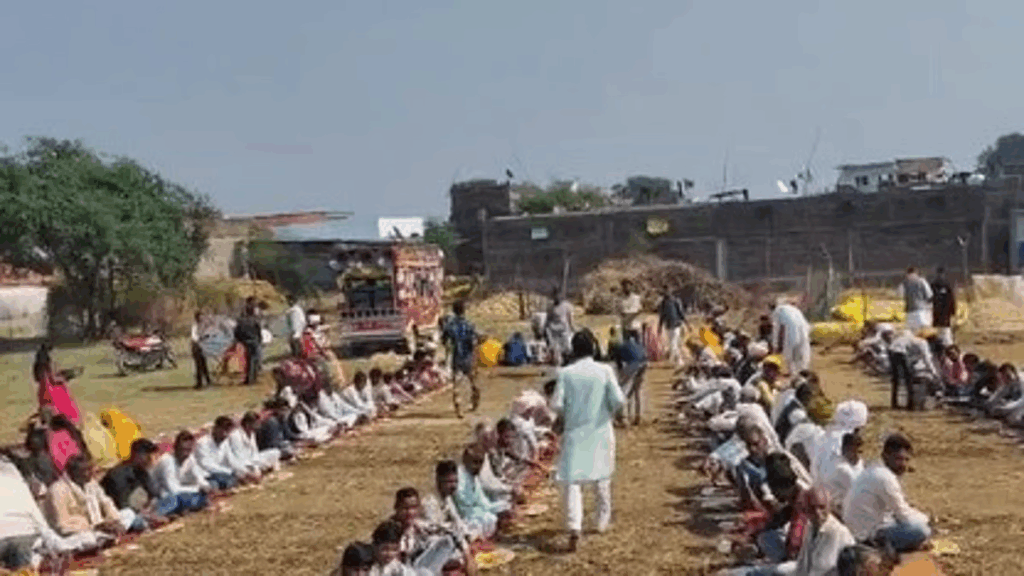
Villagers in Madhya Pradesh’s Rajgarh district recently held an elaborate funeral feast for a monkey they believed to be an incarnation of Lord Hanuman. The ritual drew more than 4,000 people and involved the same rites performed for human family members. The incident has drawn national attention for its scale, devotion, and cultural significance.
This article examines the reasons behind such rituals, what they reveal about local belief systems, and how similar traditions have evolved in rural India.
What happened in Madhya Pradesh’s Rajgarh village?
A monkey died on November 8 after being electrocuted by a high-tension power line in Darawari village. For locals, the simian was not just wildlife but a divine presence linked to Lord Hanuman. The villagers treated the death as they would that of a human elder.
A decorated bier, a funeral procession accompanied by music, and a cremation with full Hindu rites were all observed. Priests conducted the ceremony, and later, village elders travelled to Ujjain to immerse the ashes in the Shipra River. This mirrored the traditional eleventh-day rites carried out during human funerals.
Twelve days after the cremation, more than 4,000 villagers gathered for a mrityu bhoj, a community feast that marks the end of mourning. Residents contributed nearly Rs 1 lakh to prepare a large variety of vegetarian dishes. Invitations were sent across nearby villages, drawing attendees from up to 35 kilometres away.
Why do villagers consider monkeys sacred?
Monkeys have a unique place in Hindu belief systems due to their association with Lord Hanuman. In many parts of rural India, monkeys are treated with reverence, and harming them is considered inauspicious.
Cultural roots of simian reverence
The reverence stems from:
- The depiction of Hanuman as the embodiment of loyalty, strength and devotion
- Rituals that position monkeys as symbolic protectors of the village
- Oral traditions that encourage respectful coexistence with wildlife
In communities where folklore has a strong influence on daily life, treating monkeys as divine intermediaries is not uncommon.
Why do funerary rituals extend to animals
For many rural societies, religious faith often intersects with collective identity. Rituals like Mrityu Bhoj are not simply religious events; they reinforce social bonds and mark communal participation. Performing these rites for a sacred animal becomes an extension of human religious duty.
How rare are such full-scale animal funerals?
This is not an isolated case. Similar ceremonies have been recorded in various parts of India.
In 2021, residents of Dalupura village in the same Rajgarh district performed a full funeral for a langur that died due to cold. Around 1,500 people attended, and villagers claimed that such rituals were a long-standing custom.
These events reveal a consistent pattern: in regions where Hanuman worship is dominant, monkeys receive human-like ceremonial treatment upon death.
What does this tell us about faith and rural identity?
A collective expression of belief
The participation of thousands in Darawari is not only an act of devotion but also a reflection of how communities define themselves through ritual. The shared belief that the monkey was an incarnation of Hanuman created a collective religious moment.
Rituals as social glue
Events like Mrityu Bhoj:
- Reinforce community solidarity
- Offer a shared space for mourning and celebration
- Strengthen social hierarchy and roles (priests, patels, elders)
Such practices often serve as social events that maintain continuity in long-standing traditions.
The blurred boundary between human and divine
In these contexts, animals deemed sacred are not seen as separate from the human sphere. Their presence is integrated into the spiritual and emotional ecosystem of the community.
Why does this matter beyond one village?
Stories like this are more than curiosities. They illustrate deeper cultural patterns:
- How religion shapes environmental attitudes
- How rural communities negotiate modernity while keeping traditions alive
- How symbolic actions reflect collective values and social cohesion
For researchers studying anthropology, rural sociology or religious practices, these events offer insight into living belief systems that continue to evolve.
How the story connects to broader national conversations
The incident opens discussions on:
- The socio-cultural importance of rituals in rural life
- Human-wildlife coexistence in densely populated regions
- The role of faith in shaping public behaviour
It also comes at a time when India is seeing renewed global interest in traditional practices, making this an important moment to examine cultural continuity.
TL;DR
- A monkey believed to be an incarnation of Lord Hanuman received full human-style funeral rites in Madhya Pradesh’s Rajgarh district.
- More than 4,000 villagers attended a grand Mrityu Bhoj held 12 days after the cremation.
- Priests performed all rituals, including ash immersion in Ujjain’s Shipra River.
- Similar traditions exist in the region, reflecting deep-rooted reverence for monkeys.
- The event highlights how faith, community identity and cultural continuity shape rural life.