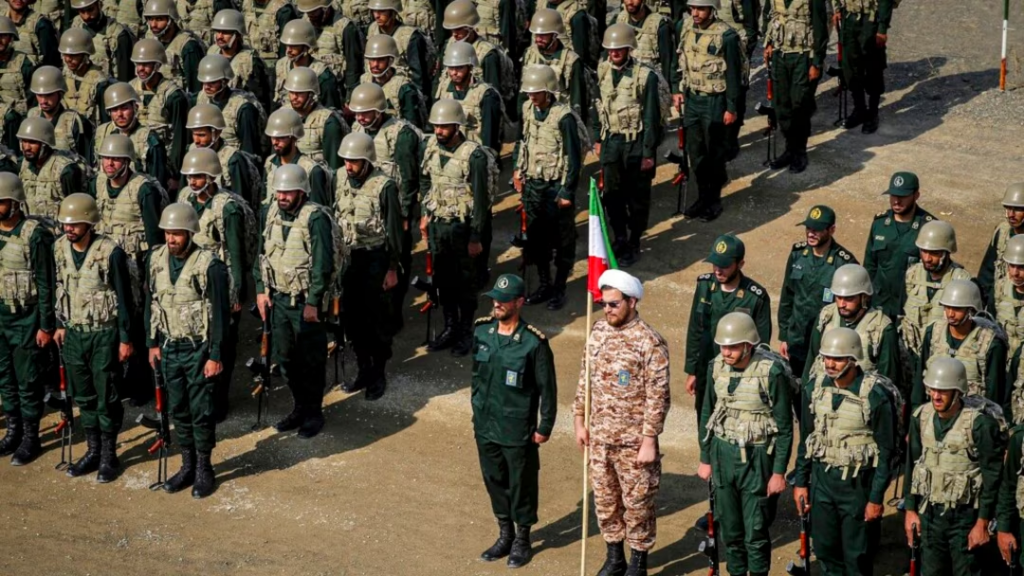
Iran says it has fully activated its “Decentralized Mosaic Defense” doctrine, a sweeping restructuring of the Islamic Revolutionary Guard Corps (IRGC) into 31 autonomous operational units. One unit aligns with Tehran. The remaining 30 correspond to provincial commands across the country.
The timing is not accidental. The shift follows reported U.S. and Israeli strikes targeting key infrastructure and command nodes. Iranian officials say the goal is clear: prevent systemic paralysis if leadership or communications hubs are taken out.
This isn’t just bureaucratic reshuffling. It’s a strategic recalibration designed for survival under sustained attack.
What Is “Decentralised Mosaic Defense”?
At its core, Mosaic Defence replaces rigid hierarchy with distributed autonomy.
Instead of relying on a centralized command vulnerable to precision strikes, Iran disperses authority across semi-autonomous regional commands. If one node falls, the system keeps functioning.
How It Works
Under the doctrine:
- Each provincial IRGC unit can operate independently if central communications are severed.
- Commanders reportedly have the authority to deploy missiles, drones, naval swarm tactics, or guerrilla operations without awaiting approval from Tehran.
- Strategic assets are geographically dispersed to complicate targeting.
Military planners call this avoiding “single-point failure.” In plain terms: removing the head does not disable the body.
The IRGC, estimated at roughly 190,000 personnel across ground, naval, and aerospace branches, provides the institutional depth to make this feasible.
Why Activate Mosaic Defense Now?
Iran has written about decentralized warfare for years. What appears new is full operationalization.
Recent U.S. and Israeli strikes, particularly those aimed at leadership and command nodes, likely accelerated the shift. Decapitation strategies rely on speed and coordination. Mosaic Defence is built to blunt exactly that.
Stress Tests in the Strait of Hormuz
Mid-February drills near the Strait of Hormuz reportedly tested decentralized command protocols.
According to Iranian accounts:
- Naval units rehearsed swarm tactics with fast-attack craft.
- Electronic warfare units simulated radar and communications disruption.
- Missile units practiced independent launch readiness.
These exercises appear less symbolic and more procedural, rehearsals for operating without centralized direction.
How Does This Affect Israel’s Iron Dome and Regional Defenses?
Decentralization changes the threat profile.
Israel’s Iron Dome excels at intercepting short-range rockets and drones. It performs especially well against limited barrages.
But Mosaic Defence increases the likelihood of:
- Simultaneous missile launches from multiple provinces
- Drone swarms launched from dispersed locations
- Maritime harassment combined with land-based strikes
Iran’s ballistic missile arsenal, including longer-range systems such as Sejjil and Emad, presents a different challenge than short-range rockets.
The risk isn’t necessarily technological superiority. It’s saturation. A sufficiently large, multi-axis attack can strain even advanced air defenses.
What Role Does Air Defense Play in Modern Warfare?
Modern conflict hinges on control of airspace and missile corridors.
For decades, U.S. and Israeli doctrine has emphasized rapid suppression of enemy air defenses and command centers in the opening hours of conflict. Speed and precision are intended to disable coordination before it begins.
Mosaic Defence aims to blunt that advantage.
If provincial commanders can act independently:
- Missile salvos can continue even after leadership strikes.
- Drone operations can proceed without central synchronization.
- Naval harassment can escalate unpredictably.
This shifts conflict from decisive opening blows to prolonged attrition.
How Does This Fit Into Iran’s “Axis of Resistance”?
Iran’s regional strategy extends beyond its borders. Through allied militias and proxy forces, often described as the “Axis of Resistance.” Tehran exerts influence in Lebanon, Iraq, Syria, and Yemen.
Decentralization inside Iran mirrors that external model:
- Distributed actors
- Local autonomy
- Central strategic alignment
The result is a layered network, domestic and regional, that complicates any attempt at swift military resolution.
What Are the Strategic Risks?
Resilience comes with trade-offs.
1. Faster Escalation
Autonomy at the provincial level reduces delay. But it may also reduce restraint.
In centralized systems, escalation can be managed at the top. In decentralized ones, initiative moves outward. A local commander under attack may respond immediately, potentially escalating before diplomatic channels activate.
2. Maritime Volatility
The Strait of Hormuz handles a significant share of global energy shipments. Increased unpredictability there affects:
- Oil prices
- Shipping insurance costs
- Naval deployments by outside powers
Consider embedding a map highlighting oil transit routes through the Gulf.
3. Prolonged Conflict
For adversaries counting on swift dominance, decentralization presents a problem: eliminating leadership may not end resistance.
The conflict risks shifting from short-term shock to sustained, dispersed pressure.
Is Mosaic DDefenseStabilizing or Destabilizing?
There are two competing interpretations.
Stabilizing View
By reducing vulnerability to leadership decapitation, Iran may deter adversaries from attempting such strikes in the first place.
If leadership targeting no longer guarantees quick victory, escalation may become less attractive.
Destabilizing View
Greater autonomy increases the risk of miscalculation. A provincial commander’s rapid retaliation could spiral before central authorities regain control.
Foreign Minister Abbas Araghchi recently said Iran would determine “when and how” any confrontation concludes — widely interpreted as signaling confidence in this new defensive posture.
Confidence can deter. It can also embolden.
The Bigger Picture: Preparing for Protracted Conflict
Iran’s geography reinforces Mosaic DDefense:
- Mountainous interiors provide natural fortification.
- Vast deserts complicate ground offensives.
- Control of key maritime chokepoints increases leverage.
The restructuring sends a clear message: Tehran is preparing for endurance, not quick resolution.
It is positioning itself for a long contest of resilience rather than a decisive opening exchange.
TL;DR
- Iran has activated its “Decentralised Mosaic Defence” doctrine.
- The IRGC is now structured into 31 semi-autonomous operational units.
- The goal: prevent systemic collapse if leadership or communications are struck.
- Decentralization complicates rapid-strike military doctrines.
- Greater autonomy may increase both deterrence and escalation risk.
What to Watch Next
- Evidence of independent provincial missile launches.
- Naval activity patterns in the Strait of Hormuz.
- Changes in IRGC command communications.
- Diplomatic responses from the U.S., Israel, and Gulf states.
Whether Mosaic Defence proves a stabilizing deterrent or a catalyst for escalation will depend not on doctrine alone — but on how commanders choose to exercise the autonomy they’ve been given.