For decades, the glittering skylines of Dubai and Abu Dhabi have sold a singular, irresistible promise to the world: absolute security. It was the ultimate “safe haven” for global millionaires, remote workers, and millions of expatriates seeking a tax-free, crime-free utopia.
But on the evening of February 28, 2026, that illusion was violently shattered.
As the joint US-Israeli “Operation Epic Fury” triggered a massive wave of retaliatory Iranian drone and missile strikes across the Arabian Peninsula, the unthinkable happened. Air-raid sirens wailed, and the sky over the iconic Palm Jumeirah lit up with the fiery streaks of missile interceptions.
Panic in Paradise: Palm Jumeirah and Burj Khalifa
Witnesses in Dubai’s most exclusive neighborhoods described scenes of disbelief turning into sheer panic.
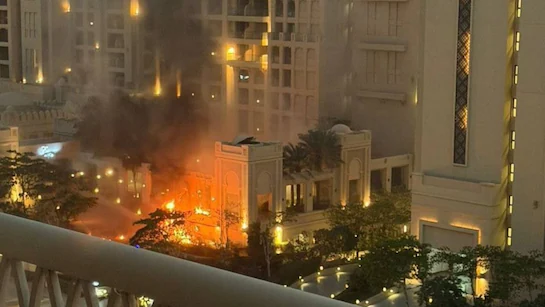
Residents of the Palm Jumeirah watched in horror as a projectile—suspected to be an Iranian kamikaze drone or intercepted debris—crashed near the luxurious Fairmont The Palm hotel. Authorities quickly contained the resulting fire, but the psychological damage was done. Four people were reported injured, a shocking reality for a neighborhood where the biggest daily concern is usually valet parking.
Miles away, in Downtown Dubai, the Burj Khalifa, the tallest building in the world and the crown jewel of the UAE’s economic triumph, was briefly evacuated as a precaution after high-altitude interceptions echoed across the city.
“We were having dinner at a rooftop restaurant when the sky just lit up orange,” said Sarah, a British expat living in the Dubai Marina. “My phone started screaming with emergency alerts. Everyone just froze. You never, ever expect to see war in Dubai.”
WhatsApp Groups Explode as Reality Sets In
Across the UAE, expat community WhatsApp and Facebook groups went into overdrive. Questions that had never been asked in the UAE suddenly flooded the chats:
- Where is the nearest bomb shelter?
- Are the supermarkets running out of water?
- How do we get out if the airports are closed?
The tragic news from Abu Dhabi only deepened the anxiety. The confirmation of the first civilian fatality—an Asian expatriate killed by falling shrapnel in a residential neighborhood—proved that the Gulf’s impenetrable “bubble” had burst.
What Happens to the ‘Dubai Dream’?
This escalation poses an existential threat to the region’s economic model. Dubai’s post-pandemic real estate boom was driven largely by wealthy investors fleeing geopolitical instability in Europe and Asia.
Now, with airspace closed, major airlines like Emirates grounding flights, and US military bases like Al-Dhafra actively engaging ballistic targets, the narrative has shifted overnight. Real estate analysts warn that if the region remains an active conflict zone, the capital flight out of the UAE could be unprecedented.
Survival Mode: Expats Pack Their ‘Go-Bags’
For now, the glitz and glamour of brunch culture and beach clubs have been replaced by wartime pragmatism. Embassies from the US, UK, and India are urging their citizens to stay indoors, conserve phone batteries, and avoid glass windows.
Thousands of expats spent Saturday night packing emergency “go-bags” with passports, cash, and medication—praying that the “third wave” of Iranian strikes promised by the IRGC never comes.
The golden city is holding its breath. The safe haven has survived its first night under fire, but the feeling of invincibility is gone forever.