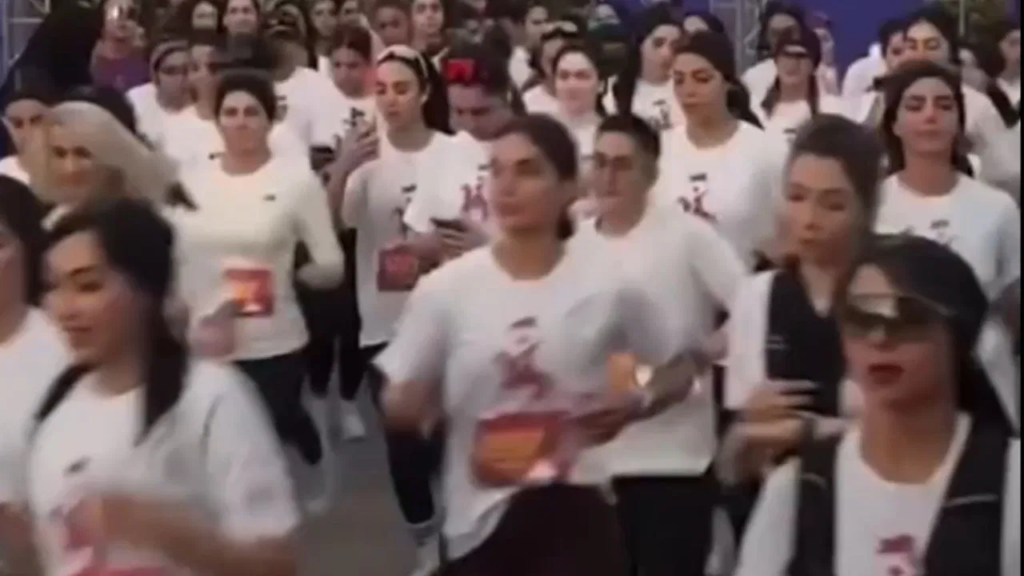
A group of Iranian women participated in a 10-kilometer road race in Tehran without wearing headscarves, openly challenging the country’s mandatory hijab rules at a public sporting event.
The race took place at Velayat Park, where organizers held separate competitions for men and women. The women’s race covered two laps of the 10-kilometer course.
Footage of the runners circulated on social media, drawing attention to Iran’s restrictions on women’s clothing and the continuing debate over how strictly authorities enforce the country’s compulsory hijab law.
The event also attracted attention because authorities had previously cracked down on a similar race in which women competed without headscarves.
What happened at the Tehran 10K race?
The road race brought male and female runners to Velayat Park in Tehran for separate competitions. Women participating in the event were seen running without the headscarves required under Iran’s dress regulations.
Among the notable participants was Parisa Arab, an Iranian distance runner who holds national records in the women’s 5,000 meters, 10,000 meters and half marathon.
Arab won the race and later shared a video of herself crossing the finish line, thanking spectators for encouraging her during the competition.
The appearance of women running without headscarves was particularly significant given the legal restrictions that continue to govern women’s clothing in Iran.
Although the race itself was a sporting event, images of the participants quickly became part of a wider discussion about women’s public visibility, personal choice and the enforcement of the country’s dress code.
Why did the race attract attention across Iran?
The event coincided with a state-backed rally
The 10K race took place on the same day as the Janfadayan-e Iran rally, a large state-backed gathering in Tehran.
The rally included members of the Islamic Revolutionary Guard Corps, Basij members, and volunteers who pledged to defend the country.
The two events were not connected, but footage of the unveiled runners was shared by some state-affiliated accounts on X, formerly known as Twitter.
That coincidence brought additional attention to the race. Images of women running without headscarves circulated alongside coverage of a gathering centered on national defense and support for the state.
The contrast also highlighted the different ways women’s participation in public life can be viewed in Iran, where official rules continue to require head coverings even as more women appear in public without them.
The circulation of the footage, however, does not by itself establish that authorities approved of the participants’ clothing or that the event represented a change in government policy.
A previous crackdown adds to the significance
The Tehran race also comes against the backdrop of an earlier crackdown on a similar sporting event where participants competed without headscarves.
That history makes the latest incident noteworthy. It raises questions about how authorities respond to violations of the mandatory hijab law at public events and whether enforcement varies depending on the circumstances.
The available information does not establish whether officials have initiated proceedings against the runners in this case. It would therefore be premature to conclude that the participants will face penalties or that the event signals a formal relaxation of the rules.
How does Iran’s mandatory hijab law affect women?
Iran’s compulsory hijab requirements extend beyond sporting competitions. Women are required to cover their hair in public, and authorities have used various measures to enforce the rules.
The restrictions have affected women’s access to public spaces, employment, and everyday activities. Government offices and many official establishments continue to require women to wear headscarves to enter.
The enforcement of these rules has also drawn scrutiny from international human rights organisations.
In September 2022, the death of Mahsa “Jina” Amini in morality police custody triggered nationwide protests under the slogan “Woman, Life, Freedom.” Amini had been detained over alleged noncompliance with Iran’s mandatory hijab rules. Her death became a focal point for demonstrations calling for women’s rights and greater personal freedoms. The United Nations has raised concerns about the treatment of women and girls under Iran’s compulsory veiling laws, including reports of arrests, harassment and violence linked to enforcement.
Why are more women appearing in public without headscarves?
Since the 2022 protests, women have increasingly appeared in public without headscarves, making uncovered hair more visible in parts of Iranian society.
This change in public behavior has not meant that the legal requirement has been repealed. Instead, it illustrates a gap between the rules on the books and the way some women choose to dress in everyday life.
The Tehran race offers another example of that tension. Women participated in a public sporting event with their hair uncovered, even though compulsory hijab requirements remain in force.
The distinction matters: increased public visibility of women without headscarves is not the same as a formal change in the law. The race alone also cannot establish how authorities will respond to similar events in the future.
Who won the Tehran 10K race?
Parisa Arab takes first place
Iranian distance runner Parisa Arab won the women’s race.
Arab is a national record holder in three events:
- Women’s 5,000 meters
- Women’s 10,000 meters
- Women’s half marathon
After the race, Arab shared a video showing her crossing the finish line. She also thanked spectators for their encouragement, saying their support gave her energy during the more difficult stretches of the competition.
Her victory added a sporting achievement to an event that has attracted attention for reasons extending beyond the results.
The footage of the runners has also prompted renewed discussion about the relationship between athletic participation, personal expression and the rules governing women’s appearance in public.
What could the race mean for women’s rights in Iran?
The Tehran 10K has become a visible example of the continuing debate over compulsory hijab in Iran.
Its significance lies not only in the participants’ clothing but also in the setting: a public sporting event where women competed without headscarves despite the continuing legal requirement.
Several developments help explain why the race has attracted attention:
- Public visibility: The appearance of women without headscarves at a public event reflects a broader change in how some women dress in public.
- Continuing legal restrictions: The compulsory hijab requirement remains in force, even as compliance has become less uniform in everyday life.
- Uncertainty over enforcement: The earlier crackdown on a similar event highlights the possibility of official action, although the available reporting does not establish what consequences, if any, the Tehran participants will face.
- Social media attention: The circulation of footage, including by some state-affiliated accounts, has brought the event to a wider audience.
The race should not, on its own, be treated as evidence that Iran has changed its laws or officially accepted uncovered hair at public sporting events. It does, however, provide a concrete example of women participating in public life in ways that challenge the country’s existing dress requirements.
The bottom line
Iranian women competed without headscarves at the Tehran 10K at Velayat Park, drawing attention to the country’s mandatory hijab law and the changing visibility of women in public spaces.
The race coincided with a separate state-backed rally, and footage of the runners circulated online. National record holder Parisa Arab won the women’s competition and later thanked spectators for their encouragement.
With compulsory hijab rules still in force and authorities having previously acted against a similar event, the Tehran race has renewed questions about enforcement, women’s rights, and the space available for individual choice in Iran.