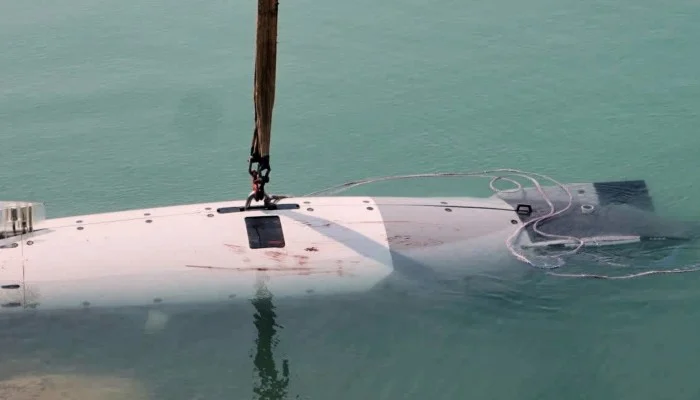
Iran has claimed that it captured a US military underwater drone near the Strait of Hormuz, putting a relatively unfamiliar piece of American autonomous technology at the center of another high-stakes confrontation between Washington and Tehran. Iran’s Islamic Revolutionary Guard Corps identified the vehicle as the Dive-LD, an autonomous underwater vehicle developed by California-based defense company Anduril Industries. Iranian state media presented the capture as a major intelligence and military achievement.
The United States has offered a markedly different assessment.
US Central Command said the vehicle was an older Dive-LD model that had malfunctioned more than a day before the reported seizure and was effectively “dead in the water.” Officials also said it was not carrying classified sonar or radar equipment or collecting sensitive data.
That leaves two very different narratives: Iran is portraying the drone as a sophisticated American prize, while the US is emphasizing that the particular vehicle was an older, non-sensitive system designed to operate in risky environments.
What is the Dive-LD?
The Dive-LD is a large autonomous underwater vehicle, or AUV, designed to operate without a crew inside the vehicle.
The system is about 5.8 meters, or 19 feet, long and weighs roughly three metric tons. Anduril says it can conduct autonomous missions for as long as 10 days and dive to depths of up to 6,000 meters, or nearly 20,000 feet.
That combination of endurance and depth gives the vehicle a very different role from conventional surface drones.
It can disappear beneath the water for extended periods, collect information and perform specialized missions while keeping human operators away from potentially dangerous environments.
What can the Dive-LD actually do?
The Dive-LD is a modular platform rather than a single-purpose submarine.
Its potential missions include intelligence, surveillance and reconnaissance, seabed mapping, mine countermeasures and inspection of underwater infrastructure such as cables and pipelines.
Its modular architecture allows different sensors and payloads to be integrated depending on the mission.
That flexibility is particularly valuable in waters such as the Persian Gulf, where a single autonomous platform could potentially be used for several different maritime tasks.
Why would the US Navy use an underwater drone near Hormuz?
The Strait of Hormuz is one of the world’s most strategically important waterways.
It connects the Persian Gulf with the Gulf of Oman and the Arabian Sea and carries a major share of global energy shipments. During the current US-Iran conflict, the waterway has also become a contested military environment involving mines, missiles, drones and naval forces.
An autonomous underwater vehicle can perform some surveillance and mine-related missions without putting a sailor inside a submarine or sending a surface ship directly into the most dangerous area.
US forces have been increasingly relying on unmanned systems for precisely that reason.
Why is the Dive-LD useful for mine warfare?
Mines are among the most difficult threats to detect and eliminate because they can remain hidden beneath the water while posing a serious risk to ships.
An autonomous underwater vehicle can carry sensors designed to search the seabed and identify suspicious objects.
It can also operate for long periods without requiring a human crew to remain in the immediate danger zone.
That is particularly relevant in the Strait of Hormuz, where the US has been conducting mine-clearance and maritime security operations during the conflict with Iran.
How advanced is the Dive-LD?
The Dive-LD is certainly a sophisticated military-grade autonomous underwater system, but calling it the “most advanced” American submarine drone, as Iranian officials have done, requires qualification.
Anduril developed the platform for long-endurance autonomous operations, and the vehicle incorporates sophisticated navigation, sensing and control technologies.
However, US officials said the particular vehicle captured by Iran was an older model using commercially available technology and did not contain classified sonar or radar systems.
So the technology itself is significant, but the intelligence value of this particular lost vehicle may be considerably more limited than Iran’s public messaging suggests.
How did Iran capture the underwater drone?
The exact circumstances remain unclear.
Iran’s IRGC said it captured the vehicle near the entrance to the Strait of Hormuz and released photographs and video purporting to show the drone in Iranian possession.
The images are consistent with an Anduril Dive-LD, and specialist analysis has identified distinctive external features matching the design. However, the exact method used to recover the vehicle has not been publicly established.
The US account is that the vehicle malfunctioned more than a day before Iran announced its capture.
That means the incident may have involved an abandoned or disabled vehicle rather than an operational US drone being forcibly intercepted during a successful Iranian intelligence operation.
What does ‘dead in the water’ mean in this case?
According to a US Central Command spokesman, the underwater drone had been malfunctioning for more than a day before Iran’s announcement.
In practical terms, that means the vehicle was no longer carrying out its intended mission when it was recovered.
This distinction matters because an operational system captured while transmitting or collecting intelligence could potentially reveal much more about current US tactics and technology.
A disabled, older vehicle with no sensitive payload presents a substantially different intelligence risk.
Could Iran reverse-engineer the Dive-LD?
Potentially, although the extent of the benefit remains uncertain.
Even when a system uses commercially available technology, physically examining a captured platform can reveal details that are difficult to obtain from photographs or public specifications.
Engineers could potentially study its mechanical layout, materials, propulsion system, navigation components, sensors and manufacturing techniques.
Reuters cited analysts who said Iran could use the opportunity to learn more about the design even if it does not obtain a major military advantage.
That makes the physical loss of the vehicle relevant even if the Pentagon is correct that it contained no classified equipment.
Why does Anduril describe Dive-LD as ‘attritable’?
The company uses the term “attritable” for systems that are designed to operate in dangerous environments where losing a vehicle is considered an acceptable possibility.
That is fundamentally different from the philosophy surrounding a crewed submarine, which represents a major human and financial investment and carries personnel whose survival must be protected.
An attritable autonomous vehicle is intended to be useful precisely because it can take risks that commanders would be reluctant to ask humans to take.
Anduril has said the Dive-LD is designed to keep warfighters out of the most hazardous parts of undersea missions.
When did the US Navy start using Dive-LD?
The US Navy began receiving Dive-LD systems in 2025 for use by specialized unmanned undersea units.
The platform is part of a broader effort by the Navy and Pentagon to increase the number of autonomous systems operating at sea.
That strategy reflects a larger shift in modern warfare.
Instead of relying exclusively on expensive crewed ships and submarines, militaries are increasingly developing fleets of smaller autonomous platforms that can survey, monitor, clear mines and perform other missions with fewer personnel at risk.
What is Dive-XL?
Dive-XL is Anduril’s larger autonomous underwater platform.
It shares some design principles with the Dive-LD but is substantially bigger and intended for missions requiring greater payload capacity and endurance.
Dive-XL is also connected to the broader development of large unmanned underwater systems, including Australia’s Ghost Shark program.
The progression from Dive-LD to larger autonomous submarines reflects a clear direction in naval technology: more underwater missions are moving toward unmanned platforms.
Why does the incident matter strategically?
The immediate loss of one older underwater drone is unlikely to transform the military balance in the Gulf.
The larger significance lies in what the incident reveals about the changing character of naval warfare.
The US is increasingly sending autonomous systems into contested waters to perform missions that traditionally required manned ships, submarines or divers.
Iran, meanwhile, is demonstrating that it is watching those systems closely and is willing to publicize any opportunity to portray a US technological loss as a victory.
The incident is therefore as much an information battle as a hardware story.
Does Iran now have a major US military secret?
There is no evidence of that based on the information publicly released so far.
US Central Command said the Dive-LD was an older model that did not carry classified sonar or radar equipment and was not collecting sensitive data when it malfunctioned.
That does not mean the recovered vehicle has zero intelligence value.
A captured platform can still provide useful information about engineering choices and operational practices. But that is very different from gaining access to the latest classified American undersea technology.
Why is this important for the Strait of Hormuz?
The episode comes as the Strait of Hormuz is becoming increasingly militarized during the US-Iran conflict.
Underwater mines, maritime surveillance and naval movements have made the seabed itself a critical part of the battlefield.
That makes autonomous underwater vehicles particularly valuable.
A system capable of spending days underwater and descending thousands of meters can help map the environment, detect threats and monitor activity without putting a crewed vessel directly into harm’s way.
The capture therefore offers a rare public glimpse into the kind of technology the US is deploying beneath the surface.
Could this change the future of naval warfare?
It is one small example of a much larger shift.
Navies are increasingly moving toward fleets that combine crewed ships and submarines with autonomous surface and underwater vehicles.
The logic is straightforward: autonomous systems can be smaller, cheaper and more expendable than major warships while still providing surveillance, mine detection and other capabilities.
The Dive-LD illustrates that philosophy particularly well.
Its greatest value may not be in fighting like a conventional submarine. It is in allowing the military to put sensors and machines into places where sending a human would be unnecessarily dangerous.
What we know about Iran’s Dive-LD claim
Iran says it captured a US Dive-LD near the Strait of Hormuz on September 8, 2026, and released imagery of the vehicle. Independent naval analysts found that the publicly released images are consistent with the Anduril Dive-LD design.
The US has acknowledged losing an underwater drone in the area but says the older model had malfunctioned more than a day earlier, was not collecting sensitive information and carried no classified sonar or radar equipment.
The precise circumstances of the recovery remain unclear, and the two countries’ descriptions of the incident differ sharply.