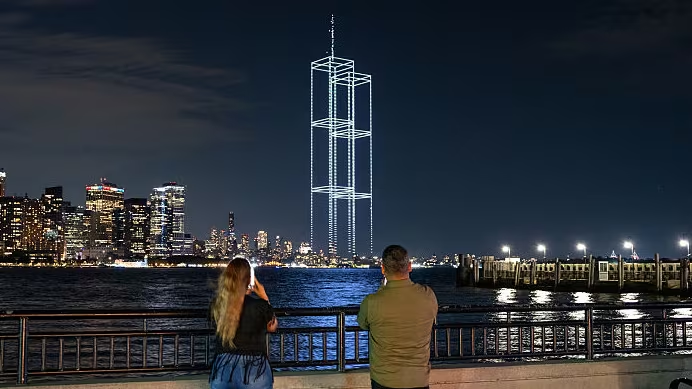
Twenty-five years after the 9/11 attacks, an unusual social media project is recreating one of the darkest days in modern US history as it happened, minute by minute.
The X account 2001 Live, operated by historian and social media creator Manny Marotta, is publishing posts at the original times of events from September 11, 2001. The goal is to give younger people a sense of how the tragedy unfolded before the full scale of the attacks became known.
Rather than presenting the day as a retrospective timeline, the project is designed to recreate the uncertainty of following breaking news as it emerged.
How will the 9/11 live coverage work?
Marotta said he has prepared about 410 posts for September 11, with updates appearing roughly every three minutes throughout the day.
The pace becomes much faster during the crucial period between 8:46 a.m. and 10:30 a.m. Eastern Time, when he plans to publish an average of about two posts per minute. The posts are intended to appear as close as possible to the actual time each event occurred.
Marotta says the updates will be written and published manually rather than scheduled in advance.
That approach is intended to make the reconstruction feel less like an automated archive and more like a live news feed unfolding in real time.
What is the 2001 Live account?
The account, @25YearsAgoLive, operates under the name “2001 Live” and describes itself as “live-posting as a reporter embedded in history.”
It is part of Marotta’s broader historical project, which also includes accounts dedicated to other decades and periods. The account had hundreds of thousands of followers before the 9/11 anniversary coverage began.
Its September 11 project is therefore not a one-off social media stunt. Marotta has been running similar historical live-posting projects for years.
How did he research 9/11?
Marotta says he spent months building the timeline and reviewed roughly 240 hours of archival material.
His research included television news coverage, footage recorded at the scenes, eyewitness testimony and academic material. He also said he consulted people with professional knowledge of the events and attempted to corroborate accounts before including them.
The emphasis on corroboration is particularly important for a project reconstructing a chaotic day when early reports were often incomplete, contradictory or later corrected.
Some events can be assigned to an exact time, while others were reported gradually as information moved between officials, newsrooms and witnesses. That means the project is ultimately a reconstruction based on the historical record, not a literal recreation of every second of September 11.
Why won’t the account show graphic images?
Marotta has deliberately decided against posting graphic photographs and videos of the attacks.
He said such material would be disrespectful to victims and their families, even though extensive graphic footage from the day exists.
The decision leaves the account focused on events, reports, official developments and the changing understanding of what was happening.
That distinction matters because the project is trying to communicate the sequence and uncertainty of the day rather than turn the anniversary into graphic spectacle.
Why recreate 9/11 in real time?
For people who lived through September 11, the day’s chronology is deeply familiar.
For younger generations, however, the attacks are increasingly something encountered through history books, documentaries and archived footage rather than lived memory.
Marotta says his aim is to bridge that gap by allowing followers to experience the progression of information in roughly the same order it became known in 2001.
The format also illustrates something that conventional retrospective reporting cannot fully capture: the uncertainty of the first hours.
At different points that morning, Americans did not yet know how many aircraft had been hijacked, how extensive the attacks were or what might happen next.
A minute-by-minute timeline can therefore show not only what happened, but also how knowledge of the event changed as the morning unfolded.
Is the project controversial?
Reconstructing a mass-casualty terrorist attack as a live social media feed is inevitably a sensitive undertaking.
The experience can be unsettling because posts arrive without the benefit of hindsight, recreating the rhythm of breaking news rather than simply stating the final historical outcome.
Marotta has tried to address some of those concerns by excluding graphic material and stating that he is approaching the project as a historical exercise rather than entertainment. He has also said that users posting 9/11 conspiracy theories will be removed from the conversation.
That moderation is especially relevant because anniversary discussions about 9/11 can quickly become overwhelmed by misinformation and conspiracy theories.
Is Manny Marotta making money from the 9/11 posts?
Marotta says he is not currently monetizing the project.
In his FAQ, he said he had not applied for X’s replacement creator-monetization programme and was treating the 9/11 coverage as a passion project. He also said that money previously generated from 9/11-related posts had been donated and that any future earnings connected to the anniversary would also be donated.
That statement cannot independently establish how X’s monetization systems ultimately treat individual posts, but it explains the stated financial rationale behind the project.
What makes this different from watching a 9/11 documentary?
A documentary tells viewers what happened after the fact.
2001 Live is trying to remove some of that hindsight.
Instead of starting with the knowledge that the United States was under attack, followers encounter the information in sequence: an event happens, a report emerges, another development follows and the picture gradually becomes clearer.
That structure recreates one of the defining characteristics of September 11 itself: information was arriving faster than people could understand it.
Twenty-five years later, the technology is different, but the historical timeline remains fixed.
The project is essentially using one of today’s fastest communication platforms to recreate the slow, fragmented process through which the world first learned what was happening on September 11, 2001.