
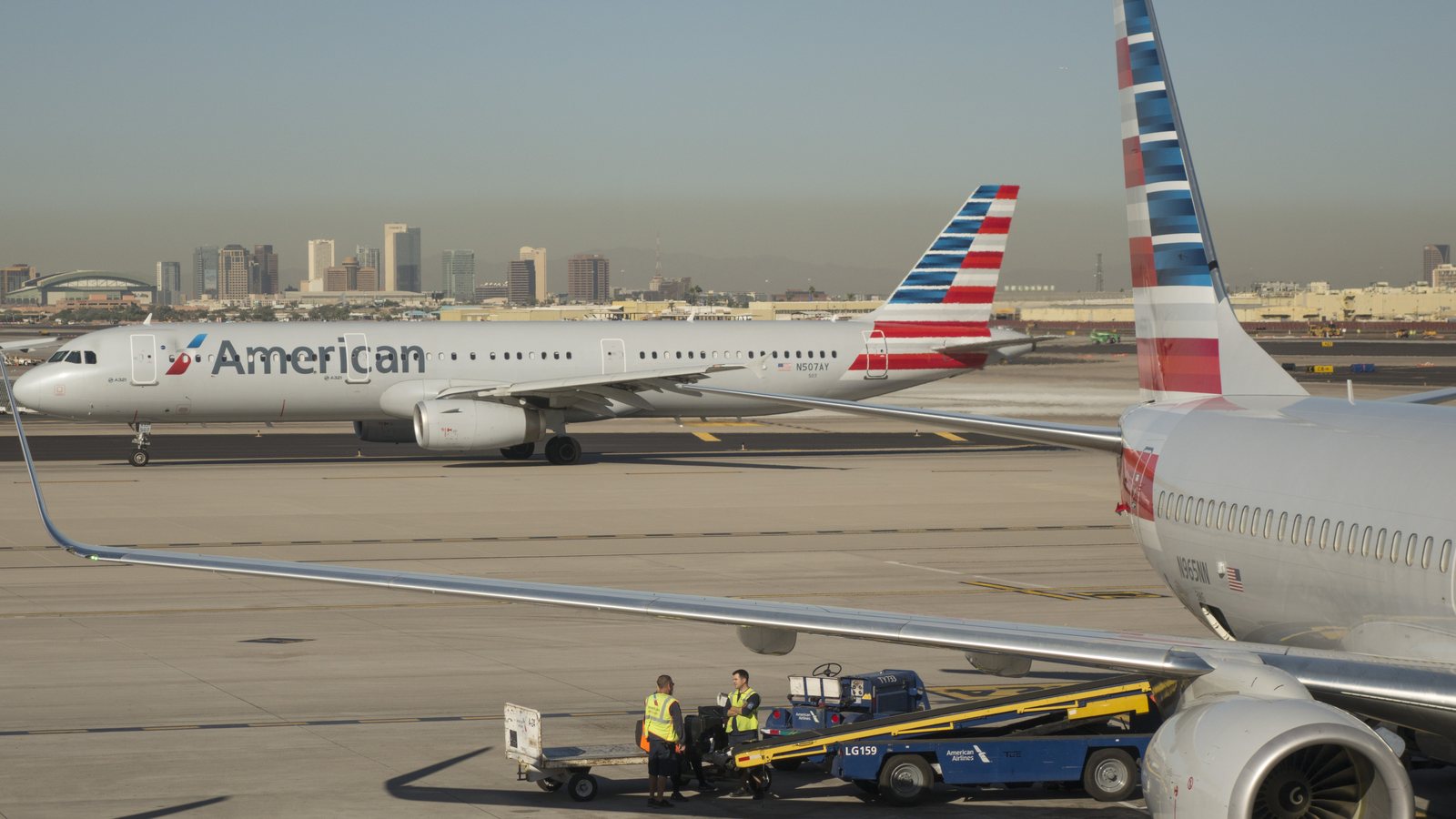

American Airlines Flight 1494, a red-eye from San Diego to Chicago O’Hare, diverted to Phoenix early Wednesday, Nov. 25. A passenger had allegedly gone to the front of the plane and tried to open a door. Crew members and passengers held him down until the jet landed at Phoenix Sky Harbor International Airport around 1 a.m. local time, police said.
No one else was hurt. As of Thursday, police had not named the man and no charges had been announced.
The door itself was almost certainly never going to open, and our cabin-pressure math below shows why. The bigger risk for the passenger is legal: a federal interference charge carries up to 20 years, and the FAA can add civil fines.
What police and American say happened
The man “left his assigned seat and moved to the front of the aircraft,” Phoenix police said, CBS Chicago reported. Police said he repeatedly refused crew instructions to sit down and tried to tamper with an exit door.
The plane was near the Arizona-California border, south of Needles, California, police told ABC7.
A passenger, Josh Flanders, told NBC 7 San Diego that the man was “pulling at the door and saying, ‘I have to get out of here.'” Flanders said it took about five minutes to restrain him.
Another passenger, Sean Bennett, told ABC7 it was “remarkable how quickly everyone sprang into action to restrain this man.”
American said the flight “diverted to Phoenix (PHX) due to a disruptive customer.” Law enforcement met the aircraft and helped deplane him “before the flight continued to its destination,” the airline said in a statement carried by ABC15 Arizona.
The other passengers waited about five hours in Phoenix for a new crew, NBC 7 reported.
Police said the man had a minor injury and went to a hospital for evaluation. Accounts of his status differ. CBS Chicago quoted police as saying he was not arrested, while NBC 7 reported that officers took him into custody.
Police said the FBI will review the officers’ reports. The FAA said the flight landed safely and that “the FAA will investigate.”
ABC15 reported that air traffic controllers logged it as a “Level 3 threat.” That label comes from the federal Common Strategy, which crews use to grade onboard threats on a four-step scale.
FAA Advisory Circular 90-103 defines Level 3 as “life-threatening behavior.” Level 4, the top rung, is an attempted or actual breach of the cockpit.
Why the door almost certainly couldn’t open
Phoenix police told NBC News the man tried the door at 35,000 feet. At that height, the air outside is thin, and the plane’s air system keeps the cabin at a much higher pressure.
Federal rules require airliners to hold a cabin altitude of no more than 8,000 feet in normal flight, under 14 CFR 25.841.
We ran both altitudes through NASA’s standard-atmosphere equations. Air pressure is about 3.5 pounds per square inch at 35,000 feet and about 10.9 psi at 8,000 feet. That leaves a gap of roughly 7.5 psi, or about 1,070 pounds pushing outward on every square foot of the door.
If the crew keeps the cabin lower than 8,000 feet, the push grows, and even at 30,000 feet it comes to about 6.5 psi.
Spread that across a panel the size of a standard 30-by-80-inch house door and the load comes to roughly 17,900 pounds, about nine tons. No one standing in an aisle can overcome that.
The design adds a second barrier. Most emergency exits are “plug” doors that must move inward before they can swing open, AFAR explained. Cabin pressure presses the door outward into its frame, so pulling the handle at cruise does nothing useful.
“When the aircraft is pressurized, the door physically cannot be opened,” pilot Ryan Irwin told the magazine.
That protection fades close to the ground, where the pressure difference shrinks. AFAR noted that the 2023 Asiana Airlines case, in which a passenger opened an exit, happened at about 700 feet as the jet came in to land.
The door scare most Americans remember, Alaska Airlines Flight 1282 in January 2024, was different again. A fixed door plug blew out, and the NTSB traced it to missing bolts, not to anything a passenger did.
The federal charge prosecutors would weigh
Because the door could not have opened, any legal case turns on the disruption itself. Crew members had to stop and restrain a passenger, and the pilots had to divert. Interfering with a crew’s duties is the conduct federal law targets.
The main statute is 49 U.S.C. 46504. It covers anyone on a plane who assaults or intimidates a flight crew member or flight attendant and interferes with their duties, or attempts to. The maximum is 20 years in prison, or life if the person uses a dangerous weapon.
It is the law we explained after United Flight 1681 turned back over a hijack text in October.
A case this year shows how prosecutors use it. In June, federal prosecutors in Miami charged a passenger who allegedly tried to open an emergency exit and the cockpit door on a San Juan-to-Chicago flight. That flight also diverted.
He faces up to 20 years on the interference count, the US Attorney’s Office said. The office added that a complaint “is merely an allegation.”
Prosecutors have made no such complaint public in the Flight 1494 case. Whether they file one will turn on the officers’ reports and witness accounts, including the passenger videos.
FAA fines, and a year on pace to pass 2025
The FAA cannot bring criminal charges, but it can fine passengers and refer cases to the FBI. It can propose up to $43,658 per violation in unruly-passenger cases, and one incident can produce several violations.
The unruly-passenger dashboard on the same FAA page, current to Nov. 22, counts 1,539 reports from airline crews so far in 2026. The agency opened 108 investigations, started 88 enforcement actions and lists $1.7 million in fines against unruly passengers. By our count, it opened an investigation into about one report in 14.
The 2026 total is already 95% of 2025’s full-year count of 1,621. At this year’s average of about 4.7 reports a day, our calculation shows 2026 passing last year’s total around Dec. 9. That would still be far below the 5,973 reports logged in 2021.
Flight 1494 diverted early on the day before Thanksgiving, in a week when the FBI, DHS and TSA had warned airlines about Al Qaeda messaging that praised an attempted hijacking. TSA says there is no credible threat to US aviation, and nothing reported so far links that warning to this flight.
The next steps are the FAA’s investigation and the FBI’s review of the Phoenix officers’ reports. If prosecutors bring a case, a criminal complaint in federal court would be the first public charging document.