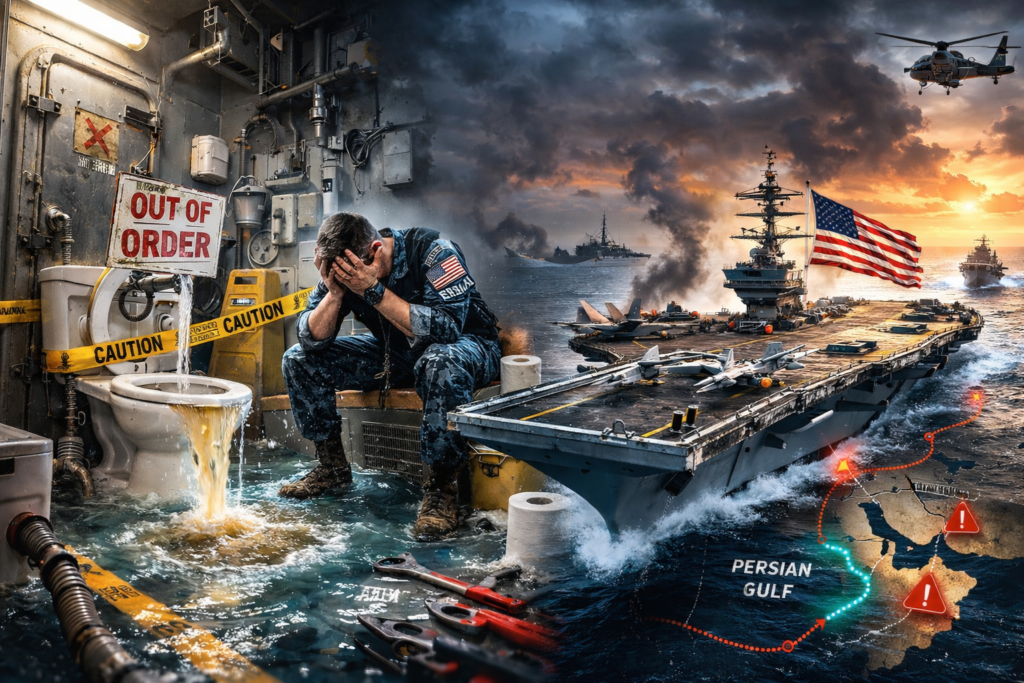
As the United States stages its largest military buildup in the Middle East since the 2003 Iraq invasion, an unlikely phrase has gone viral: “USS Ford bathroom crisis.”
At the center of the story is the USS Gerald R. Ford, the Navy’s newest and most expensive aircraft carrier. While the ship plays a key role in deterring Iran amid nuclear tensions, it is also battling a long-running sanitary systems problem that sailors have bluntly dubbed a “bathroom war.”
The juxtaposition is striking. On one hand, two carrier strike groups, stealth aircraft, and missile defense assets. On the other, clogged vacuum toilets and overworked engineering crews. Both stories are real. And both matter.
Why is the USS Ford bathroom crisis happening?
The USS Ford bathroom crisis is not new. It has been documented since the carrier entered service in 2017.
The $13 billion warship uses an advanced vacuum-based sewage system designed to reduce water usage and improve efficiency. In practice, the system has proven prone to clogs and mechanical breakdowns.
The numbers help explain the strain:
- Roughly 650 toilets.
- A crew that can exceed 4,600 to 5,000 sailors when fully loaded with its air wing.
- Continuous high-tempo deployments since 2025.
Multiple outlets, including NPR, Navy Times, and The Wall Street Journal, have previously reported on repeated sewage backups, leaks, and long repair shifts for engineering crews.
Design flaw, not overcrowding
It is important to separate myth from mechanics.
The issue is not that “too many sailors” are packed aboard. Aircraft carriers are designed for dense populations. The challenge appears to be systemic:
- The vacuum toilets are sensitive to improper use.
- The pipe diameters were widely reported to be smaller than ideal.
- Repairs at sea are complex and time-consuming.
- Sustained deployment limits opportunities for full overhaul maintenance.
Under normal peacetime operations, the Navy can rotate ships through shipyards. During extended high-alert deployments, that margin disappears.
Why is the USS Ford deployed to the Middle East now?
The USS Ford bathroom crisis is unfolding during one of the most significant U.S. force movements in two decades.
The Ford and the USS Abraham Lincoln are currently leading two carrier strike groups in or near the Arabian Sea, the Persian Gulf, and the eastern Mediterranean.
According to defense analysts and open-source tracking:
- At least 16 to 20 surface combatants are operating in or near the region.
- More than 120 additional U.S. aircraft have been deployed.
- Advanced assets include F-22s, F-35s, F-15s, and long-range bomber support.
The Pentagon has framed the buildup as leverage in the standoff over Iran’s nuclear program.
President Donald Trump has publicly insisted on “zero enrichment” from Iran and warned of “severe consequences” if negotiations fail. Indirect talks, reportedly mediated by Oman, are scheduled in Geneva.
The strategy is classic coercive diplomacy: negotiate from a position of overwhelming force.
How serious is the Middle East buildup?
Defense analysts describe the current posture as the largest visible U.S. military concentration in the region since the Iraq War.
The objectives appear to include:
- Deterring Iranian retaliation.
- Providing credible strike options against nuclear facilities.
- Reassuring regional allies.
- Protecting shipping lanes and bases.
What are the likely military scenarios?
Officials and analysts broadly outline two paths forward.
1. A negotiated nuclear deal
Diplomatic talks in Geneva could yield an interim agreement limiting enrichment levels and expanding inspections. This would allow both sides to claim progress while avoiding escalation.
2. A limited air campaign
If talks collapse, analysts expect a limited strike campaign targeting nuclear facilities, missile infrastructure, and associated assets.
Most experts do not foresee:
- A full-scale ground invasion.
- Regime change operations.
- A short “in-and-out” raid on hardened facilities.
Iran has reportedly reinforced key sites such as Natanz and Isfahan. Satellite imagery published by Reuters and the Institute for Science and International Security indicates new fortifications, buried tunnel entrances, and reinforced structures designed to withstand bunker-buster munitions.
That hardening complicates military planning and raises the cost of escalation.
Why the bathroom crisis matters strategically
At first glance, plumbing failures seem trivial compared to nuclear brinkmanship.
They are not.
Modern aircraft carriers are floating cities. When sanitation systems fail:
- Crew morale suffers.
- Disease risks increase.
- Maintenance teams are diverted from other tasks.
- Operational tempo becomes harder to sustain.
Extended deployments already push sailors physically and mentally. Adding chronic infrastructure problems compounds stress.
In a prolonged crisis with Iran, endurance matters as much as firepower.
What does this reveal about next-generation warships?
The Ford-class carriers were designed to represent a leap forward:
- Electromagnetic aircraft launch systems.
- Advanced radar.
- Reduced crew requirements.
- Higher sortie generation rates.
But new technologies often come with early reliability challenges.
The sanitation issue joins a list of initial technical hurdles the class has faced, including launch system debugging and weapons elevator delays during early testing phases.
For balanced reporting, include:
- Navy statements on corrective actions.
- Budget documents outlining upgrade funding.
- GAO assessments of Ford-class performance.
The bigger story is not that the ship has problems. It is how quickly and effectively those problems are resolved during real-world deployments.
TL;DR
- The USS Ford bathroom crisis stems from chronic vacuum sewage system failures documented since 2017.
- The issue is design-related and exacerbated by extended high-tempo deployments, not overcrowding.
- The crisis coincides with America’s largest Middle East military buildup since 2003.
- Two carrier strike groups and over 120 aircraft are deployed amid Iran nuclear tensions.
- Diplomacy continues in Geneva, but limited military strikes remain a possible fallback option.