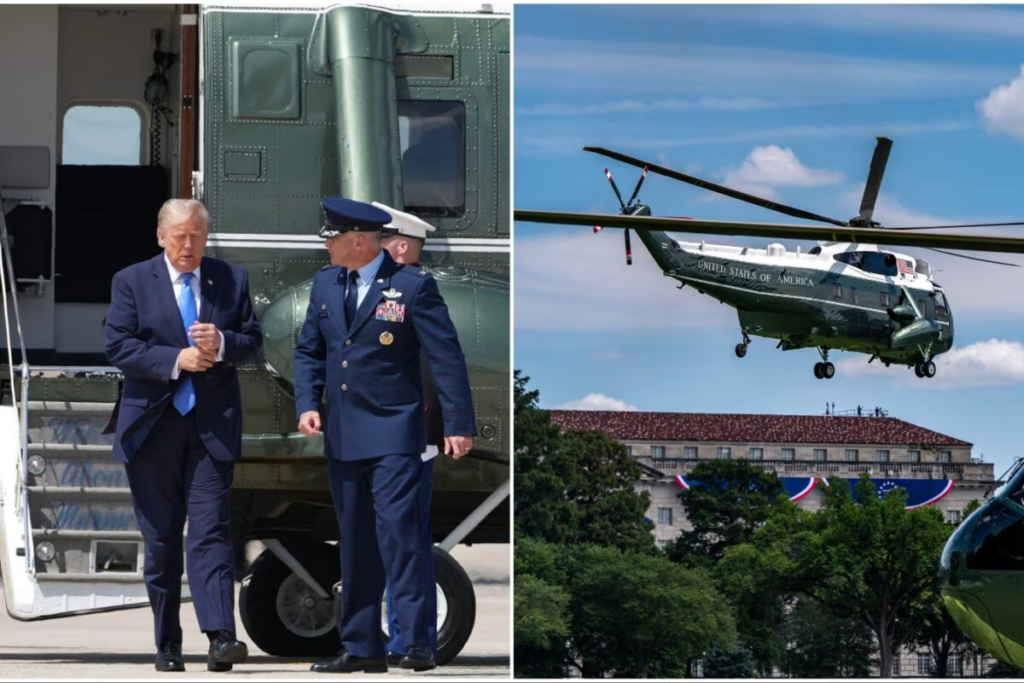
US aviation authorities are investigating an incident involving President Donald Trump‘s Marine One helicopter and a commercial passenger aircraft after the two aircraft experienced what regulators call a “loss of separation” near Washington, D.C.
While early reports described the aircraft as coming unusually close during the presidential flight, both the Federal Aviation Administration (FAA) and the White House have emphasised that the president was never in danger. Investigators are now examining whether air traffic control procedures, communications, or other operational factors contributed to the incident.
Here’s what happened and what the investigation is expected to determine.
What happened between Marine One and the passenger jet?
The incident occurred on August 4 as President Donald Trump travelled aboard Marine One to Joint Base Andrews, where he was scheduled to board Air Force One for a trip to California.
According to reporting by The New York Times, citing people familiar with the matter, Marine One came within less than a mile of a departing commercial aircraft after what was described as garbled communications with air traffic controllers.
The commercial flight was reportedly an American Airlines Embraer E-170 operated by regional carrier Envoy Air that had departed from Ronald Reagan Washington National Airport.
Although the aircraft temporarily breached required separation standards, both continued safely on their intended flight paths.
What are the FAA and NTSB investigating?
The National Transportation Safety Board (NTSB) has opened an investigation into what officials describe as a “loss of separation” event.
In a statement, the NTSB said it is investigating the reported loss of separation involving Marine One and a commercial aircraft departing Washington National Airport.
The FAA also confirmed that:
- Air traffic controllers were communicating with both aircraft.
- The event is under review.
- Corrective measures will be implemented if investigators determine changes are necessary.
The agencies have not yet identified the cause of the incident.
What is a “loss of separation”?
A loss of separation occurs when two aircraft come closer than the minimum distance required under air traffic control safety standards.
It is an important aviation safety classification, but it does not automatically mean:
- A collision was imminent.
- The aircraft narrowly avoided crashing.
- Passengers or crew were in immediate danger.
Instead, it indicates that the required safety buffer between aircraft was temporarily reduced below regulatory limits.
Modern aviation relies on multiple overlapping safety systems, meaning a loss of separation often remains a procedural issue rather than an emergency.
How close did the aircraft come?
According to The Wall Street Journal, aircraft operating in similar circumstances are generally expected to maintain:
- At least 1.5 miles of horizontal separation.
- At least 500 feet of vertical separation.
Reports indicate Marine One came within less than one mile of the departing passenger aircraft.
Investigators will use radar data, flight recordings, and air traffic control communications to determine the precise distances involved and whether established procedures were followed.
Was President Trump ever in danger?
Both the White House and the FAA say no.
White House spokesperson Kush Desai said Marine One is operated by highly experienced military aviators and that the president “was never in harm’s way.”
The FAA similarly stated that the president was never in danger during the incident.
Those statements are consistent with how aviation authorities typically classify a loss of separation, which is treated as a serious safety event but does not necessarily indicate an imminent collision.
Why is the investigation receiving so much attention?
The incident comes at a time of heightened concern about aviation safety around Ronald Reagan Washington National Airport.
The airport’s airspace is among the busiest and most complex in the United States because it accommodates the following:
- Commercial airline traffic.
- Military aircraft.
- Presidential flights.
- Law enforcement helicopters.
- Other government operations.
Safety has been under increased scrutiny since the January 2025 midair collision involving a US Army Black Hawk helicopter and a commercial airliner near Washington, D.C., which killed 67 people.
Following that tragedy, the FAA introduced additional safety measures and reviewed helicopter operations around the capital.
The latest incident is therefore likely to receive close attention as investigators assess whether further procedural changes are needed.
What happens next?
The NTSB and FAA will conduct a detailed review of the incident by examining:
- Radar tracking data.
- Air traffic control audio recordings.
- Flight paths of both aircraft.
- Pilot communications.
- Controller instructions.
- Applicable airspace procedures.
Investigators will determine:
- What caused the temporary loss of separation.
- Whether communication issues contributed.
- If existing procedures were followed.
- Whether changes to operations or regulations are warranted.
At this stage, neither agency has concluded that any pilot or controller was at fault.
TL;DR
The FAA and NTSB are investigating a reported loss of separation involving President Donald Trump’s Marine One helicopter and a departing commercial passenger jet near Washington, D.C. Reports say the aircraft came within less than a mile of each other after possible communication issues with air traffic control. Officials stress that the president was never in danger, and investigators have not determined the cause of the incident.