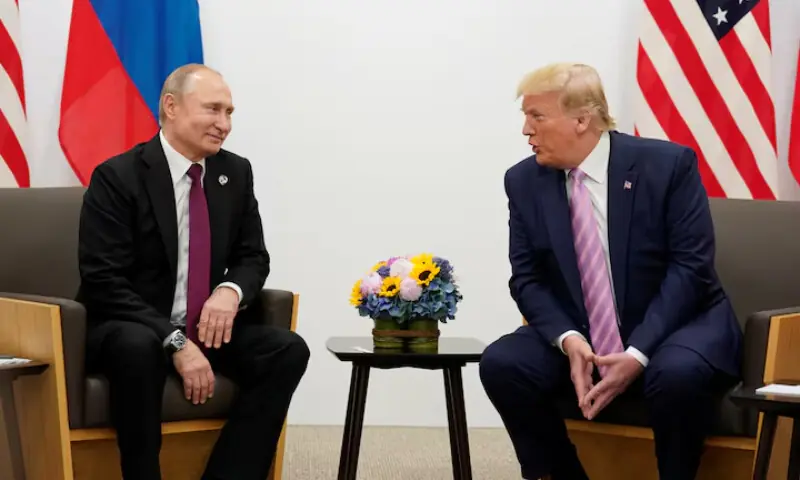
US President Donald Trump has invited Russian President Vladimir Putin to join a proposed “Board of Peace” that would oversee governance and reconstruction in postwar Gaza. The Kremlin confirmed the invitation on Monday, saying Moscow is seeking clarity from Washington on the scope and intent of the offer.
The idea, still light on detail, raises immediate questions about US diplomacy in the Middle East, Russia’s evolving role in the Gaza conflict, and whether a multinational oversight body can work in one of the world’s most politically charged territories. This article breaks down what we know so far, what remains unclear, and why the proposal has drawn global attention.
What is the Gaza “board of peace” proposed by Donald Trump?
The “Board of Peace” is described by the Trump administration as a governing and reconstruction body for Gaza once active hostilities end. While Washington has not yet released a formal framework, the board appears to intend to:
- Oversee postwar administration in Gaza
- Coordinate reconstruction of infrastructure and public services
- Provide a political mechanism to prevent renewed conflict
The proposal signals a move away from unilateral US management toward a more internationalized structure, at least in concept. Inviting Russia, a geopolitical rival with deep regional ties, underscores that shift.
Within the first 100 days of previous conflicts, similar international arrangements have struggled to gain traction. The novelty here lies in the explicit inclusion of Moscow at the leadership level rather than as a peripheral stakeholder.
Why was Vladimir Putin invited?
Russia’s diplomatic footprint in the Middle East
Russia has maintained working relationships with Israel, Iran, and several Palestinian factions, allowing it to position itself as a power broker rather than a partisan actor. From Washington’s perspective, including Moscow could:
- Lend broader international legitimacy to postwar governance
- Reduce the risk of Russian obstruction at the UN Security Council
- Signal a willingness to compartmentalize Middle East diplomacy from other US-Russia disputes
For the Kremlin, participation offers a chance to reassert relevance on the global stage at a time when relations with the West remain strained.
Strategic signaling by the Trump administration
Inviting Putin may also be a calculated political signal. Trump has long argued that engaging rivals directly can produce results where traditional alliances stall. Extending the invitation allows the White House to claim it is pursuing an “all-hands” approach to stabilizing Gaza, even as details remain sparse.
It also places the onus on Moscow. If Russia declines or sets conditions, Washington can argue it made a good-faith effort at inclusion.
What did the Kremlin say about the offer?
Kremlin spokesman Dmitry Peskov confirmed the invitation, telling journalists that President Putin had been asked to join the board and that Russia was seeking to “clarify all the nuances” with Washington.
That phrasing is diplomatic but noncommittal. It suggests Moscow is weighing
- The board’s legal authority
- Its relationship with existing Palestinian governance structures
- The extent of US influence over decision-making
Russia’s response also hints at concern over being seen as endorsing a US-led framework without clear international backing.
How would this affect Gaza’s postwar governance?
Overlapping authorities and unresolved questions
Any postwar arrangement in Gaza must contend with existing political realities, including:
- The role of the Palestinian leadership
- Security guarantees for Israel
- The influence of regional actors such as Egypt and Qatar
Adding a US-Russia-led board introduces another layer of authority. Without clear lines of responsibility, governance could become fragmented rather than stabilized.
Key questions still unanswered include:
- Who appoints board members, and for how long?
- Does the board have enforcement powers or advisory status?
- How are local Palestinian voices represented?
Risks of geopolitical gridlock
Including major powers with divergent interests carries obvious risks. If Washington and Moscow disagree on reconstruction priorities or security arrangements, decision-making could stall. Gaza’s recovery would then become hostage to broader geopolitical disputes.
Past international administrations in conflict zones show that consensus-driven bodies often struggle without a strong executive mandate.
Why does this matter for US–Russia relations?
The invitation comes at a moment when US-Russia relations are defined by competition rather than cooperation. Against that backdrop, the Gaza board proposal stands out as a rare point of potential engagement.
If accepted, it could:
- Create a narrow channel for US-Russia cooperation
- Reduce diplomatic friction over Middle East resolutions at the UN
- Test whether limited collaboration is still possible
If rejected, it would reinforce the narrative that even humanitarian and reconstruction efforts are now filtered through strategic rivalry.
How are other global players likely to respond?
Allies and regional stakeholders
US allies may greet the proposal cautiously. European governments have generally favored multilateral approaches but remain wary of legitimizing Russia’s leadership role in sensitive regions.
Regional actors will also scrutinize the plan. Countries like Egypt and Jordan, which border Gaza or manage refugee flows, may seek guarantees that their interests are not sidelined by great-power diplomacy.
The United Nations factor
Any durable governance arrangement in Gaza will likely require some form of UN endorsement. Russia’s inclusion could smooth that path, but only if the board aligns with existing international law frameworks.
What happens next?
For now, the Gaza “Board of Peace” remains more concept than concrete plan. The next steps to watch include:
- Formal clarification from Washington on the board’s mandate
- Russia’s decision to accept, reject, or condition its participation
- Reactions from Israel, Palestinian representatives, and regional governments
Until those pieces fall into place, the invitation itself is the story. It reflects an attempt by Donald Trump to reshape postwar Gaza governance through unconventional diplomacy, even if the outcome remains uncertain.
TL;DR
- Donald Trump has invited Vladimir Putin to join a proposed Gaza “Board of Peace.”
- The board aims to oversee governance and reconstruction in postwar Gaza.
- Russia has confirmed the invitation but wants clarity on its scope.
- The move could reshape Gaza’s recovery or deepen geopolitical tensions, depending on how it unfolds.