Quick Summary
North Carolina professor John Hutton has created a simple four-step system for drawing every US president and first lady, published in his new book with the White House Historical Association. By starting with an egg-shaped oval and adding features, outlines, hair, and shoulders, even beginners can create recognizable portraits. His method shows that drawing isn’t about talent—it’s about structure and practice.
Who is John Hutton?
John Hutton believes drawing isn’t a gift; it’s a process. The 64-year-old art history professor at Salem College in Winston-Salem, North Carolina, has spent decades studying portraits and perfecting a system that makes sketching America’s presidents and first ladies accessible to anyone, even complete beginners.
His method, laid out in his new book How to Draw the Presidents & First Ladies (published July 2025 by the White House Historical Association), breaks the complex task of portraiture into just four repeatable steps. The goal: make history personal, visual, and approachable.
What is Hutton’s four-step method?
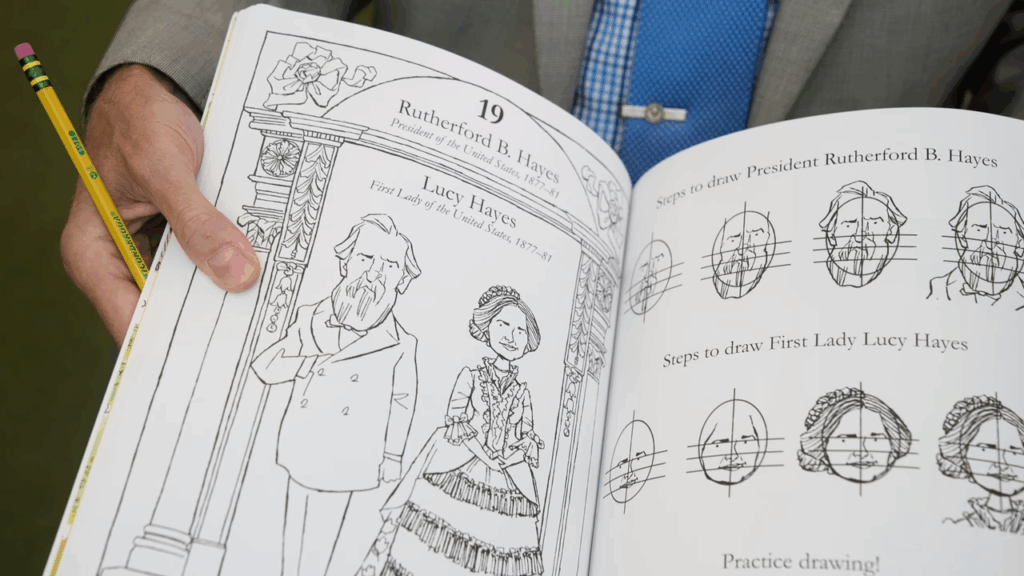
At its core, Hutton’s approach simplifies portraiture into patterns and shapes. Every drawing begins with the same foundation: an egg-shaped oval divided by guiding lines.
From there, he layers details in four steps:
- Facial features first
Nose, mouth, eyes, and eyebrows are drawn based on simple line patterns. - Outline of the face
The oval is refined into the unique contours of the subject’s head. - Hair or headwear
Hairstyles, wigs, or bonnets provide the strongest cues to era and identity. - Neck and shoulders
Adding a frame beneath the head grounds the portrait and gives it definition.
“Once you copy the shapes correctly, you’re halfway there,” Hutton explains. The method removes the intimidation of starting from scratch—students only need to follow patterns, not guess proportions.
Why does this method work?
Most people give up on drawing because they feel they “can’t make it look right.” Hutton argues the barrier isn’t talent but structure.
- Patterns build confidence: By supplying ready-made line guides, beginners skip the hardest part—figuring out where features go.
- Strong features = easier recognition: Presidents with distinct traits, like Abraham Lincoln’s beard or Donald Trump’s hair, are more instantly recognizable. A sketch doesn’t need to be perfect for the viewer to “get it.”
- Repetition develops skill: Because every portrait follows the same sequence, learners can improve quickly through practice.
An Associated Press reporter tested Hutton’s method, producing passable likenesses of George Washington and Jacqueline Kennedy on the first attempt—a strong proof of concept.
Who is John Hutton?
Hutton is more than a hobbyist with a knack for doodling. His credentials include:
- Education: Studied at Princeton, Harvard, and London’s Courtauld Institute of Art.
- Teaching career: Over 30 years as an art history professor at Salem College.
- Illustration work: Created award-winning children’s books for the White House Historical Association.
- Public engagement: Offers drawing lessons to children at the annual White House Easter Egg Roll.
He has been sketching since the age of three and still spends free time capturing landscapes and people. His interest in presidential portraits began when he illustrated an alphabet book for the Historical Association—a project that evolved into his newest guidebook.
Which presidents and first ladies are hardest to draw?
Not all historical figures translate equally well into sketches.
- Easiest: Those with bold, distinctive features—think George Washington’s powdered wig, Teddy Roosevelt’s glasses, or Jacqueline Kennedy’s iconic style. Recognition comes quickly, even with simple lines.
- Hardest: Figures with smaller, less defined features, such as Franklin Pierce, are a challenge. “Nobody knows who he is,” Hutton jokes, highlighting how public familiarity affects perception.
This insight reveals a broader truth: recognition plays as much a role in portrait drawing as technical accuracy.
Why does this book matter now?
Hutton’s book isn’t just a niche art manual. It sits at the intersection of history, education, and creativity.
- Civic learning through art: Drawing presidents can deepen students’ connection to American history.
- Accessibility: The step-by-step method empowers even self-proclaimed “non-artists.”
- Cultural preservation: By updating his earlier guide with new presidents and first ladies, Hutton ensures the visual record keeps pace with political history.
The White House Historical Association’s decision to publish it also signals an institutional commitment to blending art with civic education. For families, classrooms, or amateur artists, it’s a resource that makes history tangible.
How can readers apply this technique?
Even outside presidential portraits, Hutton’s system can help anyone improve their drawing:
- Use an egg-shaped frame for any face, celebrity or personal.
- Break down complex features into repeatable shapes.
- Practice recognition by sketching figures with distinct traits before tackling subtler ones.
Teachers could adapt the method for art or history lessons. Museums and cultural institutions could also integrate it into public workshops.