Federal authorities have launched one of the most visible anti-fentanyl operations in recent months, targeting drug trafficking networks operating around MacArthur Park in an effort officials say is aimed at dismantling open-air narcotics markets tied to gang activity and cartel-linked supply chains.
At the center of the operation is Mallaly Moreno-Lopez, a woman federal investigators describe as a “mid-level distributor” allegedly responsible for helping move fentanyl from cartel-connected suppliers into the streets of downtown Los Angeles.
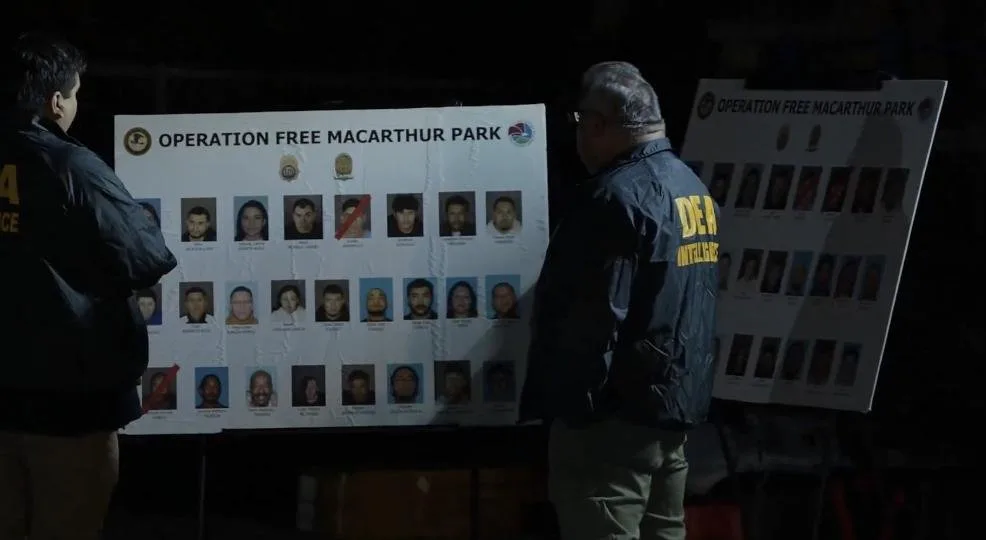
The operation, called “Operation Free MacArthur Park,” involved coordinated raids across Southern California, dozens of DEA agents, and the arrest of multiple suspects tied to fentanyl trafficking investigations.
The case highlights how federal authorities are increasingly focusing on the middle layers of fentanyl distribution networks — the people investigators believe connect international suppliers to local street dealers.
TL;DR
- DEA agents raided an apartment in South Los Angeles tied to Mallaly Moreno-Lopez.
- Authorities accuse her of acting as a mid-level fentanyl distributor connected to cartel supply chains.
- Officials say Moreno-Lopez and her boyfriend attempted to destroy fentanyl evidence during the raid.
- The operation led to multiple arrests and large fentanyl seizures across Southern California.
- MacArthur Park remains a major focus for law enforcement efforts targeting open-air drug markets.
- Moreno-Lopez has been charged federally and remains presumed innocent unless proven guilty.
What Was Operation Free MacArthur Park?
“Operation Free MacArthur Park” was a large-scale federal crackdown led by the Drug Enforcement Administration targeting fentanyl trafficking networks in Los Angeles.
The operation focused heavily on the MacArthur Park area, which has long been associated with gang activity, narcotics sales, and public safety concerns. Federal authorities say the goal was not just to arrest street-level dealers, but to disrupt the broader fentanyl supply chain operating in Southern California.
According to officials, the investigation included:
- Coordinated raids across multiple locations
- Federal drug trafficking charges against 25 individuals
- Major fentanyl seizures
- Arrests tied to alleged gang-linked distribution networks
By Wednesday afternoon, authorities said 19 suspects had already been arrested.
Who Is Mallaly Moreno-Lopez?
Federal investigators allege that Mallaly Moreno-Lopez played an important role in the fentanyl distribution chain operating near MacArthur Park.
Authorities claim she acted as a connector between Mexican cartel suppliers and local street-level dealers.
Officials have described her as a “mid-level distributor,” a category law enforcement often considers strategically important because these individuals allegedly help move drugs between high-volume suppliers and neighbourhood distribution networks.
Unlike cartel leaders or street dealers, mid-level distributors are often viewed by investigators as operational coordinators who help maintain supply flow and logistics.
Why mid-level distributors matter
Federal agencies increasingly target mid-level operators because:
- They allegedly manage local distribution systems
- They may oversee stash houses or transport operations
- They often connect multiple trafficking groups
- Their arrests can disrupt entire supply networks
Law enforcement experts frequently argue that removing these figures creates more operational instability than arresting low-level dealers alone.
What Happened During the DEA Raid?
On Wednesday morning, nearly two dozen DEA agents raided Moreno-Lopez’s apartment in South Los Angeles.
Authorities said the apartment featured a reinforced steel door that agents ultimately breached after Moreno-Lopez and her boyfriend, Jackson Tarfur, allegedly refused to exit the residence.
Video footage showing heavily armed federal agents entering the apartment spread quickly across social media platforms and news broadcasts, turning the raid into one of the most widely discussed law-enforcement operations of the week.
Allegations of destroyed evidence
Federal officials allege that Moreno-Lopez and Tarfur attempted to flush baggies of fentanyl down the toilet during the raid.
Authorities reportedly recovered narcotics despite the alleged effort to destroy evidence.
If prosecutors pursue obstruction-related allegations, those accusations could become significant during court proceedings because they may be presented as evidence of intent and awareness of criminal activity.
However, those allegations still need to be proven in court.
The MacArthur Park Fentanyl Problem
MacArthur Park has become one of Los Angeles’ most visible symbols of the city’s fentanyl crisis.
Local residents, business owners, and public officials have repeatedly raised concerns about:
- Open-air drug sales
- Homelessness
- Gang activity
- Public drug use
- Violent crime linked to narcotics trafficking
Federal authorities believe the neighbourhood serves as a key distribution point for fentanyl moving through Los Angeles.
The repeated focus on MacArthur Park in federal investigations suggests officials see the area as more than a localised street market. Investigators appear to believe it functions as part of a larger trafficking ecosystem connected to organised criminal groups.
The Alleged Gang and Cartel Connections
Federal investigators have also pointed to alleged gang-related ties surrounding the case.
According to reports, Moreno-Lopez’s mother was arrested earlier this year during a separate operation targeting alleged members of the 18th Street Gang.
Authorities say those investigations centered on narcotics operations tied to the MacArthur Park area.
While officials have not publicly outlined the full structure of the alleged trafficking network, investigators frequently describe fentanyl operations in Southern California as interconnected systems involving:
- Mexican cartel suppliers
- Local gang networks
- Independent distributors
- Street-level dealers
Breaking It Down: CJNG leadership questions
Some reports tied broader cartel discussions to the investigation, including references to the Jalisco New Generation Cartel, commonly known as CJNG.
However, readers should approach those claims carefully.
The mention of alleged cartel leadership changes — including references to “El Mencho” — appears separate from the federal complaint involving Moreno-Lopez and may not be directly tied to the Los Angeles case.
That distinction matters because cartel-related reporting often becomes blurred online, especially when multiple investigations overlap in public discussion.
Why Fentanyl Enforcement Has Become a National Priority
Fentanyl remains at the center of the U.S. overdose crisis.
The synthetic opioid is significantly more potent than heroin and is often mixed into counterfeit pills or other narcotics. Even small quantities can become lethal.
Federal agencies have dramatically expanded fentanyl enforcement efforts in recent years because of the drug’s role in overdose deaths nationwide.
Los Angeles has become a major battleground in those efforts due to:
- Its proximity to trafficking routes
- Dense urban distribution networks
- Existing gang infrastructure
- Large street-level narcotics markets
Operations like “Operation Free MacArthur Park” are designed to send a broader deterrence message while disrupting supply chains.
Still, critics of aggressive drug crackdowns argue that enforcement alone cannot solve addiction, homelessness, or demand for narcotics.
What Happens Next in the Case?
Mallaly Moreno-Lopez now faces federal drug trafficking charges.
Authorities have not yet publicly released full details regarding charges against Jackson Tarfur.
Both remain presumed innocent unless proven guilty in court.
Meanwhile, investigators say the broader operation remains active, meaning:
- Additional arrests are possible
- More narcotics seizures could occur
- Federal prosecutors may expand the case
- Further gang-related indictments may emerge
The investigation may also offer insight into how federal agencies plan to approach fentanyl enforcement in major American cities moving forward.