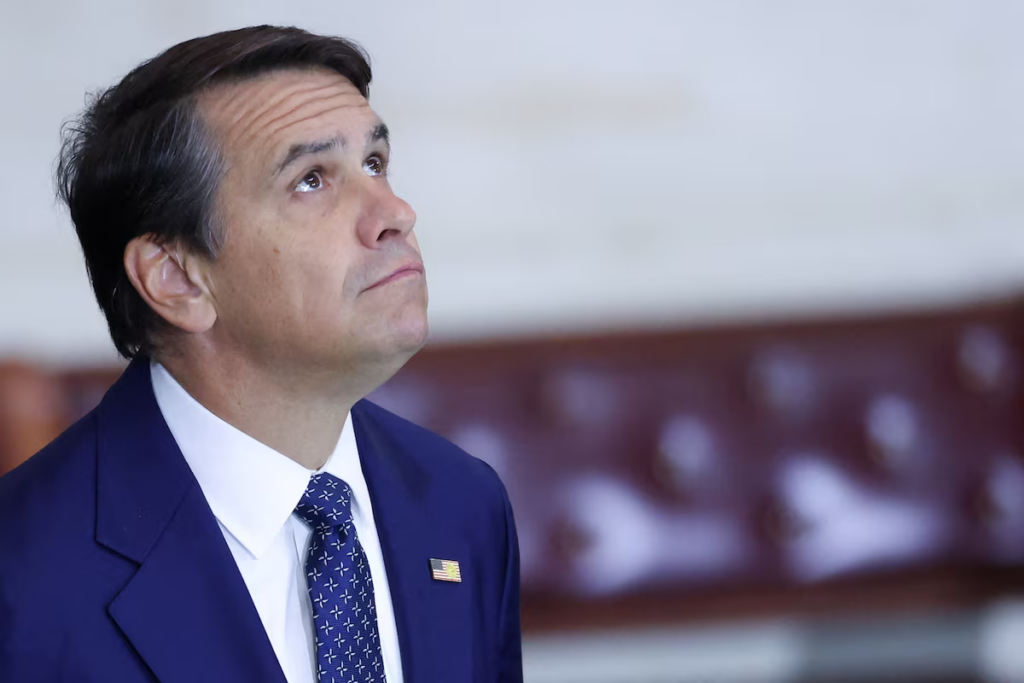
Todd Blanche has been confirmed as the next US attorney general, handing President Donald Trump a significant political victory as his former personal lawyer takes charge of the Justice Department.
The Senate approved Blanche’s nomination by a narrow margin on Friday, with Republicans Bill Cassidy, Susan Collins and Lisa Murkowski breaking ranks. Cassidy ultimately voted in favour, while Collins and Murkowski opposed the nomination. Democrats unanimously voted against him.
Blanche’s confirmation comes after weeks of uncertainty surrounding his nomination and growing concerns among lawmakers about the direction of the Justice Department under Trump.
A narrow path to confirmation
Blanche’s nomination faced resistance even within Trump’s Republican Party.
Cassidy became the deciding vote, arguing that while Todd Blanche was not a perfect choice, the alternative could be an acting attorney general who would be less effective at running the department under Trump.
Collins and Murkowski, however, concluded that Blanche’s record raised deeper concerns about the independence of the Justice Department.
Collins said the department had become increasingly politicised and argued that Todd Blanche had taken actions that further weakened its independence.
The $1.8 billion fund became a major obstacle
One of the biggest controversies surrounding Blanche’s nomination was a proposed $1.8 billion Justice Department fund described by critics as an “anti-weaponisation fund”.
Some Republican senators feared the arrangement could potentially benefit people involved in the January 6, 2021, Capitol riot. Murkowski said she was particularly concerned that once Todd Blanche was confirmed, the Senate would lose its leverage to stop the proposal.
Senators John Cornyn and Thom Tillis pushed Blanche to provide written assurances that the fund would not move forward and sought clarification over a separate agreement involving the Internal Revenue Service.
Those commitments helped secure enough Republican support for Blanche, although critics argued that the assurances did not provide a guarantee.
Epstein files controversy added pressure
Blanche also faced criticism over the Justice Department’s handling of files related to Jeffrey Epstein.
The department’s release of documents drew scrutiny after information that should have remained private was reportedly left unredacted, while other material was redacted in ways critics questioned.
During his confirmation process, Todd Blanche initially declined to personally meet with Epstein survivors before eventually agreeing to do so. The survivors later said the meeting provided few answers.
The controversy added another layer of scrutiny to an already contentious confirmation battle.
From Trump’s lawyer to America’s top law enforcement official
Blanche’s path to the attorney general’s office is unusual because of his close personal relationship with Trump.
He left a lucrative legal partnership in 2023 to represent Trump and became one of the president’s most trusted lawyers. He later moved into senior leadership at the Justice Department, eventually serving as acting attorney general.
That history has fueled concerns among Democrats and some Republicans about whether Todd Blanche can maintain the independence traditionally expected from the nation’s top law enforcement official.
Blanche has repeatedly defended his loyalty to Trump, describing his work for the president as one of the greatest honours of his career.
Justice Department faces accusations of politicisation.
Blanche’s confirmation comes as the Justice Department faces intense criticism over its treatment of Trump’s political opponents.
Under Blanche’s leadership, the department has pursued cases involving former FBI Director James Comey and New York Attorney General Letitia James, among others. Critics have argued that several of these cases appear politically motivated or legally weak.
The department has also faced controversy over efforts involving Democratic senators and Federal Reserve officials.
Meanwhile, several career Justice Department lawyers have departed, while federal judges have criticised government attorneys over representations made in court.
These developments have intensified a broader debate over whether the department is becoming more directly aligned with the White House.
What Blanche’s confirmation means for Trump
Blanche’s elevation gives Trump an attorney general with whom he already has a close working relationship.
That could make it easier for the administration to pursue its priorities on immigration, abortion, federal law enforcement and other politically sensitive issues.
For critics, however, the appointment raises the opposite concern: that the nation’s top law enforcement agency could become too closely tied to the president personally.
Blanche’s challenge will therefore extend beyond managing the Justice Department. He will also face the much larger question of whether he can convince lawmakers, career prosecutors and the public that the department can enforce federal law independently while carrying out the administration’s agenda.