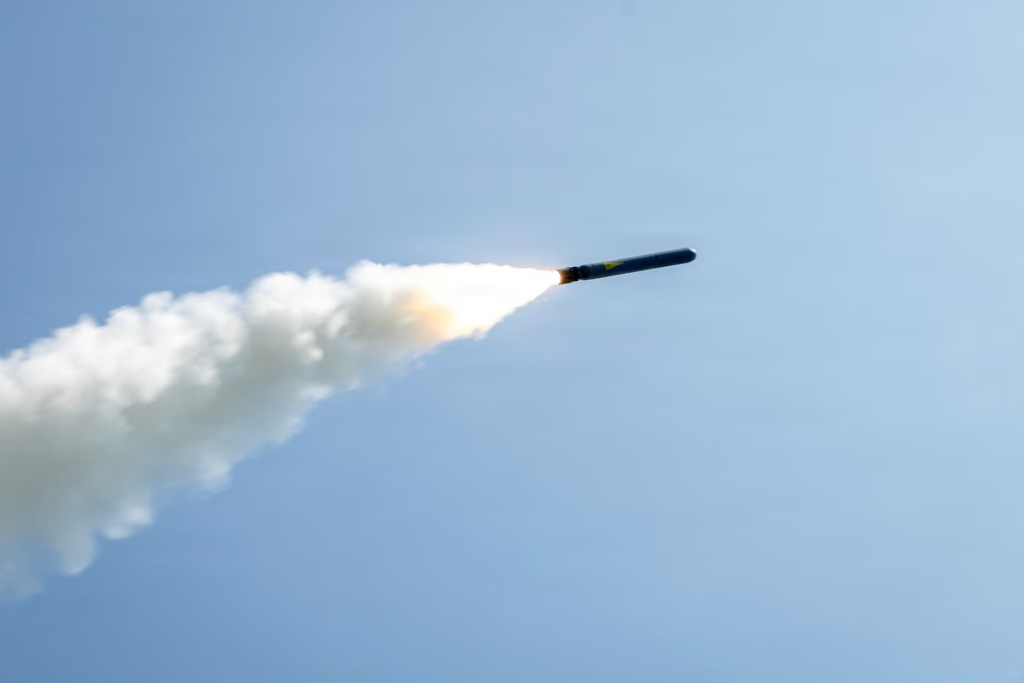
The United States is making a major push to rebuild its long-range strike arsenal, awarding Raytheon, an RTX business, a $22.9 billion, seven-year contract to expand production of Tomahawk cruise missiles dramatically.
The deal is designed to take annual Tomahawk production from roughly 60 missiles to more than 1,000, a more than 16-fold increase. The agreement comes as Washington seeks to replenish weapons inventories strained by transfers to allies and the use of precision munitions in recent military operations.
The scale of the contract reflects a broader shift in US defense planning: maintaining advanced weapons is no longer simply about having sophisticated systems. Washington increasingly wants the industrial capacity to produce them quickly and in large numbers.
Why is the US dramatically increasing Tomahawk production?
The immediate concern is ammunition stockpiles.
The United States has supplied substantial quantities of weapons to partners while also consuming precision-guided munitions in its own operations. Those demands have exposed a longstanding weakness in the US defense industrial base: some of the country’s most advanced weapons cannot be manufactured nearly as quickly as they can be used.
Tomahawk is one of the systems Washington now wants to scale up.
The Pentagon has been pursuing multiyear procurement arrangements that give defense companies more certainty about future demand. That, in turn, allows manufacturers to hire workers, expand facilities, secure suppliers and invest in machinery without worrying that orders will disappear after a single production cycle.
The Tomahawk contract is part of that broader effort.
How much will Tomahawk production increase?
The numbers are striking.
Raytheon currently produces approximately 60 Tomahawks per year, according to the company. Under the new arrangement, production is expected to exceed 1,000 annually.
That represents an increase of more than 16 times the current annual rate.
| Measure | Current level | Planned level |
|---|---|---|
| Annual Tomahawk production | ~60 | 1,000+ |
| Increase | — | More than 16-fold |
| Contract duration | — | 7 years |
| Contract value | — | $22.9 billion |
The production target does not mean 1,000 missiles will immediately roll off the assembly line every year. Expanding industrial capacity takes time, particularly when it involves specialised components, trained workers and suppliers.
RTX said in February that it was investing in Tomahawk production facilities in Tucson, Arizona, as part of a broader effort to expand missile manufacturing.
What is the Tomahawk missile?
The Tomahawk is a long-range, precision-guided cruise missile used primarily for attacks against targets on land.
Unlike a ballistic missile, which follows a high-arcing trajectory, a cruise missile flies through the atmosphere toward its target. Tomahawks are designed to navigate over long distances and can be launched from surface ships and submarines.
The US government describes the weapon as a combat-proven, long-range strike system capable of delivering a roughly 1,000-pound-class warhead at ranges exceeding 900 nautical miles.
RTX says newer Tomahawk variants can strike targets from around 1,000 miles away, including in heavily defended airspace. The company says the missile has been flight-tested more than 550 times and used operationally more than 2,300 times. (RTX)
That combination of range, precision and launch flexibility has made the Tomahawk an important component of the US military’s long-range strike capability.
Why does production capacity matter as much as the missile itself?
The new contract highlights a fundamental lesson from recent wars: weapons stockpiles can disappear faster than factories can replace them.
A military may possess highly capable missiles, but that advantage becomes harder to sustain if production is too slow to replenish weapons after they are fired.
The issue is particularly important for expensive precision weapons.
Building a modern missile requires a network of specialized suppliers producing guidance systems, propulsion components, electronics, warheads and other parts. Increasing output therefore requires more than simply adding another assembly line.
It can require:
- Expanding manufacturing facilities
- Hiring and training workers
- Increasing supplier capacity
- Purchasing additional specialized equipment
- Securing long-term orders
- Reducing production bottlenecks
- Maintaining quality control while output increases
The Pentagon’s multiyear contracting strategy is intended to give industry the confidence to make those investments.
Why is Washington using multiyear defense contracts?
Traditional defense procurement can create uncertainty for manufacturers.
A company may be asked to produce a small number of weapons in one year and substantially more the next. That makes it difficult to justify expensive investments in factories and equipment.
Multiyear contracts change the calculation.
By committing to larger purchases over several years, the government gives manufacturers greater visibility into future demand. Companies can then invest in capacity before the weapons are urgently needed.
RTX and the Department of War established a framework for expanding production of Tomahawk and several other critical missile systems in February 2026. That framework targeted annual production of more than 1,000 Tomahawks, at least 1,900 AMRAAM missiles and more than 500 SM-6 missiles.
The August contract turns the Tomahawk portion of that broader framework into a major seven-year agreement.
Is Tomahawk the only missile Washington is trying to produce faster?
No.
The production surge is much broader.
The US is simultaneously seeking to increase manufacturing of air-defense interceptors and other precision weapons.
Raytheon’s February agreements, for example, covered:
- Tomahawk
- AMRAAM
- SM-3 Block IB
- SM-3 Block IIA
- SM-6
The company said the agreements were designed to increase production capacity for weapons needed by the United States and its allies. (RTX)
The Pentagon has also pursued expanded production of Patriot and THAAD missile-defense components.
That broader approach reflects concern that a future major conflict could require the United States to expend large quantities of weapons over an extended period.
What does the contract mean for US military readiness?
The goal is not simply to put more missiles into warehouses.
It is to create a production system capable of replacing missiles at a much faster rate.
That matters for a military planning for conflicts in which precision weapons could be consumed rapidly.
A larger industrial base could provide the Pentagon with several advantages:
Larger stockpiles
More production allows the military to rebuild inventories depleted by combat or transfers to allies.
Faster replenishment
If weapons are being used faster than factories can replace them, stockpiles can fall quickly. Higher production rates reduce that gap.
Greater strategic flexibility
Large inventories can give military planners more options because they are less constrained by concerns about running out of particular weapons.
Stronger industrial resilience
More suppliers, workers and manufacturing capacity can reduce the impact of disruptions affecting a single factory or component.
How much has the US already invested in expanding missile production?
RTX said it made a $2.6 billion capital expenditure investment in 2025, with projects including expansion of facilities involved in producing critical missile systems.
The company has specifically been expanding Tomahawk production capacity in Tucson, Arizona.
That investment illustrates why the Pentagon is using long-term contracts: a company is more likely to spend billions expanding production when it knows the government intends to buy the resulting weapons over multiple years.
The strategy is effectively designed to turn defense procurement into a more predictable manufacturing business.
Why is the Tomahawk important for future conflicts?
The Tomahawk gives the US military a way to strike targets at long distances without immediately placing crewed aircraft over heavily defended territory.
It can be launched from ships and submarines, allowing US forces to position the weapons platform at sea while keeping the launch platform away from the target area.
That makes the missile particularly valuable in scenarios where air defenses could make conventional aircraft operations more difficult.
The system has also been used repeatedly in combat, giving US commanders decades of operational experience with the platform. The Department of Defense says more than 2,000 Tomahawk combat expenditures had occurred by the mid-2020s.
The latest production push therefore concerns an established weapon rather than an experimental system.
What does the $22.9 billion contract signal?
The size of the award sends a message beyond the Tomahawk program itself.
Washington is effectively betting that mass production will be as important to future military power as technological superiority.
For decades, the United States has maintained some of the world’s most advanced weapons. Recent conflicts, however, have demonstrated that sophisticated weapons can be consumed rapidly — and that replacing them can take years.
The Raytheon deal is an attempt to close that gap.
The immediate result will be a much larger Tomahawk production pipeline. The longer-term objective is more ambitious: build a US defense industry capable of producing advanced weapons at the speed and scale required for a prolonged conflict.
That is why a $22.9 billion missile contract is also an industrial-policy decision.
The Pentagon is not simply buying more Tomahawks.
It is buying the ability to make more of them.