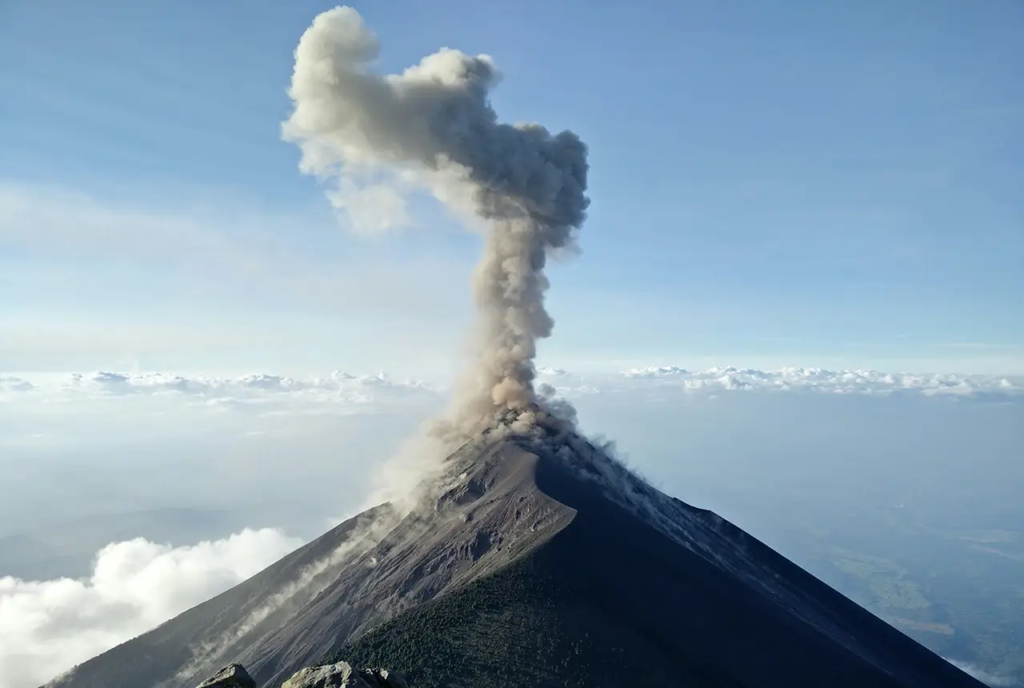
A colossal ancient volcanic system has been identified beneath eastern England, revealing that the region was once home to one of the most powerful eruptions in Earth’s geological history.
Scientists from the British Geological Survey (BGS) and the University of Oslo say the buried volcanic system lies beneath The Wash, off England’s east coast, and erupted about 454.4 million years ago during the Late Ordovician period.
The discovery was made by re-examining rock samples collected roughly 80 years ago from boreholes in Norfolk and Lincolnshire. Modern analysis of tiny zircon crystals inside those rocks allowed researchers to connect the material to a massive eruption whose ash spread across what is now northern and eastern Europe.
The findings provide a new picture of England’s geological past. They also reveal that the flat landscapes around The Wash conceal the remains of a gigantic volcanic system that has been inactive for hundreds of millions of years.
What was discovered beneath The Wash?
The volcanic system, described by researchers as the Wash supervolcano, is buried deep beneath The Wash and surrounding parts of eastern England.
There is no obvious volcano or crater visible at the surface today. Instead, scientists reconstructed its existence from geological material preserved underground.
Rock samples from boreholes at North Creake in Norfolk and Claxby in Lincolnshire were separated by about 65 kilometres. Researchers found that zircon crystals in the samples formed at essentially the same time, around 454.4 million years ago.
The findings suggest that both sites were connected to the same enormous volcanic system.
Researchers believe the volcanic structure may have included a huge caldera, a large depression formed when the ground collapses after a major eruption empties or disrupts an underlying magma system.
Suggested visual: Add a cross-section graphic showing modern eastern England above the buried volcanic system, with The Wash, Norfolk and Lincolnshire clearly labelled.
How powerful was the ancient eruption?
The eruption was enormous by any geological standard.
The British Geological Survey estimates that several hundred to as much as 1,000 cubic kilometres of Earth’s crustal material were blasted into the stratosphere during the eruption. BGS describes it as a super-Plinian eruption and places it among the largest eruptions known from the geological record.
Some media reports have compared the energy of the eruption with roughly one million nuclear bombs.
That comparison should be treated cautiously. The BGS itself uses a different comparison, describing the eruption as having a force equivalent to several thousand hydrogen bombs. The important point is not the exact bomb analogy but the sheer volume of material involved.
An eruption capable of ejecting hundreds of cubic kilometres of material would be vastly larger than the eruptions produced by most volcanoes humans have ever witnessed.
How did scientists discover a volcano that is 454 million years old?
The breakthrough came from old geological samples rather than a new excavation.
Scientists revisited material extracted decades ago from deep boreholes at North Creake in Norfolk and Claxby in Lincolnshire. The samples had been preserved in British Geological Survey archives.
During the COVID-19 lockdown, researchers turned to these existing samples and used modern analytical techniques that were not available when the material was originally collected.
They focused on zircon crystals, some roughly the width of a human hair.
These microscopic minerals are particularly useful to geologists because they can form within magma before an eruption. Uranium trapped inside zircon gradually decays into lead at a predictable rate, allowing scientists to calculate when the crystals formed.
The new measurements produced a remarkably precise age of about 454.4 million years.
That was the clue that connected the samples from Norfolk and Lincolnshire.
Where did the volcanic ash go?
The eruption did not simply leave material around what is now eastern England.
Scientists believe ash from the enormous eruption travelled across an ancient ocean and eventually settled across parts of what are now Scandinavia and the Baltic region.
One particularly important clue was the Kinnekulle tephra, a widespread layer of ancient volcanic ash found in Norway, Sweden, Belarus and Poland.
Researchers from the University of Oslo had previously analyzed material from this ash layer and obtained an almost identical age.
The chemical signatures also provide evidence supporting a connection between the Scandinavian ash and the volcanic rocks beneath eastern England.
The implication is striking: material produced by a volcano buried beneath The Wash today may have fallen onto the seafloor hundreds of millions of years ago across a large part of ancient Eurasia.
What was England like when the volcano erupted?
England looked nothing like it does today.
The eruption occurred during the Ordovician Period, roughly 454 million years ago. The land that would eventually become England was part of the Avalonian microcontinent and occupied a very different position on Earth.
An ocean separated Avalonia from Scandinavia.
The volcanic landscape would therefore have been part of a much broader geological setting involving ancient oceans, shifting continental fragments and active volcanic arcs. The BGS says the geography may have been comparable in some respects to volcanic regions around the western Pacific today.
Over hundreds of millions of years, plate movements, erosion and geological processes transformed the landscape.
The volcano disappeared from the surface, but its geological fingerprints remained underground.
Did the volcano erupt more than once?
The evidence suggests the volcanic system may have experienced more than one major eruption.
One of the samples contained younger zircon crystals dating to approximately 453.7 million years ago.
Researchers interpret these younger crystals as evidence of a further eruption associated with the collapse of the volcanic caldera.
That means the discovery is not necessarily the story of one isolated volcanic explosion.
Instead, scientists may be looking at the remains of a much larger magmatic system that was active over a period of geological time.
Could the volcano erupt again?
No.
Despite the alarming “supervolcano beneath England” headline, there is no present-day volcanic threat from this system.
The volcano is considered extinct and has been inactive for hundreds of millions of years.
British Geological Survey scientist Tim Pharaoh has emphasized that an extinct volcano cannot simply be reactivated in the way that certain geological faults can experience renewed movement.
“Once it’s gone extinct, that’s it,” Pharaoh said, according to reporting on the discovery.
So residents around The Wash, Norfolk and Lincolnshire have no reason to expect a volcanic eruption beneath their feet.
The volcano is a geological discovery, not a modern hazard.
Why does this discovery matter?
The significance of the discovery goes beyond the existence of an ancient volcano.
For geologists, volcanic rocks provide clues about how continents moved, how ancient oceans opened and closed, and how magma systems developed deep beneath Earth’s surface.
The new findings also help explain a volcanic ash layer that stretches across parts of northern Europe.
That gives scientists a geological marker that can potentially be used to correlate rocks and sediments across countries that are now separated by hundreds or thousands of miles.
The discovery also demonstrates the value of geological archives.
The crucial samples were not newly drilled for this project. They had been sitting in collections for decades, waiting for technology capable of extracting more information from them.
Why were the old rock samples so important?
The original samples were collected at a time when scientists could identify the broad geological characteristics of the rocks but could not determine their ages with the precision available today.
Modern uranium-lead dating of zircon changed that.
Instead of simply asking what type of volcanic rock the samples represented, researchers could establish when the crystals formed with much greater accuracy.
That precision allowed the Norfolk and Lincolnshire material to be compared with volcanic ash preserved in Scandinavia.
The pieces of the puzzle suddenly lined up.
It is a useful reminder that scientific discoveries do not always begin with a new expedition. Sometimes the breakthrough is hidden inside an old sample when researchers finally have the tools to read it.
Is this one of the world’s largest supervolcanoes?
The discovery places the Wash volcanic system among the major explosive volcanic events preserved in Earth’s geological record.
However, “supervolcano” is a term that can be misleading if interpreted as a single standardized measurement of size.
Scientists generally use the term for volcanic systems capable of producing exceptionally large explosive eruptions, often involving enormous volumes of erupted material.
The Wash eruption certainly qualifies as a colossal event by that standard, with BGS estimating hundreds to potentially 1,000 cubic kilometers of material expelled during its major eruption.
But comparisons with famous modern volcanic systems such as Yellowstone or Toba require care because scientists measure ancient eruptions using different geological evidence and classification methods.
What does the discovery tell us about England?
Perhaps the most fascinating part of the discovery is how little evidence of the volcano remains at the surface.
Today, the region around The Wash is dominated by low-lying landscapes and coastal environments.
There is no towering volcanic cone.
No lava field stretches across the countryside.
No obvious crater tells visitors that a gigantic eruption once occurred there.
Instead, the evidence is buried deep underground and preserved in microscopic minerals.
The discovery effectively gives England a geological backstory that was invisible from the surface.