
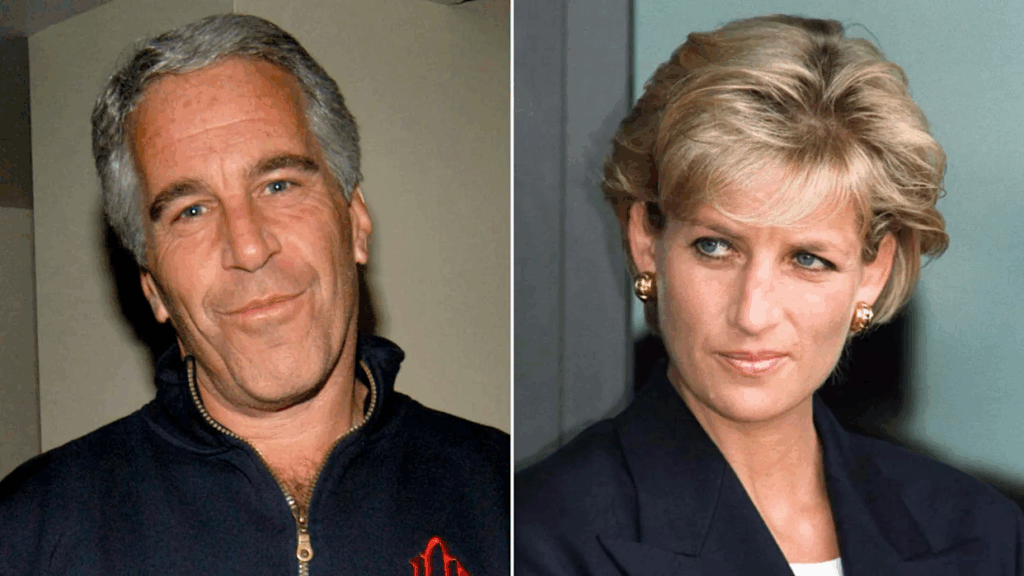
Ghislaine Maxwell, the imprisoned former associate of convicted sex offender Jeffrey Epstein, has made yet another shocking allegation. In newly released transcripts from a U.S. Department of Justice (DOJ) interview, Maxwell suggested that Epstein may have been introduced to Princess Diana through her close circle of friends in London. The claim—unverified and riddled with contradictions—has raised fresh questions about how far Epstein’s social reach extended, and whether this is part of Maxwell’s attempt to rewrite her legacy.
What exactly did Ghislaine Maxwell claim?
According to DOJ transcripts released on Friday, Maxwell told Deputy Attorney General Todd Blanche that Epstein “met and knew some truly fancy people” in London, including individuals close to Diana. She specifically named Rosa Monckton, one of Diana’s best friends, as someone who may have organized a meeting between the late Princess and Epstein.
Maxwell went so far as to suggest the possibility that Diana had been “set up as a date” for Epstein. But her own words were inconsistent:
- She admitted she was unsure if Epstein had ever actually met Diana.
- She offered no date, place, or corroborating detail.
- Her timeline referenced the early 2000s, despite Diana’s tragic death occurring in August 1997.
This contradiction casts doubt on the credibility of the statement and whether it was made as speculation rather than fact.
Why does Maxwell’s claim matter now?
Maxwell is serving a 20-year sentence in Texas for her role in Epstein’s sexual exploitation of minors. From behind bars, she has continued to make controversial statements, including appeals for a presidential pardon.
This new claim matters for three reasons:
- Public fascination with Diana: Princess Diana’s legacy continues to draw global attention, and any suggestion of her being linked—even distantly—to Epstein is bound to spark headlines.
- Epstein’s network: The billionaire cultivated relationships with powerful figures worldwide. Maxwell’s claim, if true, would suggest that his reach extended even into Diana’s intimate social circle.
- Maxwell’s credibility: Her contradictory recollections raise the question of whether she is seeking relevance or leverage by invoking Diana’s name.
Was there ever a connection between Epstein and Princess Diana?
As of now, there is no verified evidence that Jeffrey Epstein and Princess Diana ever met.
- Diana was closely associated with Rosa Monckton, a businesswoman who married journalist Dominic Lawson. Monckton has never publicly spoken about Epstein.
- Epstein, meanwhile, did maintain ties with prominent figures in London during the 1980s and 1990s. He was known for cultivating relationships with politicians, journalists, and aristocrats.
The lack of photographic proof, documented meetings, or public records makes it unlikely that Diana was directly connected to Epstein. Maxwell’s vague testimony seems to hinge more on speculation than fact.
A timeline problem
- Diana died in Paris in August 1997.
- Maxwell referenced “early 2000s” events in her DOJ interview.
- Epstein’s notoriety rose sharply in the 2000s, well after Diana’s death.
This fundamental discrepancy undermines the plausibility of Maxwell’s story.
Why might Maxwell bring up Diana’s name?
Observers note that Maxwell’s statements could serve several purposes:
- Relevance in prison life: High-profile remarks keep her in the media spotlight.
- Distraction from her own crimes: By invoking Diana’s name, Maxwell shifts public discussion away from her conviction.
- Potential leverage for clemency: She has previously appealed to Donald Trump for a pardon, and controversial revelations might be part of a broader strategy.
What do experts say about such claims?
Historians and royal commentators often caution against sensationalist narratives tying Diana to scandal after her death. Without documentary evidence, Maxwell’s remarks fall into the realm of speculation rather than history.
Legal experts also warn that Maxwell’s statements should not be taken at face value. Incarcerated individuals seeking reduced sentences or pardons sometimes exaggerate or distort details to gain attention.
Why the public should approach this claim with skepticism
There are three main reasons why Maxwell’s claim should be treated with caution:
- Lack of corroboration: No independent source has verified a meeting between Diana and Epstein.
- Inconsistent timeline: Maxwell’s version of events does not align with Diana’s life history.
- Possible motive: Maxwell has an incentive to remain in the public eye as her appeals for clemency continue.
The bigger picture: Epstein’s network of power
Even without Diana, Epstein’s network was vast and troubling. He was connected to:
- Business magnates like Leslie Wexner.
- Politicians including former U.S. presidents Bill Clinton and Donald Trump.
- Academics and scientists whom he funded through donations.
Conclusion: A sensational claim without substance
Maxwell’s suggestion that Jeffrey Epstein may have been “set up on a date” with Princess Diana makes for sensational headlines but lacks credible evidence. With contradictions in her timeline and no supporting documentation, the claim seems more like an attempt to exploit Diana’s enduring global fame than a revelation of truth.
For now, history records Princess Diana’s legacy as one of compassion, charity, and human connection—not as a figure in Epstein’s scandalous world.