
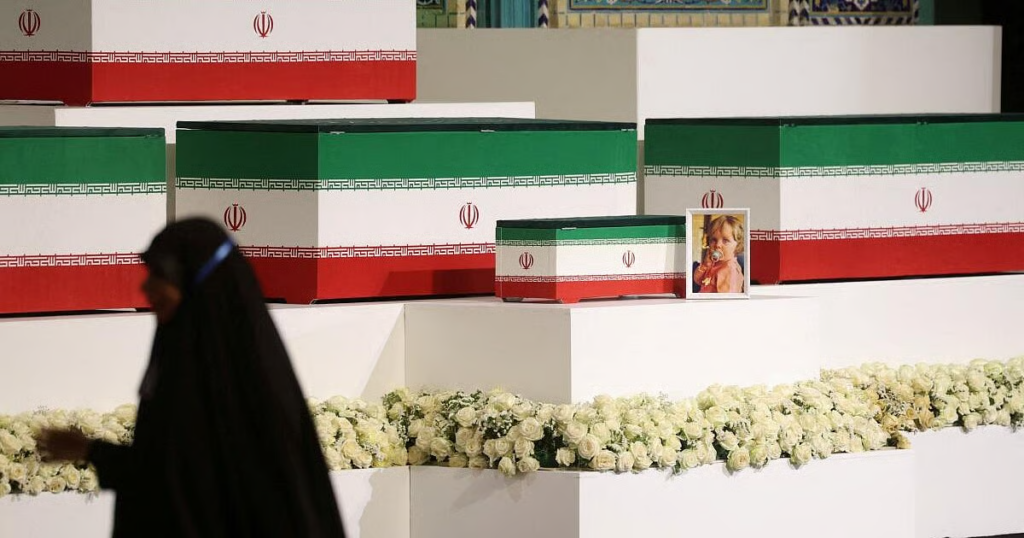
Iran’s state funeral for former Supreme Leader Ayatollah Ali Khamenei has become far more than a burial ceremony. Stretching across multiple cities and several days, the procession is being presented by Iranian authorities as both a religious tribute and a national display of remembrance.
One of the most symbolic moments came when Khamenei’s coffin was reportedly taken to the location in Tehran where Iranian officials say he was killed in a joint US-Israeli strike earlier this year. While such a step is not a formal Islamic funeral requirement, it reflects Iran’s emphasis on martyrdom and collective remembrance.
Here’s why the coffin was taken to the site of his death, what the funeral schedule looks like, and why Iran’s new supreme leader is expected to stay away from the ceremonies.
Why was Ali Khamenei’s coffin taken to the place where he died?
According to Iran’s state broadcaster, the coffin carrying Ali Khamenei’s body was transported to the location where Iranian authorities say he was killed during a joint US-Israeli airstrike on February 28.
Officials say the attack struck his residential compound on Jomhouri Street in central Tehran.
Following the strike, Iranian authorities established a temporary devotional site known as Ravagh Keshvardoust, allowing mourners to gather and pay tribute.
A symbolic act rooted in martyrdom
Taking a coffin to the place where a person died is not a standard Islamic funeral ritual.
Instead, the decision appears rooted in Iran’s broader religious and political tradition surrounding martyrdom.
Iranian leaders describe Khamenei as a martyr who died defending the nation. Returning his coffin to the site of his death reinforces that narrative, connecting the physical location with public remembrance and national identity.
For many Twelver Shia Muslims, Khamenei was not only Iran’s political leader but also a Marja-i Taqlid, one of the highest religious authorities within Shia Islam.
What is the full funeral schedule?
Iran has planned a multi-stage funeral spanning several cities and countries.
July 4 to July 6: Public viewing in Tehran
The coffin remains at Imam Khomeini Grand Mosalla in Tehran, where members of the public can pay their respects.
Thousands of mourners have gathered throughout the viewing period, with authorities expecting millions to participate overall.
July 6: Major funeral procession
A large public procession is scheduled along a roughly 10-kilometer route stretching from Imam Hossein Square to Azadi Square.
The event is expected to become the largest public gathering of the funeral.
July 7: Procession in Qom
The coffin will travel to Qom, one of Shia Islam’s holiest cities.
The planned route includes:
- Shrine of Fatima Masumeh
- Jamkaran Mosque
Both sites hold major religious significance for Shia Muslims.
Ceremonies in Iraq
Following events inside Iran, the coffin is expected to be transported to Iraq for additional ceremonies in the Shiite holy cities of:
- Najaf
- Karbala
These cities are among the most sacred destinations in Shia Islam and frequently host important religious commemorations.
Final burial in Mashhad
The final stage of the funeral takes place in Mashhad, Khamenei’s hometown.
According to Iranian officials, he will be buried inside the Imam Reza Shrine, fulfilling what authorities describe as his final wish.
Why is Mojtaba Khamenei skipping the funeral?
Iran’s new Supreme Leader, Mojtaba Khamenei, is reportedly not expected to appear during the public funeral ceremonies.
According to Ayatollah Hakim Elahi, who represents the current Iranian leadership in India, the decision is based primarily on security concerns.
Officials reportedly fear that any public appearance could expose the new leader to surveillance or potential attacks.
Reports also note that Mojtaba has maintained an extremely low public profile since succeeding his father and has reportedly avoided other high-profile public events.
Why is this funeral significant?
State funerals for Iranian supreme leaders carry religious, political and symbolic importance.
Beyond honoring the deceased, they are often intended to demonstrate:
- National unity
- Religious continuity
- Political stability
- Public support for the Islamic Republic
Iranian authorities expect attendance to surpass the estimated 10.2 million people who reportedly participated in the 1989 funeral of Ayatollah Ruhollah Khomeini, though independent verification of crowd figures is difficult.
What happens after the funeral?
Once the burial in Mashhad is complete, Iran is expected to shift its focus toward the country’s political transition under Mojtaba Khamenei.
The funeral also serves as an opportunity for Iranian leaders to receive foreign delegations and reinforce diplomatic ties with countries maintaining relations with Tehran.
How the new leadership balances domestic expectations, regional tensions and international pressure will likely shape Iran’s political trajectory in the months ahead.
TL;DR
- Iran reportedly took Ali Khamenei’s coffin to the site where officials say he was killed.
- The move is symbolic rather than a formal Islamic funeral practice.
- Authorities describe Khamenei as a martyr whose death should be commemorated at the location where it occurred.
- Funeral events span Tehran, Qom, Iraq’s Shiite holy cities and Mashhad.
- Iran’s new Supreme Leader, Mojtaba Khamenei, is reportedly skipping public ceremonies because of security concerns.