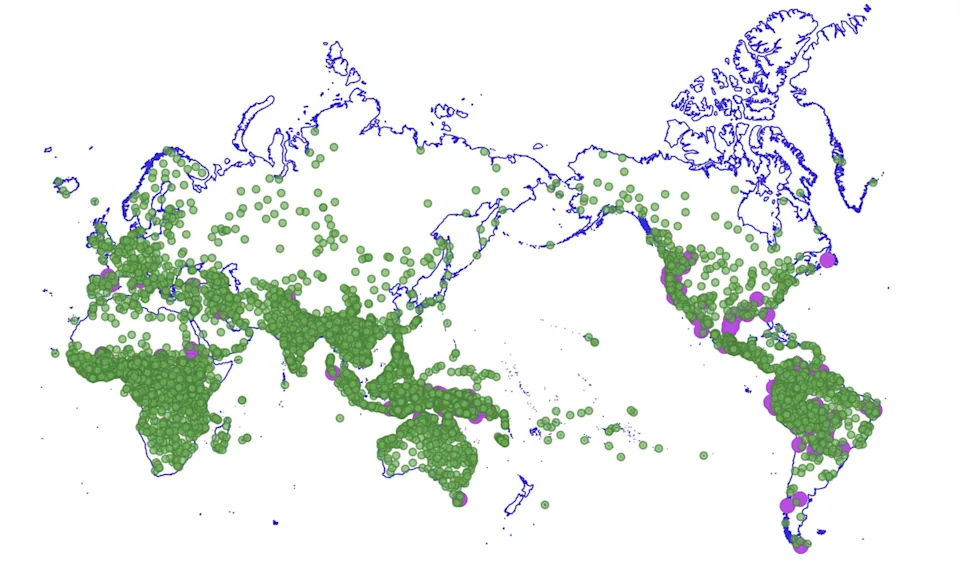
Humanity may once have spoken far more languages than exist today, according to a new study published in Science. Researchers estimate that the number of spoken and signed languages may have reached as many as 20,000 to 75,000 during a period of exceptional linguistic diversity before the expansion of large empires dramatically reduced the world’s language variety.
The study argues that agriculture initially encouraged languages to multiply by creating isolated farming communities. It was only later—through the rise of centralized states, empires, and expanding trade networks—that many of those languages gradually disappeared.
The findings offer a new perspective on how human societies evolved and why thousands of languages have been lost over time.
What Did the Study Find?
Using computer modelling, population estimates, and ethnographic data, researchers reconstructed how language diversity may have changed throughout the Holocene—the geological epoch that began around 11,700 years ago.
Their analysis suggests that:
- During the Early Holocene, roughly 12,000 years ago, Earth may have been home to between 4,500 and 6,200 languages despite having a global population of only about five million people.
- As agriculture spread between approximately 10,000 and 3,000 years ago, populations grew and settled into permanent communities.
- These relatively isolated settlements allowed languages to diverge over generations, increasing linguistic diversity.
- The study estimates that global language diversity may have peaked sometime between about 1000 BCE and 1000 CE, with between 20,000 and 75,000 spoken and signed languages.
The researchers emphasise that these figures are model-based estimates rather than direct historical counts, as many ancient languages left no written record.
How Did Agriculture Create More Languages?
Agriculture is often associated with the rise of large civilisations, but the study suggests its earliest effect was the opposite.
As farming spread:
- Communities became more permanent.
- Populations expanded.
- Villages remained geographically separated.
- Local dialects gradually evolved into distinct languages.
Over centuries, limited interaction between neighbouring communities allowed speech patterns to diverge, producing new languages.
Rather than reducing diversity, early agriculture appears to have created favourable conditions for linguistic expansion.
When Did Language Diversity Begin to Decline?
According to the study, the first major decline in language diversity began with the emergence of powerful centralised states.
As empires expanded, dominant languages became essential for:
- Government administration.
- Trade.
- Military service.
- Education.
- Legal systems.
Smaller regional languages were increasingly replaced or absorbed as communities adopted languages that offered political or economic advantages.
How Did Empires Change Human Speech?
The researchers argue that empires—not colonialism alone—created the first major bottleneck in global language diversity.
Examples include:
- The Roman Empire, where Latin spread across much of Europe and later evolved into Romance languages such as Spanish, French, Italian, Portuguese, and Romanian.
- Han China, where political consolidation encouraged the spread of standardised forms of Chinese.
- Expanding Arab-Islamic states, which promoted Arabic across large parts of the Middle East and North Africa.
As these larger political systems grew, many smaller languages disappeared without ever being documented.
Why Have So Many Languages Disappeared?
The study concludes that language loss was driven primarily by social and political change rather than by a decline in humanity’s ability to create new languages.
Factors contributing to language extinction include:
- Expansion of empires.
- Migration.
- Urbanization.
- Colonialism.
- Global trade.
- National education systems.
- Cultural assimilation.
A language typically disappears when younger generations stop learning and using it in everyday life.
Along with language, communities may also lose oral histories, traditions, ecological knowledge, and cultural identity preserved through generations.
How Many Languages Exist Today?
Today, linguists estimate that approximately 7,500 spoken and signed languages remain worldwide.
Many of these languages are endangered, with some spoken by only a few dozen or a few hundred people.
Organisations and Indigenous communities around the world are working to document, preserve, and revitalise endangered languages before they disappear.
Why This Matters
Language is more than a means of communication—it preserves history, culture, identity, and knowledge accumulated over generations.
If the study’s estimates are accurate, humanity has already lost the overwhelming majority of the languages that once existed.
The findings also challenge the traditional view that agriculture inevitably reduced cultural diversity, suggesting it initially fuelled one of the greatest periods of linguistic expansion in human history before political centralisation reversed the trend.
The Bottom Line
A new study published in Science suggests humanity may once have spoken tens of thousands more languages than exist today. Researchers argue that early agriculture encouraged language diversification as isolated farming communities developed, while later political consolidation, empires, and globalisation drove a long-term decline in linguistic diversity. Although the exact numbers are estimates based on modelling, the research offers a new framework for understanding how human societies shaped—and sometimes erased—the world’s rich linguistic heritage.
TL;DR
- A new Science study suggests Earth may once have been home to between 20,000 and 75,000 languages.
- Researchers say agriculture initially increased language diversity by creating isolated communities.
- The first major decline in language diversity likely began with the rise of large empires.
- Later, colonialism, globalisation, and standardised education accelerated language loss.
- Today, approximately 7,500 spoken and signed languages remain worldwide.