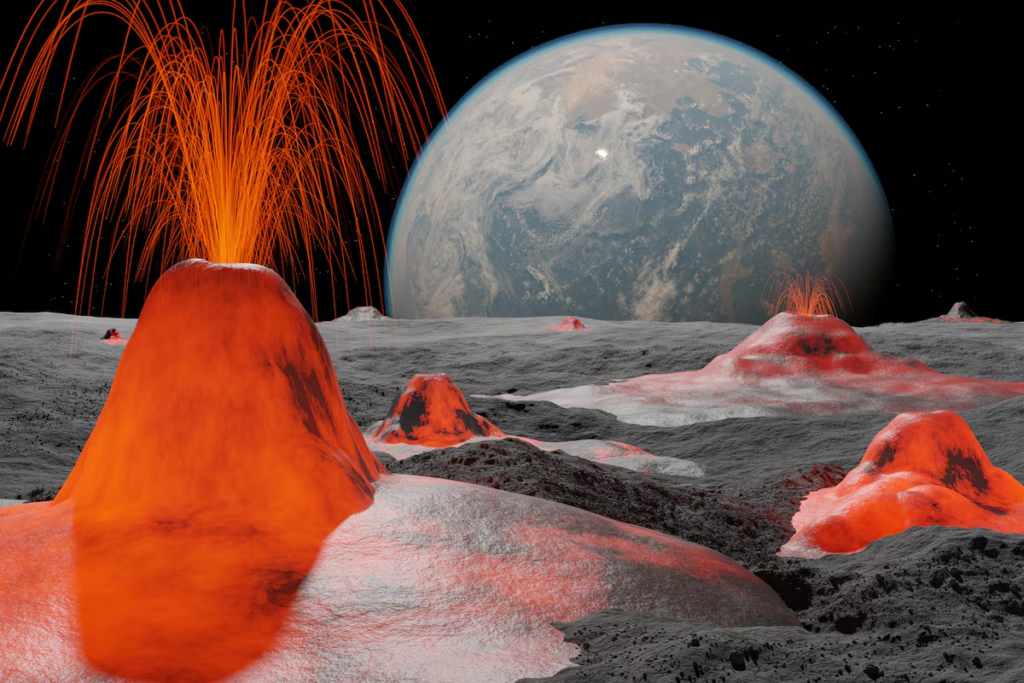
For decades, scientists have believed that the Moon formed after a planetary body called Theia collided with the young Earth roughly 4.5 billion years ago. The enormous impact blasted material into space, creating a disk of hot rock and debris that eventually came together to form Earth’s natural satellite.
But a new study suggests that the Moon’s formation may have happened far faster than previously thought.
Researchers from the Southwest Research Institute (SwRI) and the University of Arizona used high-resolution computer simulations to revisit the giant-impact theory. In some of their simulations, an intact Moon emerged in about five hours after the collision.
The finding does not mean scientists have established that the Moon definitely formed in five hours. Rather, the simulations show that a rapid formation scenario is physically possible under certain conditions.
How could the Moon form so quickly?
The leading explanation for the Moon’s origin is the giant-impact hypothesis.
According to this model, a Mars-sized protoplanet called Theia struck the early Earth when the Solar System was still taking shape. The collision released enormous amounts of energy and sent material from Earth and Theia into orbit.
Over time, that material became gravitationally bound and eventually formed the Moon.
Earlier computer models generally portrayed the colliding bodies as behaving more like fluids during the impact. Those models often produced a disk of debris that would require considerably more time to evolve into the Moon.
The new study took a different approach.
Researchers incorporated the material strength of the rocks involved in the collision rather than treating the planetary bodies simply as fluid-like masses.
That change produced a striking result.
In one simulation using the same basic parameters as earlier impact models—including comparable temperature structures inside Earth and Theia—an intact Moon appeared within approximately five hours.
Why does temperature matter?
The researchers say the temperature of Earth and Theia before the collision played an important role in determining what happened to the material after impact.
A hotter planetary body behaves differently from a colder, stronger one during an enormous collision.
The simulations therefore considered not only the amount of material involved but also its physical state and strength.
Dr. Adeene Denton, who worked on the study, explained that when the researchers used the same parameters as the earlier impact modeling, including equal temperature structures inside the two bodies, an intact Moon emerged in roughly five hours.
That result suggests that assumptions about the physical properties of the colliding worlds can substantially alter the predicted outcome of a giant impact.
What did earlier models miss?
One of the key differences between the new simulations and earlier work is the treatment of material strength.
Planetary rocks are not simply liquids. They can resist deformation, fracture and respond differently to extreme forces depending on their physical properties.
The researchers found that this strength can influence how material behaves during a planetary collision.
Denton noted that material strength is already important when scientists model collisions involving smaller bodies such as asteroids. The same principle had also been explored in previous research concerning the formation of the Pluto–Charon system.
Applying it to the Moon-forming impact produced a different picture of how quickly lunar material could come together.
Does this prove the Moon formed in five hours?
No.
This is an important distinction.
The study shows that a Moon-sized body can emerge rapidly in certain computer simulations. It does not establish that the real Moon necessarily completed its formation within five hours.
The actual Moon-forming collision occurred billions of years ago, and scientists cannot directly observe the event.
Instead, researchers compare computer simulations with evidence preserved in lunar rocks, Earth rocks and the chemical and physical characteristics of the Earth-Moon system.
The five-hour result is therefore best understood as evidence that the Moon’s formation may have been considerably more rapid than some traditional models suggested.
What does the study tell scientists about the Moon’s composition?
The speed of lunar formation matters because it could influence what material ultimately became part of the Moon.
The Moon and Earth share striking compositional similarities. Scientists have long tried to explain why the two bodies have such closely related chemical signatures despite the Moon being created through a catastrophic collision.
A rapid formation process could help researchers investigate how material from Earth and Theia was distributed during and immediately after the impact.
The simulations may also provide clues about the amount of volatile material—substances that can evaporate relatively easily under high temperatures—that could have survived the collision and remained in the developing Moon.
Understanding those processes could help scientists explain why the Moon looks the way it does today.
Why are Earth and Moon so chemically similar?
The similarity between Earth and the Moon is one of the biggest clues in the search for the Moon’s origin.
Under a simple version of the giant-impact scenario, scientists might expect the Moon to contain a substantial amount of material from Theia and therefore have a noticeably different chemical composition from Earth.
Instead, lunar samples show remarkable similarities with Earth’s material.
One explanation is that Earth and Theia formed relatively close to one another from material with similar chemical characteristics.
In other words, the two bodies may have originated from broadly similar regions of the young Solar System’s protoplanetary disk.
The contrast with Mars is useful here.
Earth and Mars have substantially different compositions, suggesting that the two planets incorporated material from different regions as they formed.
That makes the Earth-Moon chemical relationship an important piece of evidence in reconstructing the early Solar System.
Why does the Moon’s formation time matter?
Determining how quickly the Moon formed is not simply a question of adding an interesting number to the history of the Solar System.
The timescale affects how scientists understand the physical processes that followed the giant impact.
A rapid formation could influence:
- How Earth and Theia’s material was mixed
- How much material remained in orbit around Earth
- How volatile elements were retained or lost
- How the Moon’s early interior developed
- How the Moon’s composition relates to Earth’s
- How quickly the young Moon separated from the surrounding debris
The study therefore offers a new way to test different versions of the giant-impact hypothesis.
Could the Moon really have appeared almost immediately?
The answer may depend on what scientists mean by “formed.”
The Moon did not necessarily become the fully evolved world we see today within five hours.
The simulations instead indicate that a recognizable, gravitationally bound lunar body could emerge extremely quickly following the impact.
Its subsequent evolution—including cooling, differentiation and the development of its early crust and interior—would have continued for a much longer period.
That distinction is crucial.
The study is about the initial assembly of the Moon, not the completion of every geological process that transformed the young lunar body into the Moon we know today.
What happens next?
The new simulations give scientists another model to compare against geological and chemical evidence from the Moon.
Researchers can test whether rapidly assembled Moon scenarios better reproduce observations such as lunar composition, orbital characteristics and the distribution of material expected from the giant impact.
If they do, the five-hour formation scenario could become an important part of the scientific debate over the Moon’s origins.
If other evidence points toward a slower process, the simulations will still be valuable because they show how strongly the outcome depends on assumptions about temperature, material strength and the physical behavior of planetary bodies.
Either way, the study reinforces a larger lesson about the early Solar System: planetary formation was not necessarily a slow, orderly process.
Some of its most important worlds may have taken shape through violent collisions—and, at least according to these simulations, some of those transformations could have happened astonishingly fast.
The bigger picture: Earth’s Moon may have formed differently than we imagined
The giant-impact hypothesis remains the leading framework for explaining the Moon’s origin, but the details of that collision are still being investigated.
The new research does not overturn the basic idea that Theia collided with the young Earth. Instead, it challenges assumptions about what happened immediately afterward.
By accounting for the strength and temperature of planetary material, scientists found that the Moon could potentially assemble much sooner than earlier models indicated.
That makes the Moon’s origin an even more intriguing scientific puzzle—and suggests that the first few hours after Earth’s most consequential collision may have been far more important than previously understood.