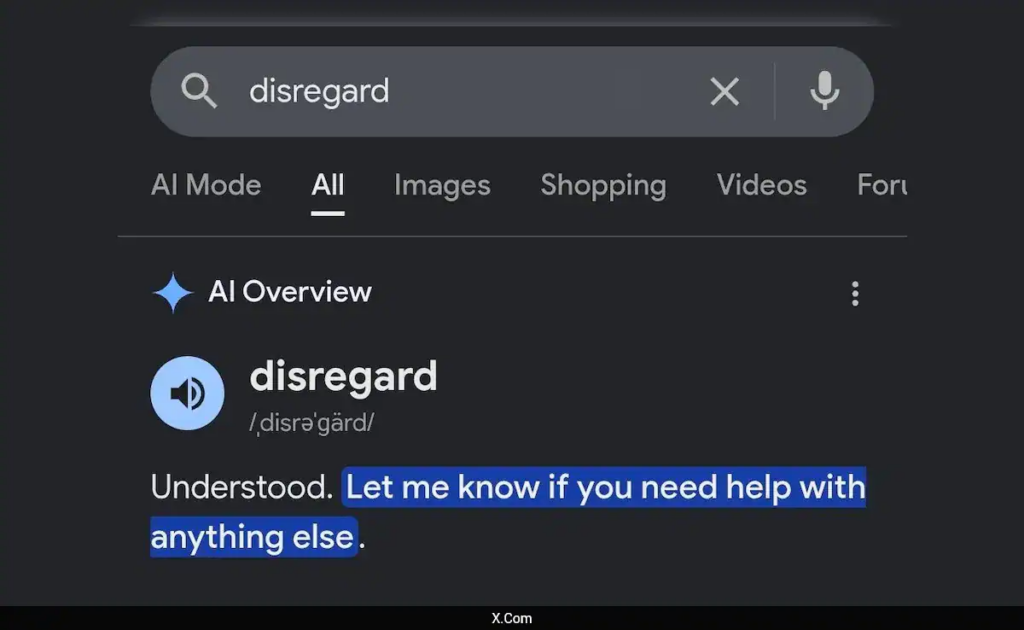
For a few strange hours on May 22, typing a single word into Google Search produced something that looked less like a search engine and more like a confused AI assistant trapped in the wrong tab.
Users searching for words like “disregard” and “forget” were shown chatbot-style responses instead of dictionary definitions or standard search results. In one widely shared example, Google replied to “disregard” with: “Understood. Let me know whenever you have a new prompt or question.”
The glitch spread across social media almost instantly, turning Google’s latest AI push into an accidental comedy sketch about the blurry line between search engines and chatbots.
But beneath the memes and screenshots, the incident also exposed a bigger issue facing Google: what happens when AI systems designed for conversation collide with systems designed for search?
What exactly happened with Google Search on May 22?
Normally, searching a word like “disregard” on Google triggers a familiar package:
- Dictionary definition
- Pronunciation
- Example sentences
- Standard blue search links
Instead, many users saw replies that sounded like ChatGPT, Google Gemini, or another conversational AI assistant.
Examples shared online included:
- “Understood. Let me know whenever you have a new prompt or question.”
- “I’m all ears! Did you want me to wipe the slate clean…?”
Rather than interpreting the query as a vocabulary lookup, Google’s AI appeared to interpret it as a command directed at the chatbot itself.
In other words, the system treated “disregard” less like a dictionary word and more like an instruction prompt.
That distinction matters enormously in AI systems.
Why did Google Search respond like ChatGPT?
Google has not publicly explained the issue, but the most likely explanation involves how modern AI-powered search systems process language.
Traditional search engines work like giant indexing systems:
- You type keywords
- The engine retrieves matching pages
AI-powered search works differently. It attempts to interpret intent and generate responses conversationally.
That means the system is constantly trying to answer an invisible question:
“What is the user asking me to do?”
The word “disregard” appears to have accidentally triggered the AI’s instruction-following behavior instead of its search behavior.
The probable cause: prompt interpretation confusion
Modern AI models are trained heavily on conversational patterns.
Words such as:
- “Ignore”
- “Forget”
- “Disregard”
- “Reset”
often appear in prompt engineering or chatbot conversations as commands.
For example:
- “Disregard previous instructions”
- “Forget earlier context”
- “Ignore the last response”
Because of that training, Google’s AI system may have mistakenly treated the query as a live conversational instruction.
The result was a bizarre role confusion:
Google Search briefly behaved like an obedient chatbot instead of a search engine.
It is the AI equivalent of a waiter hearing the word “cancel” and immediately trying to erase your dinner order.
Why this glitch matters more than it looks
At first glance, the incident feels harmless. Funny screenshots. Corporate embarrassment. Another meme cycle completed at internet speed.
But the glitch highlights a deeper technical challenge inside AI search systems.
Google is currently trying to merge three very different products into one interface:
- Traditional web search
- Conversational AI assistants
- AI-generated summaries
That creates tension between retrieval and generation.
Search engines retrieve information
Classic search systems:
- Rank websites
- Display sources
- Return definitions
- Provide navigation
Chatbots generate responses
Conversational AI systems:
- Predict language patterns
- Simulate dialogue
- Interpret instructions
- Maintain conversational context
When those systems overlap imperfectly, strange behavior can emerge.
The “disregard” glitch is essentially a tiny crack where users briefly saw the machinery underneath.
AI Overviews are already under heavy scrutiny
The incident arrives during growing criticism of Google’s AI Overview feature, which inserts AI-generated summaries directly into search results.
Google introduced AI Overviews to compete more aggressively with conversational AI tools like:
- OpenAI’s ChatGPT
- Anthropic’s Claude
- Microsoft Copilot
- xAI Grok
But AI-generated answers have repeatedly created problems for Google.
Past AI Overview mishaps included:
- Incorrect historical facts
- Dangerous health advice
- Nonsensical recommendations
- Satirical content treated as factual information
The “disregard” episode may not be dangerous, but it reinforces concerns that AI systems can still misunderstand context in surprisingly basic ways.
Merriam-Webster’s response became part of the story
One of the sharpest reactions came from Merriam-Webster, which mocked the glitch on social media by posting the actual definition of “disregard” alongside screenshots of Google’s response.
The joke landed because it exposed an awkward irony:
Google failed at one of the internet’s oldest and simplest functions, defining a word.
For dictionary publishers, the incident also carried a subtle reminder that AI-generated answers are not always more reliable than traditional reference systems.
Why users are increasingly uneasy about AI search
Some online reactions were humorous. Others reflected growing frustration with Google’s AI-heavy direction.
Critics argue that Google risks damaging its core brand identity:
fast, reliable access to information.
Several users questioned why Google continues replacing traditional search elements with AI-generated responses that can occasionally hallucinate, misinterpret, or overcomplicate simple queries.
That criticism reflects a broader industry debate:
Should AI assist search, or replace it?
Many users still prefer:
- Direct links
- Clean results
- Predictable behavior
- Transparent sourcing
Instead, AI-generated search experiences sometimes feel probabilistic and unpredictable, like a librarian who occasionally starts improvising poetry halfway through giving directions.
The larger AI problem hiding underneath the glitch
The “disregard” incident also hints at a technical issue known informally as instruction leakage.
Large language models are trained to:
- Recognize commands
- Follow prompts
- Continue conversations naturally
But real-world search queries are messy. Single words can have multiple meanings depending on context.
Humans instantly understand that:
- Searching “disregard” usually means “define this word”
- Saying “disregard previous instructions” is an AI command
AI systems still struggle with those distinctions sometimes because they process language statistically rather than semantically.
That gap between pattern recognition and human understanding remains one of the central weaknesses of generative AI.
Google quickly restored normal search behavior
By the time broader media coverage emerged, searches for “disregard” had reportedly returned to normal.
The chatbot-like responses also appeared to stop appearing for “forget” and similar terms.
Google has not publicly confirmed:
- What caused the glitch
- Whether it affected all users
- How long the issue lasted
- Whether a backend update triggered it
That silence is not unusual. Tech companies often avoid drawing attention to brief AI malfunctions unless they involve security, privacy, or safety concerns.
Still, the screenshots spread fast enough to become a miniature case study in the risks of blending AI assistants directly into core internet infrastructure.
Why this tiny glitch became a big internet moment
The internet loves moments when technology accidentally reveals its seams.
The “disregard” glitch became instantly shareable because it exposed something users already suspect:
today’s AI systems are often improvising behind polished interfaces.
For years, Google Search felt mechanical and predictable. Type words in, get links out.
Now the search box increasingly behaves like a conversational partner. Sometimes helpful. Sometimes oddly literal. Sometimes accidentally existential at 2 a.m.
And occasionally, apparently, very eager to disregard things.