As questions swirl around the health of Iran’s new Supreme Leader, a newly released video of Mojtaba Khamenei has done little to settle the debate. Instead, it has opened a new front in the information war surrounding the ongoing Iran conflict.
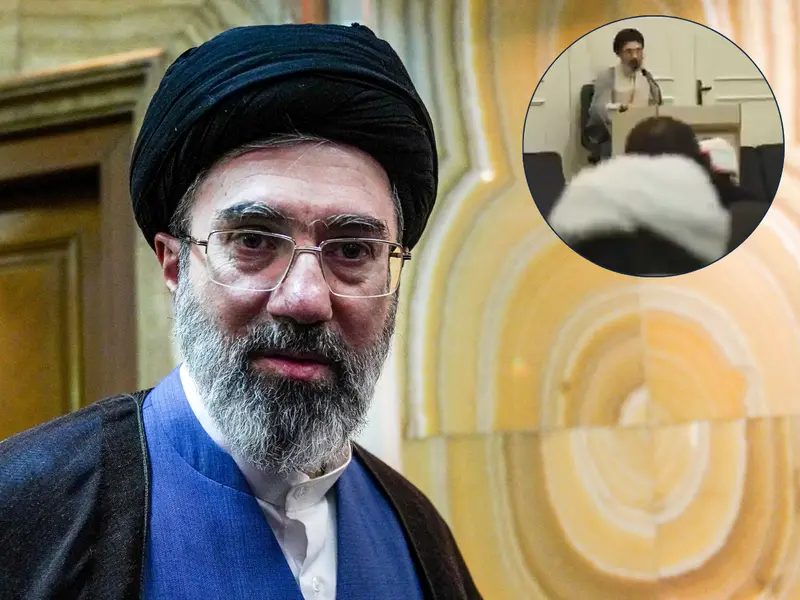
On day 21 of the war, Iran’s state broadcaster, Islamic Republic of Iran Broadcasting (IRIB), aired footage purportedly showing Khamenei teaching religious studies. The timing was no accident. It came amid claims from U.S. officials that he had been seriously injured, possibly disfigured.
But instead of closing the case, the video has fueled skepticism online and raised deeper questions about credibility, propaganda, and the fog of war.
What does the Mojtaba Khamenei video actually show?
The footage presents a calm, controlled scene.
A carefully staged academic setting
Khamenei appears seated in traditional clerical attire, addressing a small group of students in what looks like a religious classroom. His demeanor is composed, his speech measured.
Why the details matter
At face value, the video aims to signal continuity and stability. A leader teaching theology projects authority rooted in tradition.
But viewers quickly zeroed in on technical flaws:
- Low resolution and heavy pixelation
- Lack of clear timestamps or contextual markers
- No independent verification of when the video was recorded
These gaps have led many to suspect the footage may be archival rather than recent.
Why are people questioning the authenticity?
The skepticism didn’t emerge in a vacuum. It’s rooted in conflicting claims from multiple governments and the broader dynamics of wartime messaging.
Conflicting intelligence claims
Earlier, U.S. officials, including intelligence leadership, suggested Khamenei had been seriously injured during a chaotic strike. Vice President JD Vance acknowledged uncertainty, saying details remained unclear.
Meanwhile, Defense Secretary Pete Hegseth went further, describing the Iranian leader as “wounded and likely disfigured.”
On the Iranian side, statements have been more controlled. Officials have acknowledged injuries but insist Khamenei is “safe and sound.”
The credibility gap
This creates a classic credibility vacuum:
- U.S. claims lack publicly verifiable evidence
- Iranian responses rely on state-controlled media
- Independent observers have limited access
In such an environment, even authentic material struggles to gain trust.
How information warfare is shaping the narrative
The controversy around the Mojtaba Khamenei video reflects a broader reality: modern conflicts are fought as much with narratives as with weapons.
Competing narratives from key players
- Benjamin Netanyahu has openly questioned Khamenei’s visibility, suggesting instability within Iran’s leadership.
- Israeli officials have signaled a willingness to target senior Iranian figures, increasing pressure on Tehran to demonstrate leadership continuity.
- Iranian state media is working to project normalcy and resilience.
Each side has a strategic incentive:
- Iran wants to show control and continuity
- Israel wants to highlight weakness and fragmentation
- The U.S. seeks to shape global perception of the conflict’s trajectory
When “proof” becomes performance
“Proof of life” videos have long been used in conflicts. But in the age of deepfakes and AI-generated media, the bar for credibility is much higher.
A grainy clip that might have sufficed a decade ago now invites forensic scrutiny from millions of viewers in real time.
Is Mojtaba Khamenei injured?
The short answer: it remains unclear.
What we know
- U.S. officials have publicly claimed he was injured
- Iranian-linked sources have acknowledged injuries but downplayed the severity
- No independently verified visual evidence confirms his current condition
What we don’t know
- The exact timing of the video released by IRIB
- Whether Khamenei has appeared publicly in a verifiable, real-time setting
- The extent of any injuries
This uncertainty is not unusual in wartime. Information is often incomplete, delayed, or intentionally shaped.
Why the Mojtaba Khamenei video matters
At first glance, this might seem like a niche question about one individual. It’s not.
Leadership visibility is strategic
In centralized systems like Iran’s, the Supreme Leader is more than a political figure. He is a symbol of continuity.
Any doubt about his condition can:
- Affect internal morale
- Influence military decision-making
- Shape international perceptions of stability
Markets and geopolitics react to uncertainty
Uncertainty around leadership can ripple outward:
- Oil markets may react to perceived instability in Iran
- Regional actors may adjust their strategies
- Diplomatic calculations shift when leadership continuity is in doubt
The Netanyahu factor: pressure and perception
Benjamin Netanyahu has played a significant role in amplifying questions about Iran’s leadership.
Strategic ambiguity
Netanyahu has avoided detailing operational plans while making pointed remarks about Iranian leadership vulnerabilities.
His statement that he wouldn’t “issue life insurance policies” for adversaries underscores a broader strategy: keep opponents guessing while projecting strength.
A mirror effect
Interestingly, similar rumors have circulated about Netanyahu himself, with online users questioning videos released by Israel.
This symmetry highlights a key feature of modern conflicts:
distrust spreads in all directions.
What should readers take away?
The Mojtaba Khamenei video is less about what it shows and more about what it represents.
Key takeaways
- The footage has not definitively proven Khamenei’s current condition
- Conflicting claims from the U.S., Iran, and Israel reflect strategic messaging
- Public trust in visual evidence is eroding in the digital age
- Leadership visibility plays a critical role in wartime perception
TL;DR
- Iran released a video of Mojtaba Khamenei teaching to counter injury rumors
- The footage is being questioned as possibly archival
- U.S. and Israeli officials continue to cast doubt on his condition
- The situation highlights the growing role of information warfare in modern conflicts