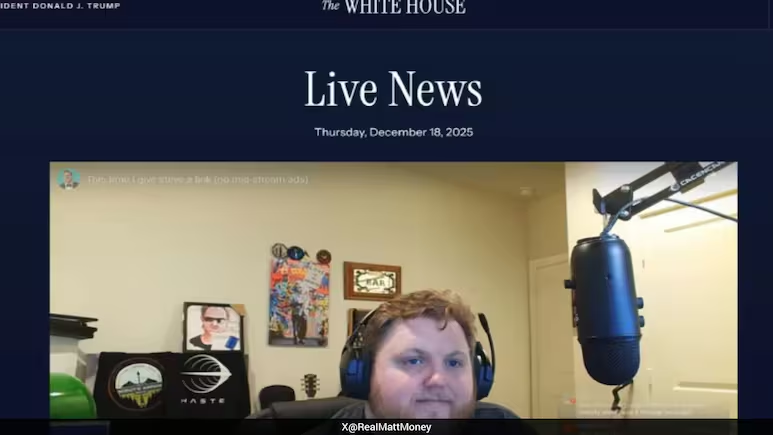
For about an hour late Thursday night, visitors to the White House website saw something unexpected in the Live News section. Instead of an official briefing or government feed, a YouTube livestream about investing appeared and disappeared in short bursts. The clip belonged to a little-known creator who later said he had no idea how his content ended up on one of the most closely watched government websites in the world.
The White House has confirmed it is investigating the incident. What remains unclear is how a private YouTube stream made its way onto a federal platform, and what the episode says about digital security, content controls, and public trust in official online spaces.
The incident has since become a talking point across tech, media, and political circles, raising a simple but unsettling question: how does something like this even happen?
What exactly happened on the White House website?
Shortly before midnight on Thursday, the Live News section of the White House website began showing a video stream that did not originate from any government agency. The feed appeared intermittently for roughly an hour before disappearing.
According to a White House official who spoke on condition of anonymity, the administration is aware of the incident and is reviewing what caused it. As of publication, officials have not said whether the appearance was due to a cyber intrusion, a misconfigured feed, or an internal posting error.
What is clear is that the video was not authorized content.
Where the video appeared
The placement matters. The Live News section is typically reserved for:
- Presidential remarks and press briefings
- Official White House livestreams
- Curated feeds tied to government events
This is not an open or user-generated space. That fact alone has fueled concern among cybersecurity experts and media observers.
Who is the YouTuber behind the stream?
The video belonged to @RealMattMoney, a YouTube account run by 34-year-old Matt Farley. Farley works as a petroleum engineer in Texas and hosts livestreams focused on investing and personal finance.
On his YouTube profile, Farley describes himself as:
- “A shepherd for individual investors”
- “An engineer enthusiastic about providing energy to the world”
In a phone call with Bloomberg News, Farley confirmed that the video was his and said he was as surprised as anyone to see it on the White House site.
“I have no idea how I got there,” he said, adding that he only learned about the situation after receiving messages from others who had spotted the feed.
Farley also joked on social media that he would have dressed differently had he known his stream would briefly appear on an official government website.
A political footnote
Farley told Bloomberg that he is a fan of President Donald Trump, though there is no indication that politics played any role in the incident. The stream itself reportedly focused on investments and casual discussion with other creators, not political commentary.
Was this a hack or a technical mistake?
At this stage, officials have not said whether the appearance of the YouTuber video on the White House website was the result of a hack or an accidental post. Both possibilities carry different implications.
If it was a hack
A cyber intrusion would raise serious concerns about:
- Access controls on government content management systems
- Third-party integrations used for livestreaming
- The potential for more malicious content to be displayed
While there is no evidence so far that classified systems were involved, even a minor breach of a public-facing site can undermine confidence in digital safeguards.
For context, the White House has dealt with cyber incidents before. In 2014, attackers believed to be linked to Russia penetrated unclassified White House computer networks, according to reporting by the Washington Post. That breach prompted major upgrades to federal cybersecurity practices.
If it were human error
An accidental posting or misconfigured feed would point to a different problem: process failure.
Possible explanations include:
- A wrongly embedded livestream URL
- A test environment bleeding into a live page
- An internal content scheduling error
While less alarming than a hack, this scenario still raises questions about review procedures and safeguards designed to prevent unauthorized content from going live.
Why the timing raised eyebrows
The episode occurred on the same day the Senate voted to confirm Ethan Klein as the US chief technology officer. While there is no established connection between the two events, the coincidence has not gone unnoticed.
The role of the US CTO includes advising the president on technology policy, innovation, and digital infrastructure. An incident involving the White House website, even a minor one, underscores how visible and unforgiving the digital environment can be.
Why this incident matters beyond the viral moment
At first glance, the YouTuber video on the White House website might seem like a harmless glitch, more amusing than alarming. But its implications go deeper.
Trust in official digital spaces
Government websites are trusted sources of information. When unexpected or unofficial content appears, even briefly, it can:
- Create confusion about what is real and authorized
- Fuel misinformation narratives
- Undermine public confidence in official communications
In an era when fake screenshots and doctored videos already spread quickly, authenticity matters more than ever.
The challenge of modern web infrastructure
Many government sites rely on complex systems that integrate:
- Third-party video platforms
- Cloud hosting services
- Automated publishing tools
Each layer introduces potential points of failure. Incidents like this highlight the tension between modernizing digital services and maintaining strict control over public-facing content.
How rare is something like this?
Public-facing government websites do experience technical hiccups, but unauthorized third-party video feeds appearing on official pages are uncommon.
Most past incidents fall into one of three categories:
- Temporary defacements by hackers
- Broken links or outdated embeds
- Test content accidentally left live
What makes this case unusual is the prominence of the site involved and the complete lack of clarity, so far, about how the video was sourced.
What happens next in the investigation?
The White House has not released details about its review process, but investigations like this typically involve:
- Auditing access logs and publishing histories
- Reviewing third-party service integrations
- Checking for signs of unauthorized access
If the cause is determined to be a technical error, officials may quietly update internal procedures. If a security issue is found, a more formal disclosure could follow, depending on severity.
TL;DR: a small glitch with big questions
- A YouTuber’s investment livestream briefly appeared on the White House website’s Live News section.
- The creator, Matt Farley, says he has no idea how it happened.
- The White House is investigating and has not said whether it was a hack or an error.
- While no harm has been reported, the incident highlights ongoing challenges in securing and managing official digital platforms.