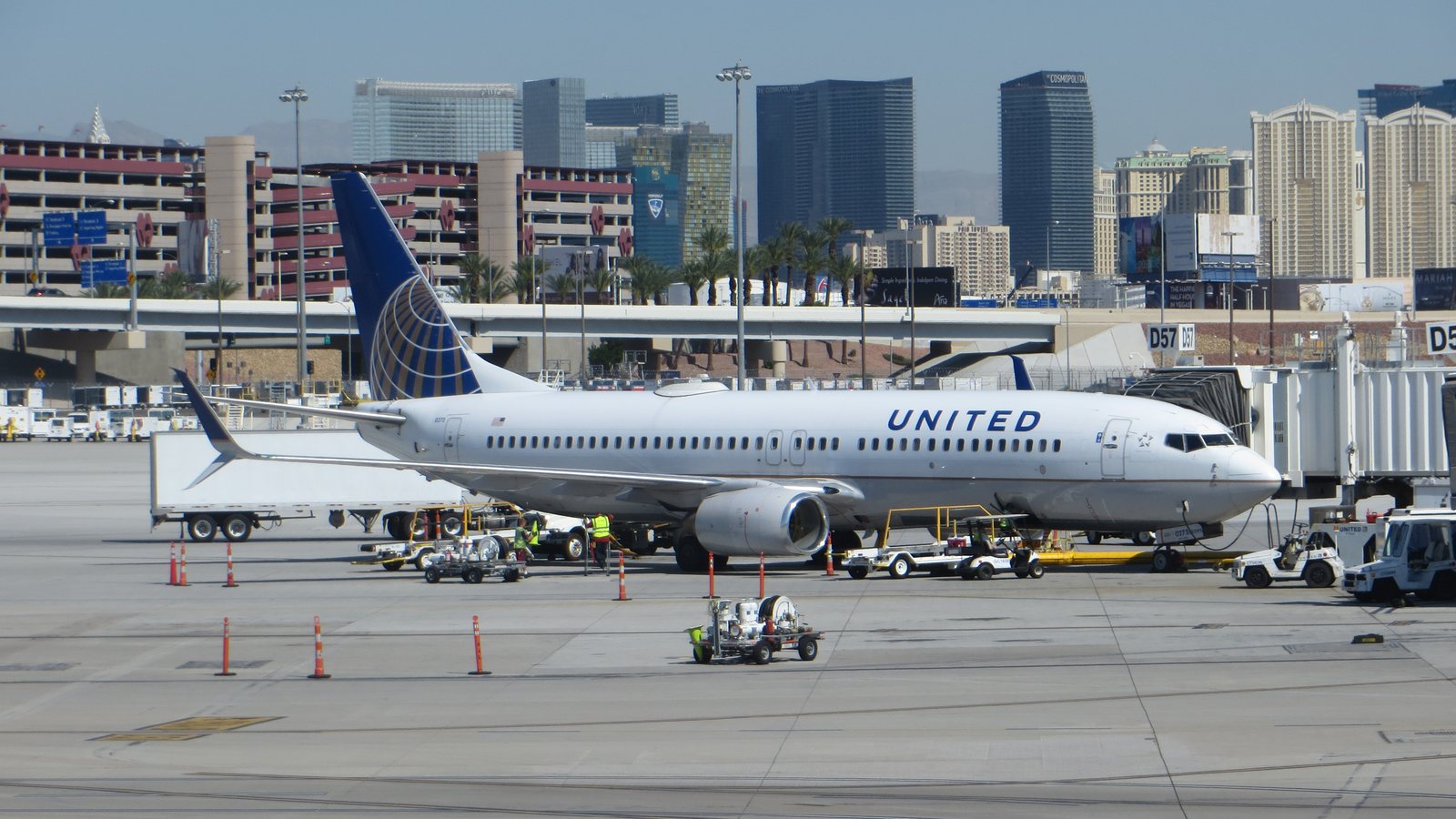
United Flight 1681 from Las Vegas to Newark turned back late Saturday, October 24. A flight attendant had reportedly seen a passenger texting that he was going to hijack the plane. Las Vegas police arrested a 25-year-old man after landing and charged him under Nevada’s terrorism-threat law.
The cockpit audio suggests the passenger had no idea anyone saw the message. So can a private text be a crime? Under Nevada law it can, but prosecutors have to prove what he intended.
What the cockpit audio says happened
The Boeing 737 carried 150 passengers and six crew members, United said. It took off from Harry Reid International Airport at 10:37 p.m. and reached the Arizona border before looping back. It landed in Las Vegas at 11:42 p.m., according to FlightAware data cited by the Las Vegas Review-Journal.
Nexstar station KLAS reported the crew’s radio call from audio posted online. A member of the cockpit crew told air traffic control what had happened.
“The passenger does not know anything is going on,” the crew member said. “The flight attendant saw him texting that he was going to hijack the aircraft. They called me, we went into lockdown, and we returned to Vegas.”
Because the man was unaware, the crew had no need to restrain him. That let the pilots keep the cockpit sealed and land without a fight in the cabin. Crews take that door seriously: a Flydubai captain recently survived an attack in his cockpit mid-flight.
The jet also came back heavy. The crew declared an emergency and warned controllers it might need all of Runway 26L, Simple Flying reported. The 737 cannot dump fuel, so an early return means landing well above its normal weight.
The arrest and the Nevada charge
United has not confirmed what the text said. Asked about the cockpit audio, the airline said the flight “safely returned to Las Vegas to address a potential security concern.”
An airport spokesman said the flight “turned around shortly after takeoff due to a passenger disturbance.” He added: “No injuries were reported.”
Las Vegas Metropolitan Police officers met the plane and arrested Dante Milne, 25, 8 News Now reported. The charge is making a threat or conveying false information about an act of terrorism. Officers detained him without incident, police told News 3 Las Vegas.
Police booked him into the Clark County Detention Center. Court records show bail of $10,000, which he posted before his release. He was due in court on Tuesday, October 27.
The charge is an allegation, and no court has found him guilty. Police have not released the text or said who received it.
The other 149 passengers spent the night in Las Vegas. United blamed a crew timeout, meaning the crew had hit its legal duty limit. The flight left for Newark just after 7 a.m. Sunday.
What Nevada’s threat law requires
The charge comes from Nevada Revised Statutes 202.448. It covers threats by oral, written or electronic communication, so a text message counts.
The law has two tests. The person must act knowingly. They must also intend to injure, intimidate or alarm someone, cause panic, extort or disrupt operations.
The threat doesn’t have to frighten or hurt anyone to count. It is a category B felony, with two to 20 years in state prison and a fine of up to $5,000.
Intent is where a case like this turns. A message to a friend reads differently in court from one meant to frighten a cabin full of people. The recipient, the exact words and any explanation from Milne have not been made public.
Federal law and FAA fines
So far the only reported charge is the state one. Federal law also reaches threats on planes.
49 U.S.C. 46507 makes it a crime to knowingly give false information about a hijacking attempt. It carries up to five years. Threats fall under it only when the person “has the apparent determination and will to carry out the threat.”
A separate law, 49 U.S.C. 46504, covers assaulting or intimidating a flight crew. It carries up to 20 years when that conduct interferes with their duties.
The FAA said it will investigate. Its powers are civil. The agency can propose fines of up to $43,658 per violation in unruly-passenger cases, and one incident can bring several. The FAA cannot prosecute, but it refers cases to the FBI when warranted.
A text has turned back a plane before
Phones in a cabin are visible to the people around them, and crews act on what they see. In July 2025, an American Airlines flight from San Juan turned back over a misread “RIP” text. A seatmate had taken it for a threat, and American said the crew found none.
The Las Vegas case went further, with an arrest and a felony charge within hours. Milne’s hearing on Tuesday is the next chance for prosecutors to say what the message said and whom he sent it to.